



|
Getting your Trinity Audio player ready...
|
By: Fern Sidman
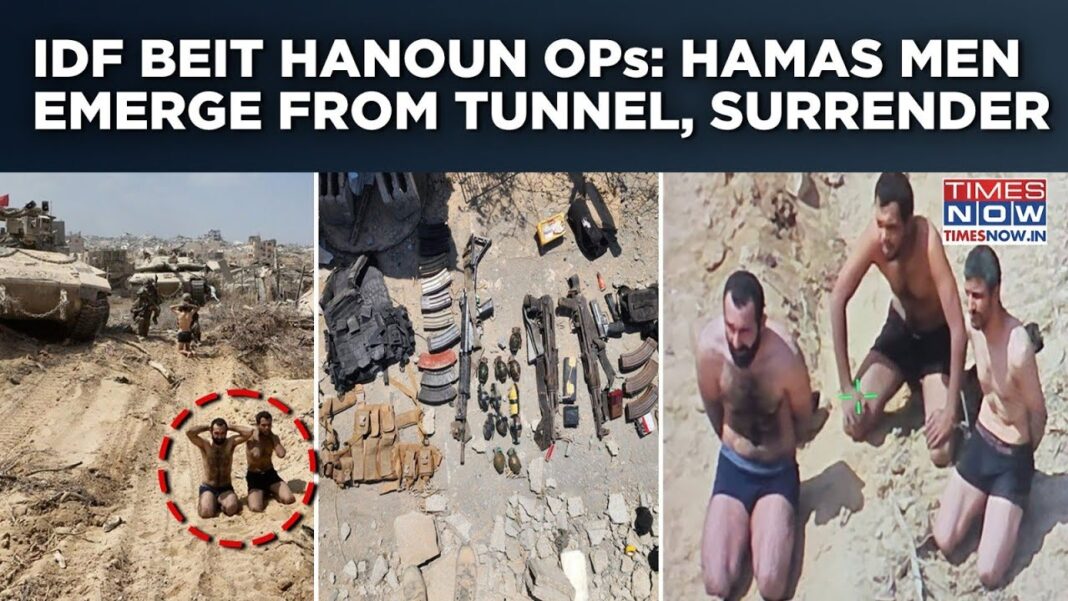
The Israel Defense Forces (IDF) announced Thursday that the Givati Brigade, operating under the 162nd Division, has completed a month-long military campaign in the Beit Hanoun sector of northern Gaza as part of Operation Gideon’s Chariots, a broad offensive aimed at dismantling entrenched Hamas strongholds.
According to details reported by World Israel News, the operation combined coordinated ground maneuvers, engineering precision, and sustained aerial strikes to neutralize a dense network of terrorist infrastructure that had long served as a strategic bastion for Hamas forces in the region.
The IDF said that Givati Brigade troops operated in close coordination with units from the Combat Engineering Corps and the Armored Corps, systematically dismantling hundreds of military targets both above and below ground. This included the destruction of fortified combat positions, weapons storage facilities, and extensive tunnel networks.
The World Israel News report noted that aerial support from the Israeli Air Force played a central role in the mission, providing real-time intelligence and precision firepower to assist ground units in striking command centers, sniper nests, and surveillance posts that had posed persistent threats to Israeli forces.
Specialized forces from the elite Yahalom unit were deployed to locate and destroy dozens of tunnel shafts, uncovering multiple interconnected subterranean passageways used by Hamas fighters to maneuver undetected and store weapons. According to the IDF, these demolitions removed critical elements of the group’s operational mobility in the northern sector.
In its operational assessment, the IDF stated that the campaign effectively dismantled the Hamas Beit Hanoun Battalion, rendering it incapable of functioning as a coherent combat force.
“The battalion’s operational structure has been dismantled,” the IDF reported. “The companies that made up the unit are no longer active, and most of the terrorists who operated in the area have been eliminated.”
As the World Israel News report detailed, military intelligence indicates that surviving members of the battalion have been left fragmented and leaderless, with their logistical networks and command hierarchy severely degraded.
Beit Hanoun, situated near the northeastern edge of the Gaza Strip and adjacent to the Israeli border, has long been considered a critical Hamas stronghold. Defense officials told World Israel News that the area’s dense urban layout, combined with its extensive subterranean tunnel infrastructure, allowed Hamas to embed military assets within civilian zones, complicating IDF operations and enabling sustained attacks on Israeli territory.
Prior to the offensive, the sector housed a network of rocket-launching sites, mortar positions, and fortified sniper posts designed to target both military and civilian locations in southern Israel. According to IDF assessments, the removal of these assets has significantly reduced Hamas’ capacity to launch coordinated assaults from the northern Gaza theater.
Combat engineers faced complex operational challenges, World Israel News reported, given the intricate network of tunnel shafts and hidden bunkers scattered beneath residential areas. In many cases, Hamas operatives had booby-trapped entry points or concealed firing positions within schools, mosques, and other civilian structures, requiring meticulous clearing operations to avoid collateral damage.
Armored units supported the engineers by providing direct fire cover against ambushes and sniper threats, while drones and reconnaissance teams mapped subterranean routes before demolition charges were placed. The coordinated use of real-time aerial surveillance ensured that IDF forces could advance through contested neighborhoods with reduced exposure to hidden enemy positions.
The Beit Hanoun campaign forms part of a broader series of IDF offensives in northern Gaza aimed at methodically eroding Hamas’ military infrastructure. Similar operations in nearby districts have focused on removing key logistical nodes, destroying weapons depots, and eliminating high-value Hamas operatives.
The report at World Israel News emphasized that the dismantling of the Beit Hanoun Battalion represents one of the most significant tactical gains in the north since the onset of the current conflict, depriving Hamas of both territorial control and operational cohesion in a strategically vital corridor.
The announcement of the operation’s conclusion coincided with Thursday night’s decision by Israel’s security cabinet to expand military operations in Gaza. As World Israel News reported, the cabinet voted by a decisive majority to intensify efforts to dismantle Hamas entirely and recover the remaining hostages.
Prime Minister Benjamin Netanyahu has proposed a temporary occupation of Gaza lasting four to five months, during which time Israeli forces would maintain security control while facilitating humanitarian assistance in areas cleared of Hamas fighters.
The plan, which initially faced opposition from IDF Chief of Staff Lt. Gen. Eyal Zamir over concerns about troop casualties and risks to hostages, underscores the government’s determination to consolidate recent battlefield gains, such as those achieved in Beit Hanoun, into a broader campaign to eliminate Hamas’ governing and military capacity.
While the IDF has highlighted the military success of the Beit Hanoun campaign, it has also stated that efforts were made to distribute humanitarian assistance to civilians outside active combat zones. The military has worked to coordinate the evacuation of non-combatants and the delivery of food, water, and medical supplies to affected communities.
Defense officials acknowledge, however, that the presence of extensive terrorist infrastructure embedded within civilian neighborhoods has complicated these efforts, often forcing difficult operational decisions to balance military objectives with the minimization of civilian harm.
With the Beit Hanoun Battalion neutralized and the northern Gaza front significantly altered, the IDF now faces the challenge of maintaining security gains while shifting focus to other sectors still under Hamas control.
According to the report at World Israel News, military planners are already evaluating lessons from Operation Gideon’s Chariots, particularly in the integration of combat engineering, armored support, and aerial reconnaissance in urban warfare settings. The success of the Beit Hanoun campaign will likely serve as a model for subsequent operations aimed at dismantling remaining Hamas strongholds across the Strip.
Defense officials caution that while Hamas has suffered heavy losses in manpower and infrastructure, the group retains the ability to adapt its tactics, leveraging smaller, more agile units and exploiting Gaza’s dense terrain to mount sporadic attacks. The dismantling of the Beit Hanoun Battalion, they stress, is a significant step — but part of a protracted and ongoing campaign to ensure that Hamas cannot reconstitute its military capabilities.
