



|
Getting your Trinity Audio player ready...
|
By: Fern Sidman
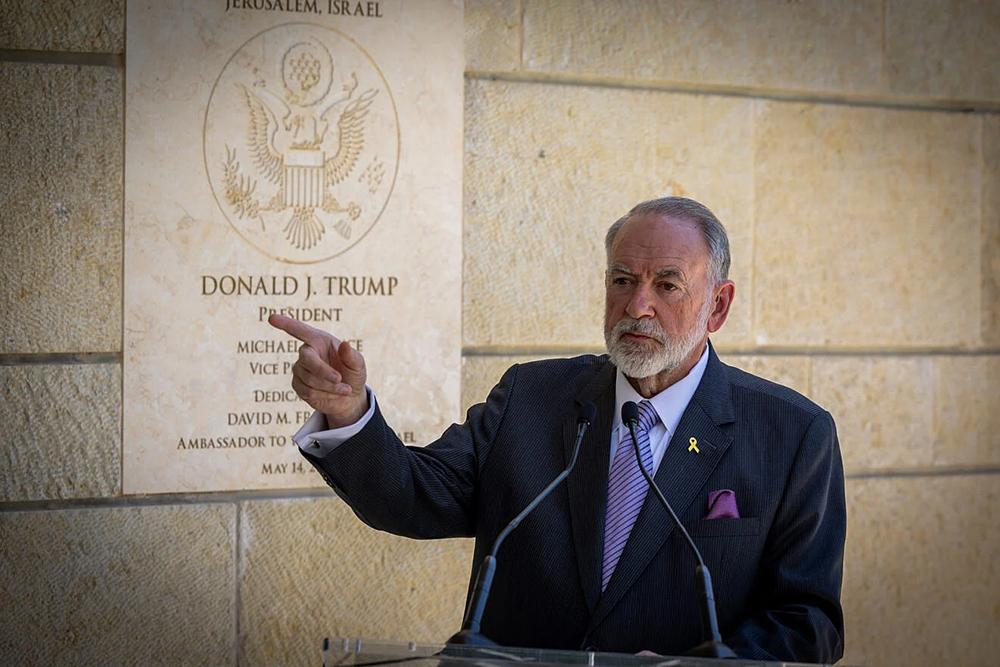
The question of Israeli sovereignty in Judea and Samaria returned to the forefront of regional diplomacy last week, as U.S. Ambassador to Israel Mike Huckabee forcefully denied that Washington had pressed Jerusalem to halt annexation discussions. Speaking to Israel’s Channel 14, Huckabee insisted that the United States has “never asked Israel not to apply sovereignty” in these territories, a statement that appears designed to reassure Israeli leaders amid conflicting reports of behind-the-scenes pressure.
According to a report that appeared on Saturday on The Jewish News Syndicate (JNS), Huckabee’s remarks came in response to Hebrew-language media reports suggesting that Washington had cautioned Israel against advancing policies that could destabilize the Palestinian Authority. The ambassador countered these narratives with unambiguous language. “I have repeatedly said that the United States respects Israel as a sovereign state and will not tell Israel what to do,” Huckabee declared. He further underscored that his stance was consistent with that of Secretary of State Marco Rubio, who, he noted, made a similar point just last week.
The timing of Huckabee’s comments was significant. As reported by JNS, Prime Minister Benjamin Netanyahu had abruptly canceled a Cabinet discussion on a proposal to annex parts of Judea and Samaria just one day earlier. The cancellation, described by Channel 14 as unexpected, immediately fueled speculation that American pressure had been decisive.
Some Israeli officials countered this claim, telling reporters the meeting was delayed merely due to “schedule congestion.” Yet according to international reporting cited by JNS, other explanations quickly surfaced. The Washington Post suggested that an “unusual message” from the United Arab Emirates had persuaded Netanyahu and senior ministers to remove annexation from the Cabinet’s agenda.
If true, the episode marks the first time an Emirati official publicly signaled that the Abraham Accords, signed in September 2020, could be jeopardized by Israeli annexation efforts.
On Tuesday, Emirati Foreign Ministry Special Envoy Lana Nusseibeh issued what the JNS report described as a strikingly blunt warning. Speaking to Hebrew and international outlets, Nusseibeh said: “Annexation would be a red line for my government, and that means there can be no lasting peace. It would foreclose the idea of regional integration and be the death knell of the two-state solution.”
Her statement carried weight precisely because the UAE was among the first Arab states to normalize relations with Israel under the Abraham Accords framework. For Emirati officials to raise questions about the durability of those agreements signaled how serious the annexation debate had become.
According to the information provided in the JNS report, the Emirati message followed multiple quiet warnings delivered through diplomatic back-channels. Netanyahu’s office, however, reportedly declined to respond to those earlier cautions, prompting Abu Dhabi to escalate by going public.
Caught between Israeli domestic politics and regional sensitivities, the Biden administration — represented in Israel by Ambassador Huckabee and on the world stage by Secretary of State Rubio — has attempted to walk a fine line.
While Huckabee’s denial of direct U.S. pressure was clear, it also served a broader purpose: to reassure Israeli leaders and voters that Washington continues to regard Israel as a sovereign partner, not a subordinate. According to the information contained in the JNS report, this message resonates strongly at a time when Israeli policymakers are wary of international attempts to impose solutions on issues central to Israel’s security and identity.
Secretary Rubio, when pressed by reporters in Ecuador, likewise refrained from dictating terms. “What you’re seeing with [Judea and Samaria] and the annexation, that’s not a final thing—that’s something being discussed among some elements of Israeli politics. I’m not going to opine on that today,” he said.
Yet Rubio simultaneously voiced sharp criticism of world leaders moving toward unilateral recognition of a Palestinian state. “We told all these countries, ‘If you guys do this recognition stuff—it’s all fake, it’s not even real. If you do it, you’re going to create really big problems,’” Rubio told reporters. His comments, highlighted by JNS, illustrate Washington’s ongoing opposition to unilateral recognition efforts that bypass negotiations.
The issue of sovereignty over Judea and Samaria remains one of the most controversial in Israeli politics. As JNS has reported, right-leaning parties view annexation as both a historical right and a security imperative, while critics within Israel and abroad warn that such moves could inflame tensions with Palestinians, destabilize the Palestinian Authority, and strain regional partnerships forged through normalization.
Netanyahu, who has long cultivated his image as the steward of Israel’s strategic alliances, now faces the challenge of balancing domestic pressures with international consequences. According to the JNS report, his decision to cancel the Cabinet session may reflect not just external signals from Washington and Abu Dhabi but also political calculus within his governing coalition, where factions remain divided over the timing and scope of annexation.
The most remarkable development of the week, according to JNS, is the first open suggestion that annexation could jeopardize the Abraham Accords. Since their signing in September 2020, the accords have reshaped the Middle East, facilitating trade, technology exchange, and diplomatic cooperation between Israel and several Arab states.
For the UAE to warn that annexation could serve as a “death knell” for regional integration reflects both the fragility of these agreements and the extent to which Palestinian statehood remains a touchstone issue in Arab diplomacy. The JNS report noted that while Gulf leaders have grown increasingly pragmatic in their dealings with Israel, they remain constrained by domestic opinion, where solidarity with Palestinians continues to hold strong resonance.
Secretary Rubio is scheduled to visit Israel on Sept. 14, a trip that may offer further clarity on the Biden administration’s strategy. As reported by JNS, U.S. officials are likely to continue emphasizing two key points: respect for Israel’s sovereignty and opposition to unilateral Palestinian state recognition.
At the same time, Washington will seek to preserve the achievements of the Abraham Accords, wary that a sudden Israeli move toward annexation could fracture the regional coalition painstakingly built over recent years.
The latest controversy calls attention to the enduring volatility of the sovereignty question in Judea and Samaria. Ambassador Huckabee’s firm denial that the United States pressured Israel not to apply sovereignty reflects Washington’s desire to avoid appearing heavy-handed, even as it navigates the diplomatic fallout of annexation debates.
As the JNS report highlighted, the episode reveals the competing forces shaping Israel’s decision-making: domestic political imperatives, international alliances, and regional normalization efforts. The UAE’s unprecedented public warning illustrates how quickly the Abraham Accords could be destabilized, while the American envoy’s remarks show the U.S. determination to affirm Israel’s autonomy while keeping the peace process alive.
Whether Netanyahu’s cancellation of the Cabinet session proves to be a tactical delay or a strategic retreat remains to be seen. What is clear, however, is that sovereignty in Judea and Samaria continues to sit at the fault line of Israeli politics and Middle Eastern diplomacy, where every decision reverberates far beyond Jerusalem’s Cabinet table.

I assume this is a typo: “ the Biden administration — represented in Israel by Ambassador Huckabee and on the world stage by Secretary of State Rubio”. In any event, the “2 state solution” is dead, and must be permanently buried with annexation. The European and other resurgent nazi sympathizers have again declared war, and Israelis must confront the reality of the resurgent antisemite world.