



|
Getting your Trinity Audio player ready...
|
By: Fern Sidman
Israel was jolted on Sunday by a startling breach of its aerial defenses when a drone launched from Yemen by the Iran-backed Houthi rebels slammed into the Ramon Airport terminal, north of Eilat. According to the Israel Defense Forces (IDF), the unmanned aerial vehicle (UAV) carried explosives, evaded Israel’s multi-layered defense system, and detonated within the passenger terminal — raising profound questions about the vulnerabilities of Israel’s air defense apparatus.
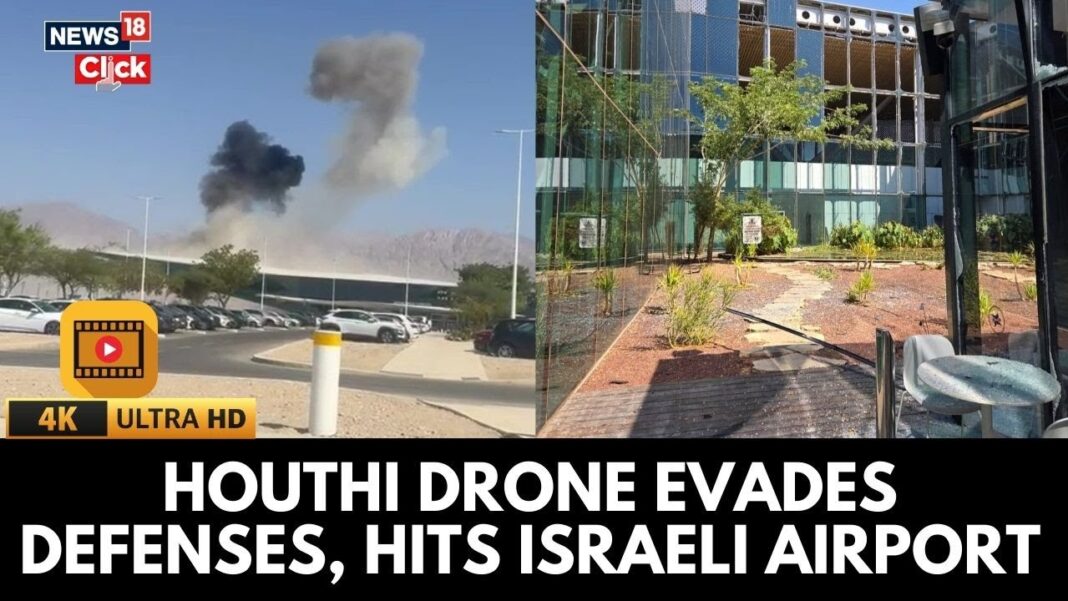
As The Times of Israel reported on Sunday, the incident marked the first time a Houthi drone successfully penetrated Israeli defenses to strike a major civilian airport. The attack left a 63-year-old man injured by shrapnel, a woman hospitalized after falling while fleeing the scene, and several others treated for acute anxiety, according to Magen David Adom paramedics. While no lives were lost, the psychological impact — compounded by images of shattered glass, debris, and smoke billowing from the airport terminal — was unmistakable.
Perhaps most troubling for Israeli authorities was the fact that no sirens were triggered before the impact. As The Times of Israel report highlighted, a preliminary probe by the Israeli Air Force found that the UAV had not been detected on its approach to southern Israel, leaving airport staff and passengers with no warning.
Footage from the scene showed travelers scrambling for cover as thick smoke rose above the airport’s baggage-screening area. Emergency responders quickly evacuated civilians, and the Israel Airports Authority (IAA) temporarily shut down all operations at Ramon, halting takeoffs and landings.
“The details are being looked into,” the IDF acknowledged in a terse statement. For a country that prides itself on having one of the most sophisticated air defense systems in the world — with the Iron Dome, David’s Sling, and Arrow missile defense networks layered across its skies — the failure to detect and intercept the drone will likely trigger a wide-ranging internal review.
The IAA confirmed shortly after the attack that Ramon’s airspace had been temporarily closed while security checks were conducted. “Takeoffs and landings at Ramon have been halted. The airport authority is working to restore operations as soon as possible,” the authority initially stated.
Hours later, following what The Times of Israel report described as a “comprehensive security assessment” involving multiple defense and aviation agencies, Ramon resumed full operations. “Following the completion of all safety and security checks, compliance with international civil aviation standards, and receipt of final approval from the Air Force — Ramon Airport has now been reopened for both departures and arrivals,” the IAA announced.
Still, for travelers and staff, the brief shutdown underscored just how vulnerable the facility is to the growing reach of Houthi drone and missile campaigns.
Although formally designated as an international airport, Ramon handles primarily domestic traffic, functioning as a relief hub when security concerns disrupt operations at Ben-Gurion Airport near Tel Aviv. During the war in Gaza, The Times of Israel report noted, Ramon also played a humanitarian role, serving as an evacuation point for thousands of Palestinians — including the wounded and their families — sent abroad for medical treatment.
By striking Ramon, the Houthis not only disrupted an important transportation link but also symbolically demonstrated their ability to hit Israeli civilian infrastructure hundreds of miles from their bases in Yemen. Analysts quoted in The Times of Israel argued that the attack was designed to send a message: that Israeli defenses, stretched by simultaneous threats from Hamas, Hezbollah, and Iran’s regional proxies, are not impenetrable.
Sunday’s drone strike did not occur in isolation. Earlier in the day, the IDF reported intercepting three other Houthi drones that triggered warning sirens in several communities along Israel’s border with Egypt. According to the information provided in The Times of Israel report, two of the drones were shot down before they crossed into Israel, while a third was intercepted after entering Israeli airspace via Egypt. Video footage circulated on social media showed an Israeli Air Force helicopter downing one of the UAVs.
The attacks were part of what officials have described as a “wave of Houthi aggression” over the past two weeks, following the targeted killing of Houthi prime minister Ahmed Ghaleb Nasser al-Rahawi and several cabinet members in Yemen. The assassination, attributed to Israeli forces, has spurred the Houthis to escalate their missile and drone barrages against Israel.
The Houthis, an Iran-aligned militia entrenched in Yemen’s civil war, adopted an explicitly anti-Israel posture after Hamas’s October 7 massacre in southern Israel. Within weeks, they began targeting Israel directly, as well as maritime traffic in the Red Sea, under the slogan: “Death to America, Death to Israel, Curse on the Jews.”
As The Times of Israel reported, the Houthis fired more than 40 ballistic missiles and dozens of drones at Israel between November 2023 and January 2025. While most were intercepted or fell short, a drone attack in Tel Aviv in July 2024 killed one civilian and injured several others, prompting Israel’s first direct military strikes on Yemeni soil.
Following a temporary ceasefire between Israel and Hamas in January 2025, the Houthis briefly suspended their attacks. But since the IDF resumed its offensive in Gaza on March 18, the Yemeni group has launched at least 80 ballistic missiles and 31 drones toward Israel, according to military figures cited in The Times of Israel report.
Israel has responded with at least 16 strikes in Yemen, targeting Houthi launch sites, storage depots, and command centers. The long-range exchanges, covering more than 1,800 kilometers, underscore the regional dimensions of the Gaza war and the increasingly active role of Iranian proxies in challenging Israel.
The breach at Ramon Airport has set off alarms across Israel’s defense establishment. Lawmakers have demanded answers from the IDF and the Air Force about how the drone managed to evade detection.
Security commentators quoted in The Times of Israel report warned that if the Houthis can penetrate Israel’s defenses once, they may attempt similar attacks on other sensitive civilian infrastructure — including energy facilities, ports, or even Ben-Gurion Airport. The psychological impact, they argued, could prove as damaging as the physical destruction.
For the Israeli public, the incident raises uncomfortable questions about the limits of national security. After decades of investment in cutting-edge missile defense, the idea that a relatively low-cost drone could slip through and strike a major airport is deeply unsettling.
The attack has also caught the attention of international aviation authorities. Ramon Airport, though smaller than Ben-Gurion, is part of Israel’s international aviation framework. The strike has prompted discussions within global airline circles about the safety of flying into Israeli airports during periods of heightened conflict.
The Times of Israel reported that Israeli officials were quick to reassure international partners that Ramon had been cleared under global civil aviation standards before reopening. Still, the fact that an airport terminal was successfully targeted by a drone underscores how civilian air hubs have become front-line targets in modern asymmetric warfare.
Beyond the immediate damage, Sunday’s attack reflects the expanding regional influence of Iran. The Houthis, Hezbollah in Lebanon, and Shiite militias in Iraq all form part of what analysts often call Tehran’s “axis of resistance.” By coordinating strikes from different fronts, Iran seeks to stretch Israel’s defenses thin, forcing the IDF to divide resources across multiple arenas.
As The Times of Israel report noted, the latest round of Houthi attacks coincides with escalations from Hezbollah on Israel’s northern border and renewed threats from Iraqi militias. Together, these attacks serve Tehran’s broader strategy of keeping Israel under constant pressure while complicating its military calculus.
Sunday’s breach at Ramon Airport may prove to be a pivotal moment in Israel’s evolving conflict with the Houthis. It highlighted both the effectiveness of the group’s drone program and the vulnerabilities inherent in even the most advanced defense systems.
While the IDF is investigating the failure to detect the UAV, analysts cited by The Times of Israel warned that Israel must now assume that further attempts to strike civilian airports and infrastructure will follow. Enhancing radar coverage, bolstering electronic warfare capabilities, and refining detection protocols will be central to Israel’s response.
But the challenge is not purely technological. It is also strategic and political. As long as Iran’s proxies continue to operate across multiple theaters — Gaza, Lebanon, Iraq, Yemen — Israel faces the prospect of being drawn deeper into a multi-front conflict with no easy resolution.
The drone strike on Ramon Airport, while causing limited physical casualties, represents a significant escalation in the conflict between Israel and the Houthis. By slipping past Israel’s defenses and striking a civilian terminal, the rebels demonstrated both their reach and their determination to hit symbolic and strategic targets deep inside Israeli territory.
As The Times of Israel report emphasized, the incident calls attention to a sobering reality: that no defense system, however advanced, is foolproof. For Israelis, the image of black smoke rising over Ramon Airport will linger as a reminder of the shifting dynamics of warfare — where low-cost drones can threaten airports, and distant conflicts in Yemen can reverberate in the skies over Eilat.
Israel’s response will likely be twofold: immediate improvements to detection and interception systems, and continued long-range strikes on Houthi targets in Yemen. Yet the broader strategic challenge remains. The Houthis’ success in hitting Ramon Airport signals not just a tactical breach but a warning of the evolving threats Israel faces in an increasingly interconnected and volatile Middle East.

No air defense system is perfect. The answer is leveling Houthi areas. NOTHING should be left – NOTHING if that is the only way to stop the attacks. The best defense is a great offense. That is the way it is.