



|
Getting your Trinity Audio player ready...
|
Home After 738 Days in Darkness: Freed Hostages Eitan Horn & Nimrod Cohen Discharged from Hospital; Nation Rejoices
By: Fern Sidman
In scenes of unrestrained emotion that swept through the streets of Kfar Saba and Rehovot, two Israeli hostages — Eitan Horn and Nimrod Cohen — returned home this week after spending more than 700 harrowing days in Hamas captivity, their release marking another chapter in Israel’s long and painful struggle to bring every abducted citizen home. As The Jewish News Syndicate (JNS) reported on Thursday, their freedom came under the most recent U.S.-brokered truce deal, which continues to test the fragile balance between humanitarian urgency and national security.
Horn, 38, and Cohen, 21, were discharged Thursday from Tel Aviv Sourasky Medical Center’s Ichilov Hospital, three days after being released from Gaza. The hospital confirmed, according to the JNS report that both men had completed comprehensive medical evaluations and would continue to receive follow-up care from dedicated medical and psychological teams in the months ahead.
The two men’s return has become a national symbol of resilience — and a sober reminder of the unending anguish faced by the families of those still held captive or missing. “Our heart is not whole, and our struggle is not over,” the Horn family said in a statement quoted by JNS. “Eitan has returned, but that’s not enough. Only when the last hostage is home can we say we’ve fulfilled our mission and our moral duty.”
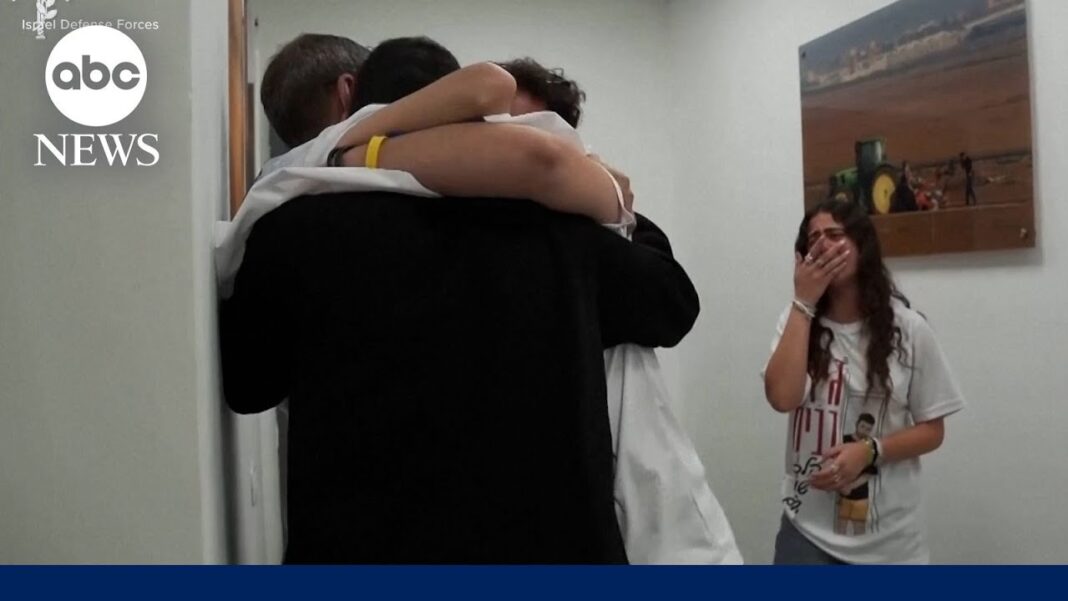
As Eitan Horn’s car made its slow approach into Kfar Saba, the streets were transformed into a spontaneous sea of blue and white. Hundreds of residents — waving Israeli flags and singing Hatikvah, the national anthem — lined the sidewalks in a display of collective celebration. The moment, described in the JNS report as “deeply emotional and quintessentially Israeli,” symbolized a rare respite from the country’s ongoing trauma.
Horn, a resident of Nir Oz before his abduction, was taken hostage on October 7, 2023, when Hamas terrorists stormed the kibbutz as part of the unprecedented attack that left more than 1,200 Israelis dead and hundreds kidnapped. He was abducted alongside his brother, Iair Horn, who was freed months earlier under the February 2025 ceasefire arrangement.
In a statement to Israeli media cited in the JNS report, the Horn family said, “After 738 difficult and long days in Hamas captivity, Eitan is finally coming home. We’re waiting for him with hugs and endless love.”
Horn’s story — emblematic of the human cost of Hamas’s campaign of terror — has been closely followed across Israel. His parents, Yael and Dov Horn, became fixtures at rallies calling for the hostages’ release, often speaking publicly about the moral and emotional toll of waiting.
In the nearby city of Rehovot, a similar scene unfolded for Corporal Nimrod Cohen, an IDF tank gunner captured in the chaos of October 7. His release, like Horn’s, was both joyous and deeply sobering.
According to the information provided in the JNS report, Cohen was taken prisoner when his armored vehicle was struck and overturned during fierce fighting near Kibbutz Nirim, just over a mile from the Gaza border. The young soldier was one of many IDF servicemen caught in the first wave of Hamas’s coordinated assault on southern Israel.
When Cohen arrived home, the streets of Rehovot erupted with cheers. Residents waved flags and chanted his name, while security and emergency vehicles escorted him through the city. “Thank you to everyone who came,” he told reporters gathered near his home. “I’m happy to see everyone. I love you all.”
The crowd’s emotion reflected not just relief but also admiration for a young man whose resilience came to embody the spirit of the IDF. The JNS report noted that Cohen’s return coincided with Israel’s national day of mourning, observed annually on the 24th of Tishrei — the same date that, two years earlier, had marked the darkest day in the country’s modern history.
Even as Israelis rejoiced in the homecomings of Horn and Cohen, the government and military made clear that the work is far from over. The remains of 19 slain hostages are still being held in Gaza, an open wound that continues to torment bereaved families.
As the JNS report emphasized, Jerusalem has accused Hamas of violating the ceasefire agreement by refusing to return the bodies — a requirement explicitly stated in the U.S.-mediated accord. The breach, officials say, undermines the already fragile trust necessary to sustain the humanitarian deal.
Israeli Prime Minister Benjamin Netanyahu, speaking at a state memorial ceremony for fallen soldiers on Thursday, struck a tone of both mourning and defiance. “The Hamas-led massacre was monstrous in every sense of the word,” Netanyahu declared. “If those killers could have done it, they would have slaughtered each and every one of us.” His remarks, broadcast live on Israeli television and cited in the JNS report, served as both a warning and a vow: Israel, he said, would continue its pursuit of every hostage — living or dead.
The medical teams at Ichilov Hospital have described the recovery process for freed hostages as extraordinarily complex — a combination of physical rehabilitation, nutritional therapy, and psychological care designed to help survivors readjust to life outside captivity.
A statement released by the hospital and reported by JNS underscored that each returning hostage undergoes “a full battery of diagnostic testing,” including evaluations for malnutrition, dehydration, and trauma-related disorders. While both Horn and Cohen were deemed in “relatively stable condition,” doctors cautioned that the effects of captivity often surface gradually.
Medical director Professor Ronni Gamzu, speaking to JNS, said, “What we have seen among these survivors is a profound strength — but also an equally profound vulnerability. They are physically present, but their minds have been forced to adapt to unimaginable conditions. Recovery takes time, community, and care.”
Experts say hostages often experience post-traumatic stress, disrupted circadian rhythms from confinement, and deep mistrust of surroundings. “The return home is not an endpoint,” said clinical psychologist Dr. Dafna Dekel, who has treated former captives. “It’s a beginning — the beginning of learning to live again.”
According to the JNS report, the release of Horn and Cohen was part of a renewed truce arrangement negotiated by the United States, Egypt, and Qatar — an extension of the earlier humanitarian deal that brought home dozens of hostages. The agreement stipulates phased releases in exchange for Israel easing certain restrictions on humanitarian shipments into Gaza.
Yet Israeli officials have accused Hamas of systematically violating the deal. Defense Minister Israel Katz quoted in JNS, said, “Hamas cannot be trusted. They manipulate every humanitarian gesture for their own propaganda. Every hostage released is a miracle — and a reminder of those still in hell.”
For many Israelis, these words ring painfully true. With each new release comes both joy and renewed grief, as families of the unreleased face the excruciating uncertainty of not knowing whether their loved ones are alive.
The Hostages and Missing Families Forum, a grassroots organization that has become a moral force in Israeli society, issued a statement welcoming Horn and Cohen’s return while urging continued diplomatic pressure. “We celebrate this homecoming,” the group said, “but we will not rest until every captive — every son, daughter, mother, and father — is back where they belong.”
As the JNS report observed, the timing of the hostages’ release — coinciding with Israel’s annual day of remembrance — deepened its symbolic weight. In ceremonies across the country, from Jerusalem to Be’er Sheva, families of fallen soldiers stood alongside those of returning captives, united by grief, endurance, and hope.
At the Knesset memorial, Netanyahu spoke of a “nation that remembers” and a “people who do not forget or forgive murderers.” His words echoed the sentiment that has defined Israel’s national character since October 7 — the intertwining of mourning and defiance, loss and survival.
“The pain is immeasurable,” Netanyahu said, “but so is our resolve.”
The return of Eitan Horn and Nimrod Cohen, as joyous as it was, underscores the profound moral and strategic dilemmas Israel continues to face. Each exchange or truce carries immense emotional weight and political risk — balancing the imperative to save lives against the knowledge that concessions may embolden Hamas to abduct again.
As JNS wrote in its analysis, the homecoming of the two men “represents not closure but continuity — a fleeting victory in a broader struggle for national security and moral justice.”
Horn and Cohen, both now symbols of survival, begin their long road to rehabilitation amid a country still haunted by the hostages’ ordeal. Yet amid the grief, their stories offer something precious: a measure of hope.
As Eitan’s mother told reporters, “For nearly two years, I dreamed of hugging my son. Tonight, that dream came true. But there are so many mothers still waiting. We won’t stop until every one of them feels this same embrace.”
And as the crowd in Kfar Saba sang Hatikvah once more — “Our hope is not yet lost” — it was impossible not to feel that the anthem’s words, carried on the evening air, had never rung truer.
As the JNS report observed, the story of Horn and Cohen’s return is a testament not only to the endurance of two men but to the unyielding spirit of an entire nation — a nation that, despite pain, refuses to surrender its faith in redemption.
