



|
Getting your Trinity Audio player ready...
|
By: Fern Sidman
At a government meeting held Sunday in the southern Israeli city of Dimona, Prime Minister Benjamin Netanyahu delivered one of the most uncompromising speeches of his tenure, issuing a sweeping indictment of what he described as Western complacency in the face of rising antisemitism. His remarks, provoked by the recent violent attacks against Jews in Australia, were not confined to expressions of sorrow or diplomatic concern. Instead, Netanyahu articulated a far-reaching moral and strategic argument: that antisemitism flourishes when political leadership is weak, equivocal, or indulgent toward extremist ideologies—and that the consequences of such indulgence are measured in blood.\
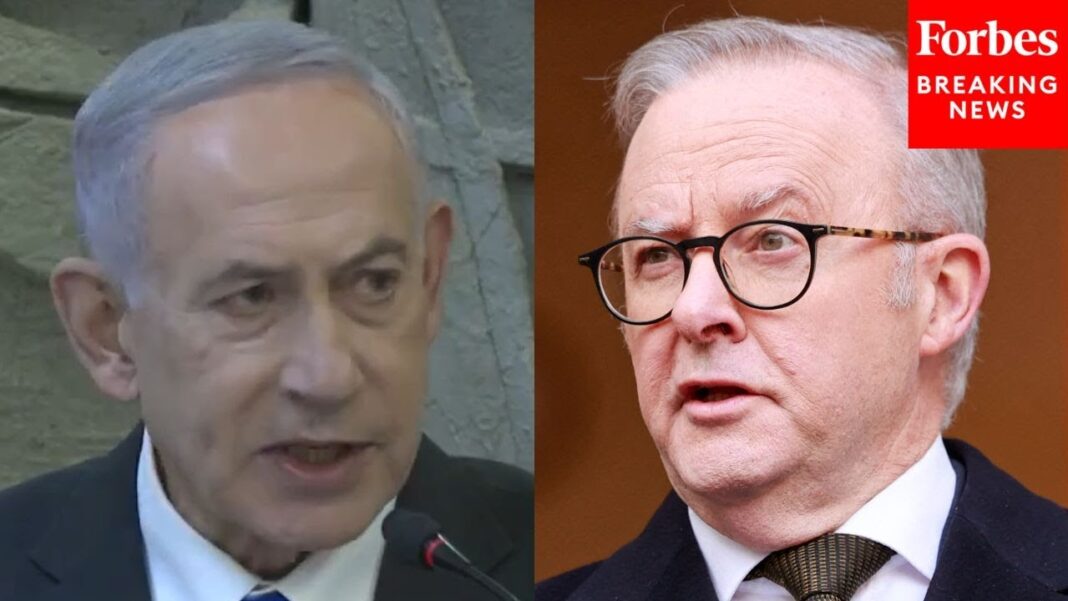
Speaking before ministers and senior officials, Netanyahu revealed that nearly four months earlier, on August 17, he had sent a sharply worded letter to Australian Prime Minister Anthony Albanese. In that correspondence, Netanyahu warned that Canberra’s foreign policy posture—particularly its calls for the establishment of a Palestinian state in the aftermath of Hamas’s October 7 massacre—was, in his words, “pouring fuel on the antisemitic fire.” The Israeli leader reiterated that warning on Sunday, arguing that rhetoric which rewards or legitimizes Hamas ultimately emboldens those who threaten Jewish communities far beyond the Middle East.
“Antisemitism is a cancer,” Netanyahu declared, employing a metaphor that framed hatred not as a spontaneous outburst, but as a malignant force that grows when left untreated. “It spreads when leaders stay silent; it retreats when leaders act.” The Prime Minister accused the Australian government of having failed to act decisively, asserting that its inaction had allowed antisemitic hostility to metastasize within Australian society, culminating in the “horrific attacks on Jews” witnessed this week.
According to Netanyahu, his August letter was explicit and unambiguous. He told Albanese that advocating for a Palestinian state under present circumstances would be interpreted by extremists as a victory for terror, rather than as a gesture toward peace. Such advocacy, Netanyahu wrote, “rewards Hamas terrorists,” emboldens those who menace Jewish citizens, and normalizes hostility toward Jews in public discourse.
On Sunday, Netanyahu accused the Australian prime minister of responding to that warning not with corrective measures, but with what he characterized as further appeasement. “Instead, Prime Minister,” Netanyahu said, addressing Albanese directly, “you replaced weakness with weakness and appeasement with more appeasement.” In the Israeli leader’s telling, the Australian government failed to curb incitement, failed to confront extremist networks, and failed to reassure its Jewish citizens that the state would act decisively to protect them.
The result, Netanyahu asserted, was tragically predictable. “You took no action. You let the disease spread,” he said, adding that the violent outcome now haunting Australia’s Jewish community was the inevitable consequence of political paralysis.
Netanyahu was careful to distinguish between individual heroism and institutional failure. He singled out what he described as the courageous intervention of a Muslim bystander who physically stopped one of the terrorists during the attack. The Prime Minister offered an emphatic salute to that individual, praising his bravery and underscoring that the struggle against antisemitism is not a conflict between religions, but between civilization and barbarism.
Yet Netanyahu stressed that individual acts of courage, however laudable, cannot substitute for decisive state action. “It requires the action of your government,” he said, “which you are not taking.” Leadership, in his formulation, is measured not by expressions of sympathy after tragedy strikes, but by preventive resolve before it does.
“History will not forgive hesitation and weakness,” Netanyahu warned. “It will honor action and strength.”
Throughout his address, Netanyahu situated antisemitism within a broader ideological and geopolitical framework. He rejected the notion that violence against Jews is a parochial or isolated phenomenon, arguing instead that it is a frontline manifestation of a wider assault on Western values.
“They’re not only trying to annihilate us,” he said of terrorist organizations and extremist ideologies. “They attack us because they attack the West.”
To illustrate this point, Netanyahu referenced events beyond Israel’s immediate borders. He cited the killing of two American soldiers and an American interpreter in Syria just days earlier, emphasizing that they were targeted not merely as individuals, but as representatives of a shared democratic culture. In Netanyahu’s analysis, the same forces that target Israeli civilians and Jewish communities abroad also seek to undermine Western societies from within.
Netanyahu drew a deliberate parallel between Israel’s security doctrine and that of the United States. He quoted recent remarks by Secretary of War Peter Hegseth, who vowed that anyone who targets Americans “anywhere in the world” would spend “the rest of your brief anxious life knowing the United States will hunt you, find you and ruthlessly kill you.”
“That is American policy,” Netanyahu said. “This is Israel’s policy.”
The Israeli prime minister was unequivocal in asserting that Israel would apply this doctrine consistently—whether in Gaza, Lebanon, or any other arena where Israeli citizens or soldiers are threatened. Those who attempt to kill Israelis, he warned, will live under the constant knowledge that Israel will pursue them relentlessly.
“We do not sit by and let these killers kill us,” Netanyahu declared.
Netanyahu’s remarks came against the backdrop of ongoing military operations and heightened regional tensions. He referenced recent attacks on Israeli soldiers in Gaza, underscoring that even attempts to wound or harm Israeli forces would be met with decisive retaliation. Deterrence, in Netanyahu’s view, is not merely a military strategy but a moral imperative—one that protects lives by making the cost of aggression unmistakably clear.
This philosophy, he suggested, stands in stark contrast to what he perceives as the equivocation of some Western governments. Where Israel responds with force and clarity, others respond with statements, commissions, and diplomatic hedging. The difference, Netanyahu implied, is not academic; it is existential.
Beyond Australia, Netanyahu’s message was directed at Western governments more broadly. Antisemitism, he warned, does not respect borders. When tolerated in one society, it emboldens extremists everywhere. The same ideological currents that target Jews today may target other minorities, institutions, or democratic norms tomorrow.
“That’s what Israel expects of each of your governments in the West and elsewhere,” Netanyahu said. The expectation, he clarified, is not blind alignment with Israeli policy, but moral clarity and the courage to confront hatred before it turns violent.
“The disease spreads,” he warned, “and it will consume you as well.”
Despite the global scope of his remarks, Netanyahu concluded by returning to what he described as Israel’s most immediate concern: the safety of the Jewish people. Israel, he emphasized, will not remain silent in the face of threats, nor will it outsource its security to international goodwill or rhetorical assurances.
“We are worrying right now about our people, our safety,” he said. “And we do not remain silent.”
In Dimona, Netanyahu’s words were delivered with the cadence of a warning and the tone of a reckoning. Whether Western leaders heed that warning remains to be seen. But the Israeli prime minister made one thing unmistakably clear: in his view, the era of ambiguity has passed. In a world where antisemitism is resurgent and increasingly violent, hesitation is not neutrality—it is complicity. And strength, he argued, is not provocation, but protection.
“History Will Not Forgive Hesitation.” The same thing can be said concerning Netanyahu before October 7th and every other threat Israel faces right now.