



|
Getting your Trinity Audio player ready...
|
By: Fern Sidman
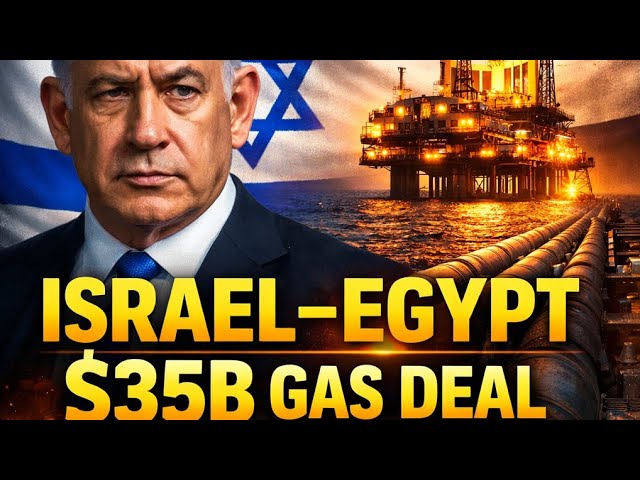
Prime Minister Benjamin Netanyahu’s announcement this week of a landmark natural gas agreement with Egypt marks a pivotal moment in Israel’s economic and geopolitical trajectory—one that, as reported on Wednesday by The Times of Israel, carries implications far beyond balance sheets and energy markets. Valued at an estimated NIS 112 billion (approximately $34.7 billion), the accord is the largest energy deal in Israel’s history and stands as a testament to the country’s transformation into a regional energy powerhouse.
Speaking in a video statement alongside Energy Minister Eli Cohen, Netanyahu framed the agreement not merely as a commercial milestone, but as a strategic instrument designed to fortify Israel’s long-term national interests. According to the information provided in The Times of Israel report, the deal is expected to funnel NIS 58 billion ($18 billion) directly into Israel’s public coffers over time—revenue earmarked, Netanyahu emphasized, for education, healthcare, infrastructure, national security, and the welfare of future generations.
“This is money that will strengthen the foundations of the state,” Netanyahu declared, invoking both fiscal prudence and national destiny. In the first four years alone, he said, state revenues would reach approximately NIS 500 million ($155 million), a figure projected to climb dramatically to NIS 6 billion ($1.9 billion) annually by 2033. As The Times of Israel report noted, such figures illustrate the scale of the agreement and its potential to reshape Israel’s public finances.
At the heart of the deal lies an agreement between Israel, Egypt, and the American energy giant Chevron, alongside Israeli partners including NewMed Energy. Under the arrangement, Israeli natural gas—primarily from the Leviathan reservoir—will be exported to Egypt, reinforcing Cairo’s energy supply while generating substantial export revenues for Jerusalem. Netanyahu underscored that the deal was only approved after rigorous assurances were secured to protect Israel’s domestic energy needs and national security concerns.
Energy Minister Eli Cohen, who had previously stalled the agreement, described the approval as “a historic moment for Israel,” calling natural gas a “strategic asset” that must be managed with foresight and caution. Cohen’s earlier reservations centered on fears that excessive exports could deplete Israel’s reserves and undermine domestic energy security, as well as concerns that Israeli consumers might not receive gas at fair prices. According to the information contained in The Times of Israel report, these apprehensions were addressed through regulatory safeguards requiring suppliers to prioritize the Israeli market and maintain competitive pricing.
“We have brought another jug of oil to the nation of Israel,” Netanyahu remarked, invoking the Hanukkah miracle in which a single jug of oil burned for eight days. The metaphor was not accidental: it linked ancient resilience with modern prosperity, casting the energy deal as a symbol of continuity and renewal.
The path to approval was neither swift nor smooth. Israeli firm NewMed Energy first announced the $35 billion export deal with Egypt in August, but the agreement languished after Cohen refused to sign off, citing insufficient guarantees. The delay drew international attention—and pressure. As reported by The Times of Israel and corroborated by Axios, the United States played a decisive role in nudging both Netanyahu and Cohen toward compromise.
Washington’s interest was multifaceted. On one level, the Biden administration—and later the Trump administration—saw the deal as a mechanism to stabilize regional energy markets. On another, it was viewed as a diplomatic lever to repair fraying ties between Israel and Egypt, relations that have been strained since Hamas’s October 7, 2023 assault and the ensuing war in Gaza. The Times of Israel report noted that U.S. Energy Secretary Chris Wright even canceled a planned six-day visit to Israel in October after Cohen initially refused to approve the agreement, a gesture widely interpreted as a signal of American frustration.
According to Axios, President Trump has expressed interest in brokering a summit between Netanyahu and Egyptian President Abdel-Fattah el-Sissi, with the gas deal serving as a cornerstone concession to entice Cairo back to the diplomatic table. In this context, the agreement transcends commerce, functioning as a catalyst for renewed strategic dialogue.
For Israel’s economy, the stakes are immense. Natural gas has emerged as one of the country’s most valuable resources, and the Leviathan reservoir—one of the world’s largest deep-water gas discoveries—has already reshaped Israel’s energy profile since domestic supply began flowing in December 2019. Exports to Egypt commenced in January 2020 under an earlier agreement for 60 billion cubic meters, expected to be fulfilled by the early 2030s. As of September 2025, Leviathan had supplied 23.5 billion cubic meters to the Egyptian market.
Israeli gas now accounts for roughly 15–20 percent of Egypt’s consumption, underscoring the interdependence that has developed between the two former adversaries. Both countries have emerged as significant gas exporters following major offshore discoveries, positioning the Eastern Mediterranean as an increasingly influential energy hub.
Yet the deal has not silenced domestic critics. Earlier this year, Israel’s Finance Ministry warned that the country could face a natural gas shortage within 25 years if domestic demand continues to outpace forecasts while export volumes remain robust. Such a shortfall, officials cautioned, could drive up electricity prices for Israeli consumers. The Times of Israel reported that these concerns fueled Cohen’s insistence on regulatory stability and long-term planning before granting approval.
NewMed Energy CEO Yossi Abu sought to allay such fears in a statement issued late Wednesday, confirming that the company had received authorization to export gas to Egypt. “This is a historic day for the natural gas sector,” Abu said, according to The Times of Israel report. “It guarantees continued investment in Israel and creates regulatory stability for years to come.” His remarks reflect industry confidence that the agreement strikes a balance between export ambition and domestic security.
Netanyahu has repeatedly argued that economic interdependence fosters stability—a thesis he reiterated in announcing the deal. By strengthening Israel’s role as a regional energy supplier, he contends, the agreement encourages neighboring states to pursue cooperation over confrontation. The Times of Israel report emphasized Netanyahu’s assertion that the deal would incentivize other countries to explore gas prospects in Israeli waters, further entrenching Israel’s centrality in regional energy networks.
This vision aligns with broader U.S. strategic goals. Washington hopes that shared economic interests—particularly in energy—can serve as a bridge to warmer relations between Israel and its neighbors, even amid persistent political tensions. The gas deal with Egypt is thus seen as a potential template for future agreements, blending commercial logic with diplomatic calculus.
In the final analysis, the Israel–Egypt gas accord represents more than a record-breaking export agreement. It is a convergence of economics, diplomacy, and national strategy at a moment of profound regional uncertainty. For Netanyahu, it is an opportunity to cement his legacy as a steward of Israel’s economic ascendancy. For Cohen, it is a validation of cautious pragmatism. For the United States, it is a lever to reshape alliances. And for Israel’s citizens, as The Times of Israel has repeatedly noted, it is a development whose benefits—and risks—will be felt for decades.
As gas flows from the depths of the Mediterranean to Egyptian shores, so too does a current of possibility: that energy, wisely managed, can illuminate not only homes and industries, but pathways toward stability in one of the world’s most volatile regions.