



|
Getting your Trinity Audio player ready...
|
By: Fern Sidman
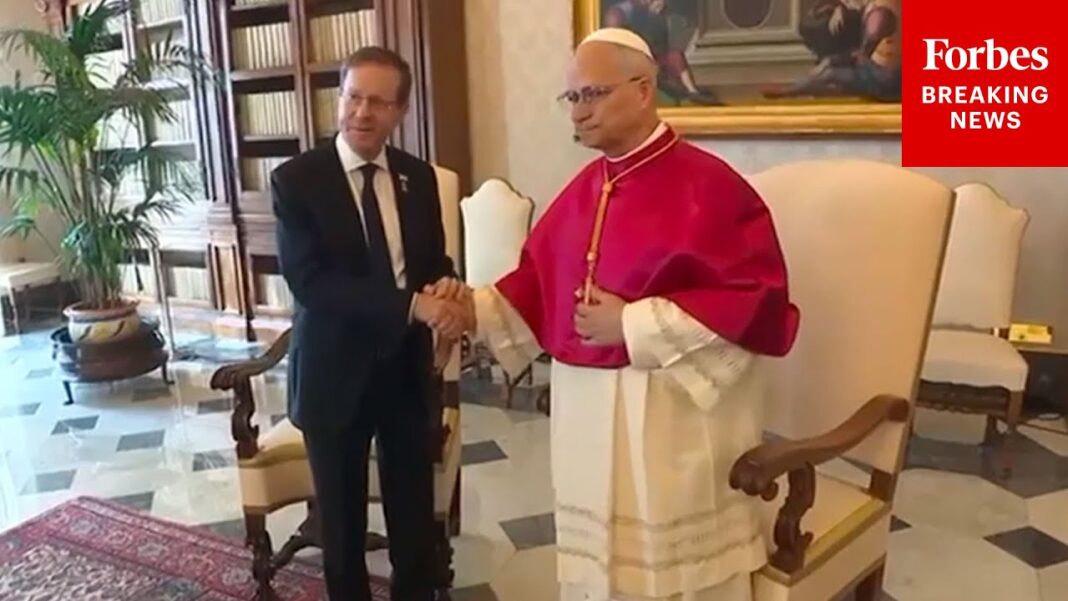
Israeli President Isaac Herzog traveled to the Vatican on Thursday for a highly symbolic meeting with Pope Leo XIV, urging global faith leaders to use their moral authority to demand the immediate release of the hostages held in Gaza by Hamas terrorists. The visit, coming just one day shy of 700 days since the abductions began, underscored both the humanitarian urgency and the spiritual dimension of the hostage crisis.
As reported by the Jewish News Syndicate (JNS) on Thursday, Herzog’s appeal placed faith at the heart of diplomacy, framing the liberation of the hostages not only as a matter of international law and human rights, but as a religious and moral imperative for people of conscience worldwide.
“Israel is doing everything possible to bring home the hostages held in brutal captivity by Hamas,” Herzog declared in a social media post written in Italian following his encounter with Pope Leo XIV. He called upon “leaders of faith and goodwill” across all religions to issue a unified demand for their release, describing this as the “first and essential step toward a better future for the entire region.”
Herzog’s choice of words, as noted in the JNS report, reflects his ongoing effort to internationalize the hostage crisis beyond state diplomacy, appealing instead to the universal moral authority of religious leaders who command global influence. “Israel longs for a day when the peoples of the Middle East, the children of Abraham, will live together in peace, cooperation and hope,” Herzog added, evoking a vision of interfaith reconciliation grounded in shared religious heritage.
Herzog’s one-day visit, arranged at the personal invitation of Pope Leo XIV, was carefully structured around three central themes: the effort to secure the return of the hostages, the rising tide of global antisemitism, and the protection of Christian communities across the Middle East.
According to a statement from the president’s office cited in the JNS report, Herzog’s itinerary included not only the papal audience but also a meeting with Vatican Secretary of State Cardinal Pietro Parolin, and a tour of the Vatican Archives and Library. The inclusion of the archives underscored the historical depth of Jewish-Catholic relations and the need to confront both historic and contemporary antisemitism through education and remembrance.
The pope himself has made repeated calls for a truce in the ongoing war against Hamas. Last week, as reported by JNS, Pope Leo XIV issued a heartfelt appeal for the release of all captives and for increased humanitarian aid to flow into Gaza. His language, emphasizing compassion and reconciliation, resonated with Herzog’s own appeal for interfaith solidarity.
Herzog expressed appreciation for what he described as the pontiff’s “global leadership in combating hatred and promoting peace worldwide.” “I look forward to deepening our cooperation for a better future of justice and compassion,” the president said, framing the visit as a moment of mutual reinforcement between Israel and the Vatican in their shared commitment to humanitarian principles.
The plight of the hostages was the defining focus of Herzog’s visit. As JNS emphasized, 48 individuals remain in Hamas captivity in Gaza—some alive, others believed to have been murdered. Families of the captives have long pleaded for world leaders and religious figures to elevate the urgency of their cause on the global stage.
Herzog’s appeal at the Vatican thus served as both a symbolic and practical gesture: it reminded the world that the hostages’ ordeal continues and that their release is indispensable for any pathway toward peace. For the families, Herzog’s effort offers renewed hope that religious leaders might leverage their platforms to amplify international pressure on Hamas.
The encounter between Herzog and Pope Leo XIV also carried profound interfaith implications. Israel, as Herzog reiterated, is committed to safeguarding religious freedom and supporting Christian communities throughout the region. This pledge has particular resonance for the Vatican, which has expressed concern for dwindling Christian populations in the Middle East amid regional conflict and instability.
By linking the hostage issue with broader commitments to protecting Christians and combating antisemitism, Herzog effectively wove together the shared vulnerabilities of Jews and Christians in the modern Middle East. As the JNS report highlighted, this framing highlights Israel’s role not only as the homeland of the Jewish people but also as a guarantor of religious freedom in a region where such freedoms are often imperiled.
The meeting also addressed the sharp rise in antisemitism worldwide since the Hamas-led massacre of October 7, 2023, which left more than 1,200 Israelis dead and 250 taken hostage. Herzog has repeatedly warned that antisemitic incidents—from attacks on Jewish institutions to open hatred on university campuses—have surged in both Europe and North America.
By bringing this concern to the Vatican, Herzog emphasized the necessity of interreligious cooperation in combating Jew-hatred. As reported by JNS, the pope and the Catholic Church remain influential voices in denouncing antisemitism, with Pope Leo XIV having already condemned anti-Jewish violence in Europe earlier this year.
The timing of Herzog’s visit was highly symbolic. Taking place just as the hostage crisis approaches its 700th day, the meeting dramatized the urgency of breaking the stalemate. The Vatican, as the global seat of Catholicism, provides Herzog with a unique platform to elevate the humanitarian plight of the hostages above the geopolitical fray.
The symbolism was further reinforced by Herzog’s Italian-language social media post, which underscored his desire to reach not only Catholic leadership but also the broader Italian and European public, where debates over Israel’s war with Hamas remain politically and morally charged.
Herzog’s Vatican diplomacy also dovetailed with messaging from Prime Minister Benjamin Netanyahu, who has consistently emphasized that Hamas must be decisively defeated for peace to take hold. While Netanyahu appeals primarily to military and political leaders, Herzog’s Vatican visit demonstrates Israel’s multi-layered strategy: appealing to religious and moral leaders who can exert pressure through their global congregations and communities.
This dual-track approach, as observed in the JNS report, reflects Israel’s recognition that the hostage issue is not merely political but deeply humanitarian, requiring appeals that resonate beyond the corridors of power.
Herzog’s meeting with Pope Leo XIV ultimately reinforced the convergence of Israeli and Vatican interests around the themes of peace, justice, and compassion. While political disagreements may persist—particularly over questions of the Israeli-Palestinian conflict—the shared demand for the hostages’ release has created a rare point of unity.
For Israel, the encounter represents both a moral victory and a strategic one: by enlisting the pope and Catholic leadership in the cause, Herzog ensures that the plight of the hostages remains at the forefront of global consciousness.
Herzog’s Vatican visit was far more than a diplomatic courtesy call. It was an urgent plea framed in the language of faith and morality, appealing to the consciences of billions worldwide through the authority of religious leadership.
By standing alongside Pope Leo XIV, Herzog elevated the hostage crisis from a regional tragedy to a universal test of humanity. Whether this moral pressure can hasten their release remains uncertain. But by turning to the Vatican, Herzog has amplified Israel’s message: that peace, reconciliation, and justice in the Middle East cannot begin until the captives are freed.
