



|
Getting your Trinity Audio player ready...
|
By: Fern Sidman
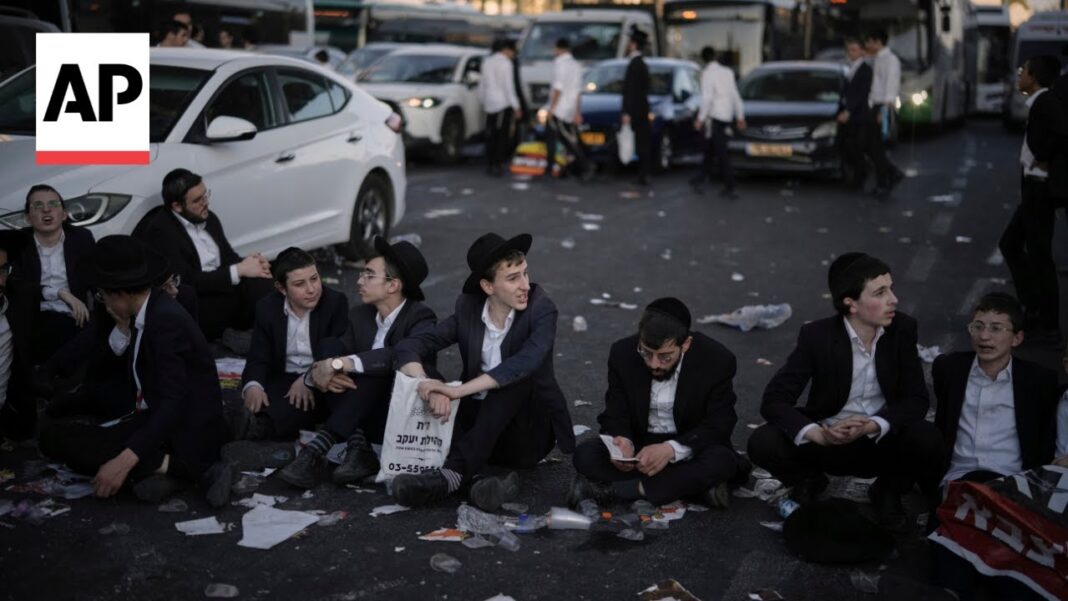
Major transportation arteries in central Israel and Jerusalem were brought to a halt on Thursday as demonstrators from the radical haredi Jerusalem Faction staged large-scale protests against the arrest of yeshiva students accused of evading mandatory military service. The unrest, which Israel National News reported unfolded in multiple locations, sparked hours-long traffic disruptions, physical confrontations with police, and the injury of at least one officer.
According to the report on Thursday at Israel National News, the most significant disruption occurred near Bnei Brak, where demonstrators blocked Route 4 in both directions. The protest, organized by adherents of the Jerusalem Faction — a hardline group within the ultra-Orthodox community that opposes conscription — began in the early afternoon and quickly escalated.
Northbound lanes of Route 4 were shut from the Aluf Sadeh Interchange, forcing traffic onto Route 471, while southbound lanes were closed from the Em Hamoshavot Junction, diverting vehicles into Petah Tikva. Police at the scene declared the gathering unlawful, warning demonstrators to disperse.
Israel National News reported that during the standoff, protesters hurled rocks at police and shouted incendiary slogans, including calling officers “Nazis.” The protest’s tone and tactics mirrored previous Jerusalem Faction demonstrations, which have frequently sought to disrupt major thoroughfares as a form of political pressure.
The blockade continued for approximately four hours before security forces managed to clear the road. Shortly thereafter, traffic resumed on both northbound and southbound lanes, though lingering congestion persisted well into the evening commute.
While Bnei Brak bore the brunt of the traffic paralysis, the Israel National News report noted that parallel protests erupted in Jerusalem, where members of the Jerusalem Faction blocked both Bar Lev Road and Begin Boulevard. Police moved in to disperse the gatherings, employing what they described as “necessary force” to restore order.
According to a police statement cited by Israel National News, demonstrators in the capital ignored repeated instructions to clear the roadways and instead escalated the confrontation. Officers reported being pelted with stones, wooden planks, glass bottles, flowerpots, and other objects.
One Border Police officer sustained light injuries from a stone thrown during the clashes and received medical treatment at the scene. Despite the violence, no fatalities or severe injuries were reported.
Central to Thursday’s demonstrations was the recent detention of yeshiva students accused of failing to report for military enlistment. In Jerusalem, some protesters held signs referring to the detained individuals as “hostages,” framing the arrests as acts of persecution against the Torah world — a recurring theme in the rhetoric of the Jerusalem Faction.
Israel National News noted that the faction’s leaders have long rejected Israel’s system of mandatory military service for Jewish men and women, arguing that full-time Torah study is a higher calling and should exempt their members from conscription. The group has routinely mobilized mass protests in response to draft enforcement actions, often resulting in traffic chaos and confrontations with law enforcement.
In a detailed account provided to Israel National News, police stated that the situation on Bar Lev Road in Jerusalem deteriorated after demonstrators began “disrupting public order” and “provoking and clashing with officers.” The objects thrown — including stones and heavy wooden boards — posed significant risks to both officers and bystanders.
Police ultimately resorted to physically removing demonstrators from the roadways, leading to a series of scuffles before the crowds were dispersed. By late afternoon, both Bar Lev Road and Begin Boulevard were reopened to traffic, although public transportation in the area experienced residual delays.
As Israel National News has frequently reported, Thursday’s unrest fits into a broader, years-long struggle over the integration of the ultra-Orthodox community into Israel’s military service framework. The Jerusalem Faction, which split from the mainstream haredi political leadership over disagreements on cooperation with the state, maintains a particularly uncompromising stance.
The arrests that triggered Thursday’s protests are part of ongoing enforcement measures by military police against individuals who have failed to appear for enlistment or secure formal exemptions. While other ultra-Orthodox groups have sought political solutions to these enforcement efforts, the Jerusalem Faction has consistently taken to the streets, often employing civil disobedience that leads to prolonged public disruptions.
Thursday’s protests also come amid heightened tensions between law enforcement and the faction, with the Israel National News report noting that similar demonstrations in recent months have involved increasingly aggressive tactics by protesters, as well as a more forceful police response.
The closure of Route 4 — one of Israel’s busiest highways — had immediate and widespread consequences for commuters. Israel National News reported extensive delays on alternate routes, with traffic spilling into side streets in Petah Tikva, Ramat Gan, and Holon. Public transportation routes serving the affected areas were forced to reroute, adding to the confusion and frustration of passengers.
In Jerusalem, the blockage of Bar Lev Road, a key artery in and out of the city center, caused significant delays for both private vehicles and buses. Local businesses also reported disruptions as customers and employees struggled to reach their destinations.
Police emphasized in their statement to Israel National News that the decision to declare the gatherings unlawful was taken in light of the “severe impact on public order and safety,” as well as the escalating violence directed at officers.
By early evening, traffic on both Route 4 and the major Jerusalem roads had returned to normal, though the confrontations have left lingering tensions between the Jerusalem Faction and law enforcement. Israel National News reported that police are reviewing video footage from the demonstrations and may pursue charges against individuals identified as having assaulted officers or engaged in other illegal acts.
No timeline has been given for the next steps in the investigation, but given the Jerusalem Faction’s history of mobilizing in response to arrests, further protests are likely.
As the Israel National News report observed, the events of Thursday once again bring to the forefront the deep divisions within Israeli society over the issue of military service, as well as the Jerusalem Faction’s determination to resist state overreach into religious life. With draft enforcement continuing and no political compromise in sight, clashes between ultra-Orthodox demonstrators and police appear set to remain a recurring feature on Israel’s roads and in its cities.

When Israel allows leftists to block traffic and alike, don’t be surprised if others do the same.