



|
Getting your Trinity Audio player ready...
|
By: Fern Sidman – Jewish Voice News
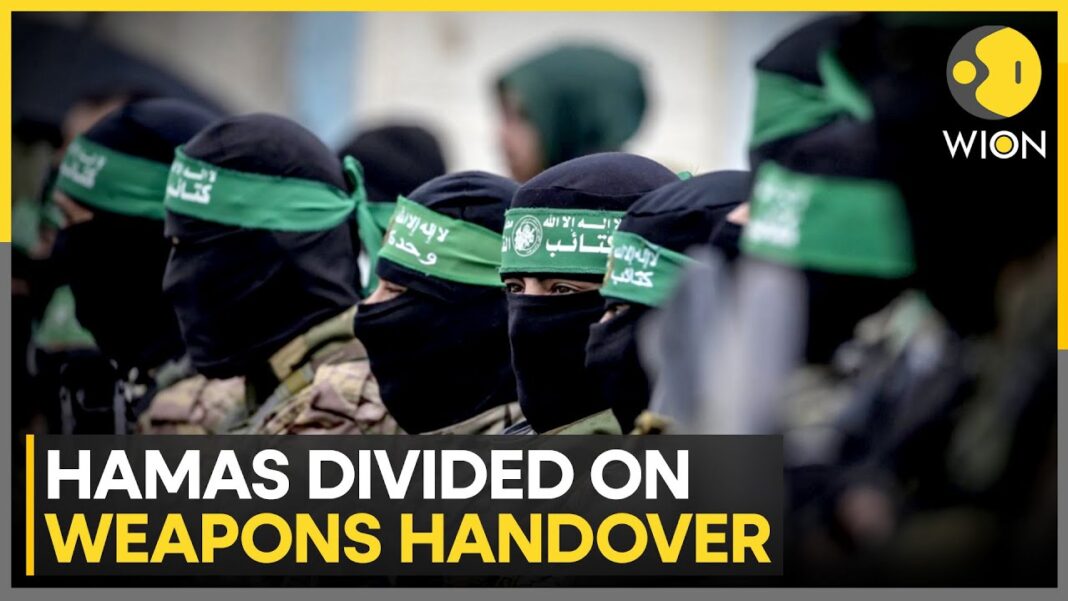
In a fiery address delivered by video to a pro-Palestinian Arab gathering in Istanbul, longtime Hamas leader Khaled Mashaal intensified the organization’s longstanding rejectionist doctrine, renewing calls for Israel’s destruction while explicitly repudiating U.S.- and U.N.-backed demands that Hamas disarm and demilitarize the Gaza Strip. His remarks, reported on Monday by The Jewish News Syndicate (JNS) and echoed across Arab media, underscored both the ideological rigidity of Hamas’s senior leadership and the mounting diplomatic challenges facing Western and regional actors attempting to shepherd the fragile Gaza ceasefire into a durable political settlement.
Mashaal, a former Hamas politburo chief and one of the group’s most visible global figures, framed his speech as a moment of historic opportunity for the “ummah,” or Islamic nation, to embrace what he described as the next phase in a generational struggle. “The time has come for the ummah to commit to the liberation of Jerusalem as the banner and symbol of freeing Palestine; to cleansing the blessed Al-Aqsa Mosque; and to reclaiming Islamic and Christian holy sites,” Mashaal proclaimed. His language—explicitly invoking “cleansing,” “liberation,” and a territorial vision extending from the Gaza Strip to Judea and Samaria and beyond—is characteristic of Hamas’s foundational charter but striking in its timing, as global powers work to implement the next stage of the Trump administration’s Gaza peace plan endorsed by the U.N. Security Council.
Mashaal’s remarks were a direct rebuttal to the central tenets of the peace framework: the requirement that Hamas fully surrender its weapons, accept international oversight, and facilitate the emergence of a demilitarized Gaza administered by a transitional authority. As Israel National News has emphasized in its coverage of the negotiations, the ceasefire agreement—and the international aid architecture set to follow—depends on Hamas’s complete disarmament, a condition firmly supported by Washington, Jerusalem, Cairo, and multiple Gulf states.
Mashaal, however, dismissed these expectations outright. “Protecting the resistance project and its weapons is the right of our people to defend themselves,” he said. “The resistance and its weapons are the ummah’s honor and pride. A thousand statements are not worth a single projectile of iron.”
This formulation, which elevates armed violence to a religious and national imperative, signals that the organization’s leadership is not prepared even to rhetorically entertain disarmament, let alone implement it. For diplomats working to advance the ceasefire’s second phase—including demilitarization and international stabilization—the speech served as a stark reminder of the ideological terrain they must navigate.
Mashaal also attempted to reposition Hamas’s political narrative following the global shock produced by the group’s October 7, 2023 massacre, which killed 1,200 Israelis and foreign nationals and triggered the devastating Gaza war. With anti-Israel protests proliferating on Western university campuses and Islamist rhetoric gaining traction in some political circles, Mashaal argued that international sentiment had shifted decisively in Hamas’s favor.
“The global anti-Israel movement that surged after October 7 has created opportunities to remove this entity [Israel] from our homeland and exclude it from the international stage,” he claimed.
This assertion—deeply discordant with Hamas’s military deterioration and Gaza’s humanitarian disaster—highlights the organization’s strategy of converting international criticism of Israel into ideological ammunition. As the JNS report noted, Mashaal’s framing aims to sustain Hamas’s claim to leadership within the broader Palestinian movement even as the group faces unprecedented military pressure and international isolation.
Central to Mashaal’s speech was his dismissal of any form of international governance in Gaza, a direct challenge to the U.S.–led proposal establishing an International Stabilization Force and a Board of Peace to guide postwar reconstruction.
“We reject all forms of guardianship, mandate and re-occupation of the Gaza Strip, the West Bank and all of Palestine,” he declared.
He further insisted that Gaza—and by extension all territories claimed by Hamas—remain exclusively under the control of what he called “the people who do not break,” describing the two years of conflict as proof that Israel’s military superiority had failed to impose its will.
“This is Gaza and this is the great Palestine—the one that drives out invaders,” Mashaal boasted, in rhetoric reminiscent of the movement’s triumphant messaging following Israel’s 2005 disengagement from the Strip.
Mashaal outlined a five-point set of priorities for the post-war period: preventing the “Judaization” of Judea and Samaria; securing the release of all imprisoned terrorists; building a unified Arab front against Israel; pursuing Israeli leaders around the world; and expanding anti-Israel messaging in academia, media and international political arenas.
This is not a blueprint for reconstruction or governance but rather a transnational, ideologically driven campaign—one that views instability as a strategic asset. As Israel National News has repeatedly documented, Hamas seeks to transform every arena in which Israel operates—military, diplomatic, academic, and cultural—into a theater of confrontation.
Mashaal’s insistence on exporting Hamas’s struggle beyond Gaza aligns with evidence that the organization has sought to rebuild its operations in Lebanon, Turkey, and Qatar and to expand its influence over Judea and Samaria militias.
Israel’s Foreign Ministry swiftly condemned Mashaal’s speech, noting that his statements were “in direct contradiction of the core terms of the peace plan itself.” Officials cited by Israel National News emphasized that Mashaal’s defiance illustrated precisely why disarmament, demilitarization, and an international stabilization force are indispensable components of the ceasefire framework.
“Israel cannot accept a situation in which a genocidal terrorist organization openly vows to reconstitute itself and resume operations, all while demanding a role in Gaza’s governance,” a senior diplomatic source told the outlet.
Israeli analysts further argued that Mashaal’s speech served a dual function: reaffirming Hamas’s refusal to compromise while signaling to regional patrons—including Iran—that the organization remains ideologically loyal to the “axis of resistance.”
Mashaal’s remarks also complicate the efforts of Washington, Cairo, Riyadh, and Doha to shepherd the ceasefire into a sustainable political settlement. The Trump administration’s peace plan—now formally endorsed by the U.N. Security Council—was crafted on the assumption that Hamas would be structurally weakened and politically coerced into accepting disarmament.
Mashaal’s speech reveals how far that assumption remains from reality.
Moreover, the rhetoric threatens to inflame tensions among Arab states that have backed the ceasefire, especially Egypt, which regards a rearmed Hamas as a direct security threat to the Sinai Peninsula.
For Qatar—long Hamas’s most important financial and political sponsor—Mashaal’s posture creates diplomatic risk, particularly as Doha seeks to maintain its role as a mediator while balancing its relations with the United States.
Mashaal’s speech underscores a fundamental paradox: Hamas defines success not in terms of state-building or improving Palestinian life, but in maintaining perpetual resistance. This is a political theology in which compromise is betrayal, disarmament is dishonor, and governance itself is secondary to conflict.
Whether the international community can impose a reconstruction framework without Hamas’s cooperation remains one of the most pressing strategic questions in the Middle East.
If Mashaal’s rhetoric is any indicator, Hamas intends to fight the political war just as relentlessly as it has fought the military one—leveraging global unrest, exploiting ideological divisions, and working to ensure that Gaza’s future remains tethered to the movement’s uncompromising doctrine.
As Israel National News has noted, the stakes extend far beyond Gaza. They speak to the future of regional stability, the durability of the emerging Arab–Israeli alignment, and the willingness of the United States and its partners to enforce the terms of the peace plan with the strength and clarity it demands.
I think the hostages were released just for Qatar to make Trump beholden to them and Hamas never had any intention of surrendering.
The strategy sure worked. Qatari influence in this country is astounding, billions invested to corrupt our universities and Congress. Who is going to change this situation if everyone is on the take?