



|
Getting your Trinity Audio player ready...
|
By: Fern Sidman
Even as the guns fall silent under a tenuous ceasefire in Gaza, the Islamist terrorist organization Hamas is tightening its stranglehold over the war-torn enclave, brutally crushing dissent while quietly rebuilding its military infrastructure. Newly released Israeli intelligence indicates that despite staggering battlefield losses, Hamas remains heavily armed, entrenched, and determined to reassert control — a development that Israeli officials and international observers described as both alarming and predictable.
According to intelligence findings reported by The Algemeiner and Israel’s Channel 12 News, the two-year war has left Hamas severely weakened but far from defeated. The data, gathered by the Israeli defense establishment, show that the terrorist group has lost more than 60 percent of its weaponry, nearly half its senior command structure, and much of its above-ground military network. Yet despite this attrition, Hamas still retains hundreds of rockets, many with the range to reach central Israel, and maintains more than half of its sprawling underground tunnel system — a subterranean labyrinth that remains the core of its operations.
Israeli estimates cited in The Algemeiner report on Wednesday further reveal that Hamas’s active fighting force still numbers roughly 20,000 men, though most are inexperienced recruits hastily conscripted from Gaza’s devastated civilian population. These new fighters, officials say, have received only limited training and lack the discipline of the once-elite Nukhba forces, whose ranks were decimated in the aftermath of the October 7, 2023, massacre that ignited the conflict.
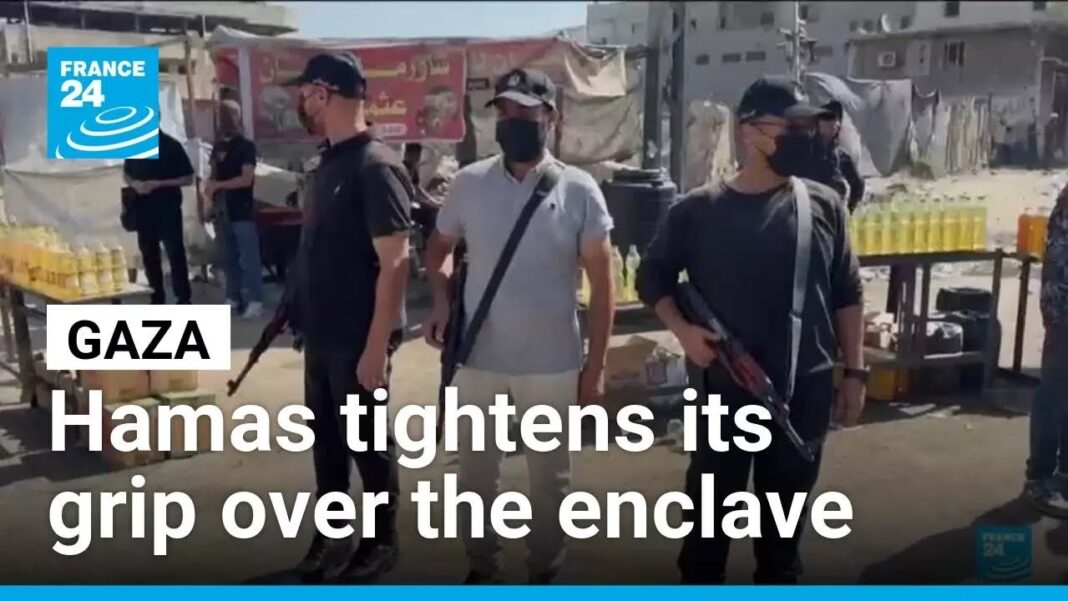
In the weeks since the U.S.-brokered ceasefire took effect, Hamas has embarked on a ferocious internal purge aimed at restoring control over the 47 percent of Gaza that remains under its authority. According to the information provided in The Algemeiner report, the group’s so-called “security campaign” has targeted Palestinians accused of collaborating with Israel or supporting rival factions.
Citing reports from Iranian state media, the outlet noted that Hamas has announced plans for “its largest operation yet” to eliminate opposition militias and alleged informants. “In the coming days, we will launch our largest security campaign yet,” a Hamas official told Tehran’s Press TV, vowing to “ensure peace and security for the people of Gaza.”
But the reality on the ground, as documented in The Algemeiner report and numerous eyewitness accounts, has been one of widespread brutality. Social media footage circulating online — much of it verified by independent analysts — shows masked gunmen dragging suspected collaborators through the streets, beating them with rifle butts, and conducting public executions. In several disturbing videos, Hamas fighters can be seen kneecapping detainees and leaving them in the road as warnings to others.
Israel’s Foreign Ministry condemned the scenes of violence, accusing international human rights organizations of selective silence. “Killings in public by Palestinian Hamas — and deafening silence from the ‘moral preachers.’ Do you hear the sound of the crickets?” the ministry posted on X, a sentiment echoed in The Algemeiner report, which has chronicled Hamas’s long history of using fear and torture to maintain its grip on power.
The ceasefire agreement, negotiated with U.S. support and endorsed by regional powers, left the Israeli military in control of more than half of Gaza’s territory — a tactical buffer zone designed to prevent Hamas from rearming along the border. Yet The Algemeiner reported that within days of the truce taking effect, the terror organization began arresting civilians, confiscating weapons, and reestablishing checkpoints across its remaining strongholds in Gaza City, Khan Yunis, and Deir al-Balah.
Israeli analysts cited in The Algemeiner report say that this “security campaign” reflects Hamas’s strategic calculation: to demonstrate that it remains the de facto ruler of Gaza despite its weakened position. “Hamas is sending a message both to Gazans and to the international community,” one intelligence source said. “They are saying, ‘We are still here, we still rule, and anyone who challenges us will be crushed.’”
The timing of Hamas’s internal crackdown, coming just as the Trump administration’s peace plan begins its reconstruction phase, underscores the group’s enduring ambition to maintain control of Gaza — not through governance, but through terror and coercion.
The resurgence of violence has not gone unnoticed in Washington. President Trump, whose administration brokered the fragile ceasefire, issued a stark warning last week on Truth Social. “If Hamas continues to kill people in Gaza, which was not the Deal, we will have no choice but to go in and kill them,” Trump wrote.
According to the information contained in The Algemeiner report, Israeli Prime Minister Benjamin Netanyahu has privately echoed Trump’s frustration, telling advisers that the international community “must hold Hamas accountable for violating every principle of the ceasefire.” The Prime Minister’s Office declined to comment publicly but has indicated that Israel will continue monitoring Hamas’s activities closely and will respond militarily if the violence spreads.
Meanwhile, Israel’s diplomatic corps has grown increasingly vocal in calling out the hypocrisy of global leaders and institutions that remain silent about Hamas’s atrocities. “The same people who call Israel an occupier,” one Israeli official told The Algemeiner, “are ignoring executions in broad daylight and mass detentions carried out by the very group they defend.”
As Hamas consolidates power through violence, two of its most loyal patrons — Qatar and Turkey — are simultaneously maneuvering to expand their roles in Gaza’s postwar reconstruction. According to The Algemeiner report, Hamas political leaders met with Qatari and Turkish officials in Doha this week to discuss the implementation of Trump’s peace plan and the future governance of the enclave.
While both nations have publicly expressed support for humanitarian rebuilding, Israeli and Western analysts warn that their involvement could inadvertently (or deliberately) reinforce Hamas’s hold on power. As The Algemeiner noted in a previous analysis, Qatar has provided Hamas with financial lifelines and diplomatic protection for more than a decade, funneling millions of dollars into Gaza under the guise of “reconstruction aid.” Turkey, meanwhile, continues to harbor senior Hamas operatives and has repeatedly defended the group as a legitimate resistance movement.
On Tuesday, Netanyahu signaled strong opposition to any Turkish security role in overseeing the ceasefire, calling it a “red line.” “Turkey cannot be trusted as an impartial actor in Gaza,” one Israeli defense official told The Algemeiner. “Their support for Hamas is not ideological — it’s operational.”
Despite its devastating losses, Hamas remains a formidable military threat. The Algemeiner, citing Israeli defense officials, reported that the group retains hundreds of short- and medium-range rockets, along with a cache of over 10,000 small arms and explosives. Crucially, its tunnel infrastructure — estimated at more than 50 percent intact — continues to serve as a lifeline for command, storage, and movement across the enclave.
Israeli intelligence has also detected efforts to rebuild weapons manufacturing sites under civilian cover, particularly in areas where international humanitarian groups are operating. A senior IDF officer quoted in The Algemeiner report described the situation as a “ticking time bomb” for both Israel and Gaza’s civilians. “They are using the lull to rebuild, to reorganize, to recruit,” he said. “If the world looks away now, we will face the same nightmare again.”
Beyond the geopolitical chessboard, the renewed repression has plunged Gaza’s population into deeper despair. Civilians who survived two years of war now find themselves caught between an Israeli-controlled buffer zone and Hamas’s reign of terror in the remaining enclaves.
As The Algemeiner has frequently emphasized, Hamas’s claim to defend Palestinians has always masked a pattern of exploitation. The organization seizes aid, taxes reconstruction funds, and treats Gaza’s civilians as hostages to its political ambitions. “This is not governance; it’s gangsterism,” one humanitarian worker told The Algemeiner. “They claim to be fighting for Palestine, but they are murdering Palestinians in the streets.”
The International Committee of the Red Cross and several U.N. agencies have yet to comment publicly on the alleged executions, prompting sharp criticism from Israeli officials and Jewish advocacy groups. “When Israel defends itself, the U.N. convenes an emergency session,” an Israeli diplomat told The Algemeiner. “When Hamas executes its own people, the world looks away.”
For now, the ceasefire remains tenuously in place, upheld as much by exhaustion as diplomacy. But analysts warn that unless Hamas is decisively dismantled — both militarily and politically — the current pause in fighting is merely a prelude to another war.
As The Algemeiner report observed, “Hamas’s survival strategy has always been to lose battles but win legitimacy.” Each cycle of conflict and reconstruction allows the terror group to reemerge stronger, more entrenched, and better funded.
Israel, for its part, appears unwilling to accept that outcome. The IDF continues to patrol the buffer zones, monitor tunnel activity, and conduct targeted operations when necessary. Yet without international pressure on Hamas’s foreign sponsors, Israeli officials warn, any peace will be fragile at best.
The latest intelligence and the scenes emerging from Gaza confirm what many Israeli analysts have long argued — that Hamas’s brutality is as much a threat to Palestinians as to Israel. As The Algemeiner report noted, “The terror group that claims to resist occupation has become the occupier of its own people.”
In the aftermath of two years of devastating conflict, Gaza stands divided: half under Israeli military supervision, half under Hamas’s reign of fear. Amid the ruins, the world faces a choice — to demand accountability from the Islamist regime that perpetuates violence or to watch as yet another generation of Gazans is crushed under its rule.
Either way, the intelligence is clear, and the images undeniable: Hamas is wounded but not gone. And for the long-suffering people of Gaza, that may be the worst tragedy of all.

An accurate and sobering analysis of the geopolitical chessboard that will unfortunately become manifest to US leaders, and its allies, only after more blood has been spilled among the Gazan civilians, many I’m sure wrongly accused of collaborating with Israel. Turkey and Qatar are serving as political co-enablers of a terror regime that Israel was making significant progress in degrading until preempted by a ceasfire circus though with all good intention unquestionably oblivious to the facts on the ground. This is highly disconcerting. Hamas has caused a political Merry-Go-Round which explains why JD Vance nor Trump couldn’t possibly give a timeline for the disempowering of Hamas. In essence, the US has unfortunately and perhaps unwittingly played the role of intrusive “in-laws” in Israel’s military mission that only Israel could judge, command, and execute. Tragically, Israel knows its enemy better than any outsider. Who is better than Israel in calculating when a war should end?
Netanyahu knew this would happen if he agreed to this ceasefire. What was he thinking? What does that say about Netanyahu?