



|
Getting your Trinity Audio player ready...
|
By: Fern Sidman
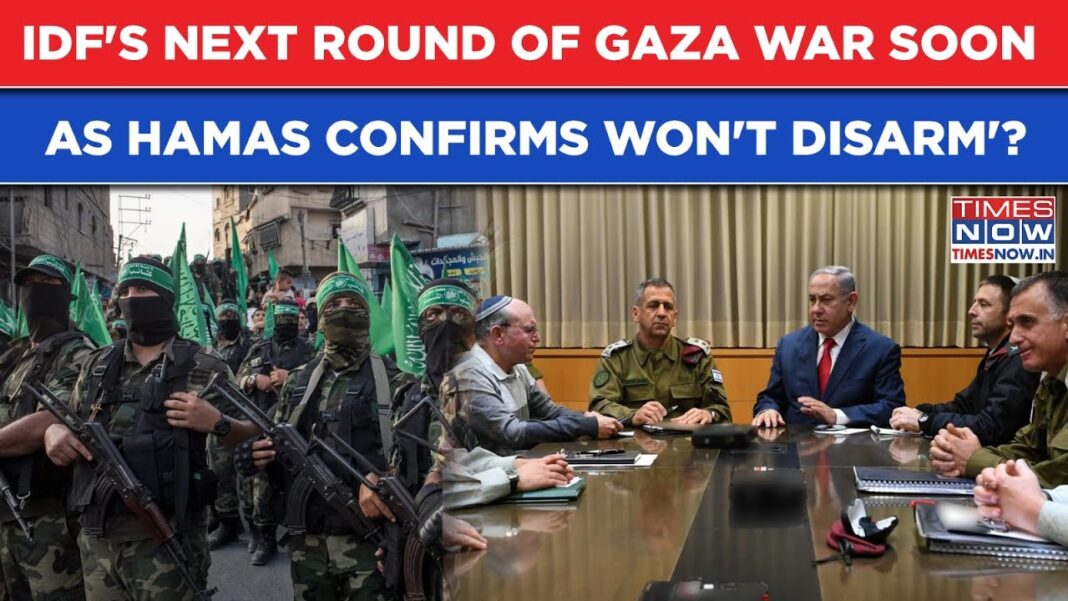
As the United States and its allies prepare to unveil the second phase of President Donald Trump’s ambitious Gaza peace initiative, a widening chasm has opened between diplomatic optimism in Washington and defiant militancy in Gaza. According to a report on Thursday in The Algemeiner, Hamas has now unequivocally hardened its position, publicly rejecting any notion of disarmament and asserting its continued claim to political and military dominance in the coastal enclave—casting a long shadow over hopes for a negotiated breakthrough.
In a revealing interview broadcast Wednesday by the Qatari network Al Jazeera, senior Hamas leader Musa Abu Marzouk dismantled any lingering illusions that the terrorist organization had agreed, explicitly or implicitly, to relinquish its arsenal under the terms of the ceasefire agreement. His language was unambiguous and uncompromising. “Not for a single moment did we talk about surrendering the weapons, or any formula about destroying, surrendering, or disarmament,” he declared. As The Algemeiner has documented, this statement was not an aberration, but rather the latest in a consistent pattern of Hamas rhetoric rejecting demilitarization as a non-negotiable red line.
Abu Marzouk’s remarks reflect more than ideological rigidity; they reveal a strategic posture. Hamas, which ruled Gaza prior to the war and still controls nearly half of its territory, has moved aggressively to reassert internal authority in areas vacated by Israeli forces. While the Israel Defense Forces maintain control over approximately 53 percent of Gaza’s landmass, The Algemeiner reported that the overwhelming majority of Gaza’s civilian population now resides in Hamas-controlled zones, where the organization has imposed a harsh internal crackdown designed to suppress dissent and consolidate power.
The Hamas leader framed disarmament not merely as unacceptable, but as delusional. “After a battle of this magnitude,” he said, “and with the inability of Israel, America, and the West to disarm or destroy Hamas’s weapons, did they think they could obtain it through talks?” His words encapsulated Hamas’s worldview: survival itself is treated as strategic victory, endurance as legitimacy, and endurance as justification for continued militarization.
This posture stands in stark contrast to the messaging emerging from Washington. Just one day after Abu Marzouk’s interview, President Trump told his cabinet that Hamas would, in fact, surrender its weapons. “A lot of people said they’ll never disarm. It looks like they’re going to disarm,” Trump said, projecting confidence that has become characteristic of his diplomatic style. His special envoy, Steve Witkoff, echoed the sentiment with striking directness. “We’ve got the terrorists out of there and they’re going to demilitarize. They will because they have no choice. They’re going to give it up. They’re going to give up the AK-47s.”
As The Algemeiner has reported, this dissonance between Hamas’s declarations and American expectations has become the central tension of the emerging peace framework. Trump has gone further, issuing stark warnings that Hamas “will be blown away very quickly” if it refuses to cooperate with the second phase of the administration’s 20-point Gaza peace plan. Multiple international media outlets now report that Washington is preparing to announce a formal deadline for Hamas to disarm, effectively transforming diplomatic pressure into a ticking clock.
For Israel, the stakes are existential rather than procedural. Prime Minister Benjamin Netanyahu made Israel’s position unmistakably clear in an address to parliament earlier this week. “We are at the threshold of the next phase: Disarming Hamas and demilitarizing the Gaza Strip,” he declared, in remarks cited in The Algemeiner report. “The next phase is not reconstruction. We have an interest in advancing this phase, not delaying it. The sooner we do so, the sooner we will complete the objectives of the war.”
Netanyahu’s framing is strategic: reconstruction without disarmament, in Israel’s view, simply rebuilds the infrastructure of terror. Israeli doctrine now treats demilitarization not as a component of peace but as its precondition. Gaza, Israeli officials argue, cannot be rebuilt while remaining an armed fortress governed by an organization committed to Israel’s destruction.
Phase one of Trump’s peace plan focused on a ceasefire and the return of hostages abducted during Hamas’s October 7, 2023, massacre across southern Israel. That phase formally concluded this week with the recovery of the remains of the final hostage, Israeli police officer Ran Gvili, whose burial on Wednesday marked a somber national milestone. In exchange for the hostages’ release, Israel freed thousands of Palestinian prisoners—including individuals serving life sentences for terrorism—and partially withdrew military forces to a newly defined “Yellow Line,” effectively dividing Gaza between eastern and western sectors.
Phase two, however, represents a far more ambitious and volatile transformation. According to the information provided in The Algemeiner report, the plan envisions the creation of a technocratic Palestinian interim administration, overseen by a newly formed international body known as the Board of Peace, supported by an International Stabilization Force (ISF). This multinational force would supervise security, protect humanitarian corridors, secure Gaza’s borders with Israel and Egypt, and train local security units—while also, in theory, overseeing Hamas’s disarmament.
It is precisely this last function that renders the plan precarious. Hamas has already rejected the legitimacy of any external authority entering Gaza without its consent. Abu Marzouk stated bluntly that “nobody can enter Gaza without understandings with Hamas,” asserting that the group will retain veto power over any administrative body. “If Hamas doesn’t agree to the administrative committee, it cannot enter the Gaza Strip,” he said, making clear that the organization views itself not as a stakeholder in a future system, but as its gatekeeper.
Despite this defiance, the peace plan is moving forward. A transitional technocratic authority has already been established, led by Ali Shaath, a former Palestinian Authority deputy minister, and composed of a 15-member body tasked with civil administration. Yet even this structure faces internal subversion. Media reports cited by The Algemeiner indicate that Hamas is seeking to embed approximately 10,000 of its police personnel into the new governing framework—effectively preserving its coercive power under a new institutional label.
The geopolitical dimension further complicates the picture. Trump’s creation of the Board of Peace, which includes countries such as Turkey despite Israeli objections, has introduced additional strategic fault lines. Israel has consistently rejected any Turkish role in Gaza, warning that Ankara’s longstanding ties to Hamas could transform peacekeeping into proxy empowerment. The Algemeiner has repeatedly documented Israeli concerns that Turkish involvement would strengthen Islamist networks rather than dismantle them.
At the international level, the plan has received formal endorsement from the United Nations, lending it institutional legitimacy. But legitimacy without enforceability risks becoming symbolism rather than substance. The ISF, still undefined in composition and command structure, would face the unprecedented task of disarming a deeply entrenched, ideologically driven terrorist organization embedded within civilian infrastructure and protected by regional allies.
The contradiction between rhetoric and reality is now impossible to ignore. Trump speaks of inevitable disarmament; Hamas speaks of permanent resistance. Washington outlines timelines; Hamas asserts sovereignty. Israel demands demilitarization; Hamas proclaims restoration of order under its own authority. The emerging peace architecture resembles less a linear process and more a collision course between incompatible visions of Gaza’s future.
For Hamas, weapons are not merely tools of war—they are instruments of identity, legitimacy, and political survival. Disarmament would not simply weaken the organization militarily; it would dissolve the very foundation of its authority. For Israel, Hamas’s weapons are not merely arms caches; they are existential threats. And for the United States, disarmament has become the symbolic benchmark of peace’s credibility.
This triangle of irreconcilable imperatives defines the current moment. Phase two of Trump’s plan is not simply a diplomatic transition; it is a confrontation between governance and militancy, between institutional reconstruction and ideological absolutism. The question is no longer whether Hamas will voluntarily disarm—it has made clear that it will not—but whether external pressure, international enforcement mechanisms, and Israeli military leverage can compel a transformation Hamas itself rejects.
The coming weeks will determine whether the peace process advances through negotiated compliance or collapses into coercive enforcement. Deadlines, ultimatums, and diplomatic frameworks may soon give way to harder instruments of power. The language of ceasefires may be replaced by the language of compulsion.
What stands at stake is not only Gaza’s future, but the credibility of international conflict resolution itself. If Hamas can retain weapons while securing political legitimacy, a precedent will be set far beyond Gaza. If disarmament becomes enforceable, a new model of post-terror governance may emerge.
For now, the path forward remains suspended between rhetoric and reality, between declarations and defiance, between hope and hard power. As The Algemeiner has chronicled throughout the conflict, Gaza’s fate will not be decided by speeches alone—but by the convergence, or collision, of diplomacy, force, and political will.
