



|
Getting your Trinity Audio player ready...
|
By: Fern Sidman
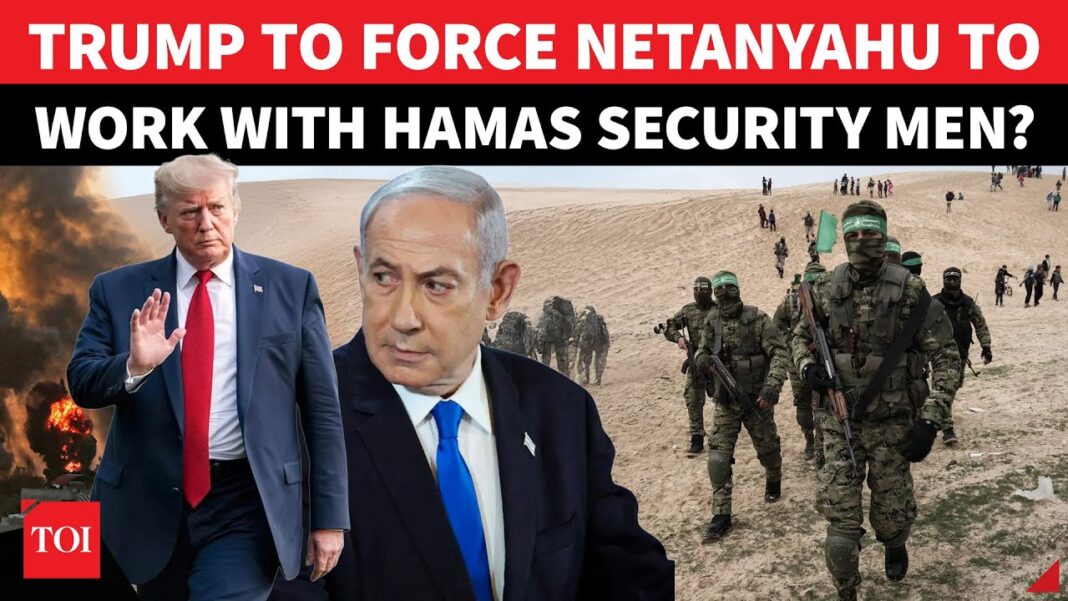
As diplomatic maneuvering intensifies over Gaza’s postwar future, a new and highly consequential demand by Hamas has injected fresh volatility into an already fragile political landscape. According to a report on Tuesday at World Israel News, the Iranian-backed terror organization is seeking to embed approximately 10,000 of its police officers into a proposed U.S.-backed technocratic Palestinian administration that would govern Gaza under an international framework. The revelation, first reported by Reuters, underscores the depth of Hamas’ determination to retain institutional control even as global pressure mounts for its disarmament and political marginalization.
At the center of the dispute lies a fundamental contradiction: the international community’s push for a technocratic, non-militant governing authority in Gaza versus Hamas’ insistence on preserving its internal security apparatus as part of any future administrative structure. For Israel, as World Israel News has consistently documented, this demand is a red line that cuts to the core of national security doctrine. Israeli officials do not distinguish between Hamas’ military wing and its so-called civil institutions; the police, internal security forces, and administrative bodies are viewed as integral components of the same terrorist infrastructure.
The context for Hamas’ maneuver is a delicate ceasefire framework brokered in October under the auspices of President Donald Trump. As World Israel News has reported, the agreement links further Israeli troop withdrawals from Gaza to Hamas’ surrender of its weapons. This conditional structure was designed to ensure that any political transition in Gaza would be anchored in demilitarization, not merely cosmetic changes in governance. Hamas’ attempt to integrate its police force into a new technocratic authority directly challenges that logic, signaling a strategy of institutional survival rather than genuine transformation.
According to Reuters, and echoed in the report at World Israel News, a letter circulated on Sunday by Gaza’s Hamas-run government instructed more than 40,000 civil servants and security personnel to cooperate with the proposed administration. The document indicated that efforts were already underway to incorporate these employees into the new governing structure. Among them are roughly 10,000 members of Hamas’ police force, many of whom have recently resumed patrols in the western half of Gaza as the organization reasserts control in areas under its authority.
For Hamas, this is not merely an administrative request; it is a bid to preserve sovereignty in all but name. By embedding its personnel within a technocratic framework, Hamas would retain operational influence, intelligence access, and coercive power while presenting an outward image of political moderation. Analysts cited by World Israel News describe this as a classic strategy of “shadow governance,” in which a terrorist group adapts to diplomatic pressure by shifting its presence from overt control to institutional entrenchment.
Israel’s response has been unequivocal. Prime Minister Benjamin Netanyahu, whose statements have been prominently featured by World Israel News, has repeatedly insisted that disarmament must precede any reconstruction or political restructuring in Gaza. “Now we are focusing on completing the two remaining missions: dismantling Hamas’ weapons and demilitarizing Gaza of arms and tunnels,” Netanyahu declared. His language leaves little room for ambiguity. In his view, governance reform without demilitarization is not reform at all—it is simply a rebranding of terror infrastructure.
Netanyahu has also directly rejected the notion that Gaza could be rebuilt before Hamas is stripped of its military and security capabilities. As World Israel News reported, he warned against proposals that would prioritize reconstruction over security, stating bluntly that such a sequence “will not happen.” This position reflects a broader Israeli consensus forged through years of conflict: that economic development and political normalization are unsustainable in the presence of armed extremist groups.
The Israeli government’s stance is also shaped by the evolving regional context. Proposals have circulated suggesting that foreign forces—particularly from Turkey or Qatar—could play a role in Gaza’s future security architecture. Netanyahu has dismissed these ideas outright, a position that World Israel News has emphasized in its coverage. From Jerusalem’s perspective, replacing Hamas with foreign-aligned forces sympathetic to Islamist movements would merely substitute one strategic threat for another.
The demand to integrate Hamas police into a technocratic administration also poses a challenge for Washington. The United States has invested significant diplomatic capital in crafting a postwar framework for Gaza that avoids both direct Israeli occupation and continued Hamas rule. As the World Israel News report noted, the concept of a technocratic Palestinian administration is intended to provide governance without militancy, administration without ideology, and stability without terror.
Hamas’ proposal undermines that vision. By insisting on the inclusion of its internal security forces, Hamas effectively rejects the premise of technocracy itself. A technocratic government, by definition, is meant to be non-partisan, professional, and detached from ideological militancy. The presence of thousands of Hamas police officers—trained, loyal, and ideologically committed—would transform such an administration into a façade rather than a genuine alternative.
Diplomatically, the issue places Israel and the United States on a collision course with Hamas’ strategy of gradual normalization. As World Israel News analysts observe, Hamas appears to be pursuing a dual-track approach: outward cooperation with international frameworks combined with internal consolidation of power. This allows the organization to claim legitimacy while retaining the capacity for coercion and violence.
The pressure on Hamas to surrender its weapons has intensified in recent months, particularly as the ceasefire framework ties political concessions to disarmament. Yet Hamas’ history suggests that it views weapons not merely as tools of warfare, but as instruments of political identity and legitimacy. Surrendering them would represent not just a tactical loss, but an existential transformation.
From Israel’s perspective, allowing Hamas’ police to remain armed and operational under a new administrative banner would perpetuate the same security threats that have defined Gaza for decades. Israeli security doctrine is rooted in the belief that any armed extremist presence near its borders constitutes an unacceptable risk.
The broader implications extend beyond Gaza. Regional actors are closely watching how this confrontation unfolds. If Hamas succeeds in embedding itself within a technocratic structure, it could establish a precedent for other terrorist groups seeking political legitimacy without genuine disarmament. Conversely, a firm rejection of this demand could reinforce the principle that political inclusion is contingent on demilitarization.
For ordinary Gazans, the stakes are profound. Reconstruction, economic recovery, and social stability all depend on the emergence of a governing authority capable of delivering services without violence. As World Israel News has highlighted in previous reporting, Gaza’s population has endured years of conflict, deprivation, and political repression. The promise of a technocratic administration offered a potential path toward normalcy. Hamas’ maneuver risks turning that promise into another cycle of domination under a different name.
The international community now faces a critical decision point. Accepting Hamas’ demand would likely secure short-term administrative continuity but at the cost of long-term stability. Rejecting it could provoke renewed confrontation but preserve the integrity of the demilitarization principle.
Netanyahu’s framing of the situation reflects this stark choice. “Either this will be done the easy way or it will be done the hard way,” he warned, a statement repeatedly cited by World Israel News. The implication is clear: Hamas’ disarmament is not optional; it is inevitable. The only question, from Israel’s perspective, is whether it will occur through negotiation or force.
As diplomatic channels remain active, the future of Gaza hangs in a precarious balance between competing visions of governance, security, and sovereignty. Hamas’ attempt to integrate its police force into a new administration is more than a bureaucratic demand—it is a declaration of intent to survive, adapt, and endure. Israel’s rejection of that demand is equally declarative, signaling a determination to reshape Gaza’s political landscape at its foundations.
In this high-stakes confrontation, the struggle is not merely over who governs Gaza, but over what kind of political order will emerge from the ruins of war: one defined by demilitarization, accountability, and civilian rule, or one that cloaks armed extremism in the language of technocracy. The outcome will shape not only Gaza’s future, but the strategic architecture of the entire region for years to come.
