



|
Getting your Trinity Audio player ready...
|
By: Fern Sidman – Jewish Voice News
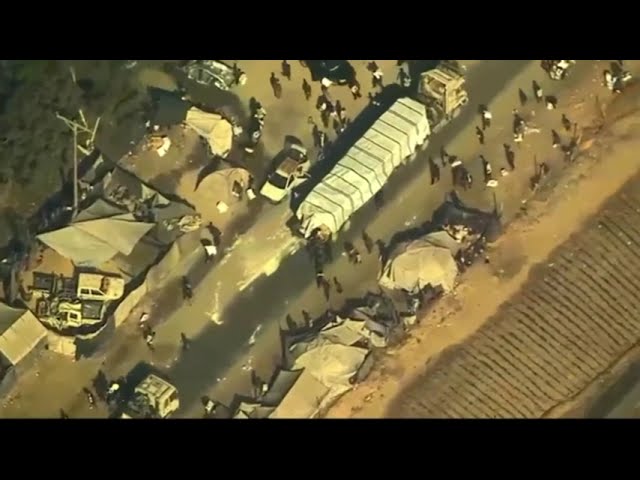
In a startling revelation underscoring the fragile state of Gaza’s post-war ceasefire, the U.S.-led Civil-Military Coordination Center (CMCC) released a verified video on Saturday showing Hamas operatives commandeering and looting a humanitarian aid truck that was delivering supplies to civilians in northern Khan Younis. As i24 News reported on Saturday, the footage, captured by a U.S. MQ-9 Reaper drone, highlights the deep challenges facing international relief efforts — and the ongoing stranglehold Hamas maintains over critical aid distribution in the enclave.
According to the CMCC statement cited in the i24 News report, the incident unfolded on a key supply route being used by a multinational convoy carrying essential humanitarian and commercial goods into southern Gaza. Surveillance imagery showed Hamas operatives halting one of the trucks, forcibly removing the driver, and subsequently seizing both the vehicle and its cargo. The driver’s current status remains unknown, and it is unclear whether he sustained injuries during the attack.
The event marks one of the most serious breaches of the fragile U.S.-brokered ceasefire since it took effect earlier this month and serves as a sobering reminder of the logistical and security challenges facing those attempting to deliver food, medicine, and fuel to Gazans devastated by two years of warfare.
As the i24 News report detailed, the U.S. military’s MQ-9 surveillance drones — typically used in counterterrorism operations — are now being employed to monitor adherence to the ceasefire agreement and ensure that aid reaches intended civilian recipients. The footage, released by the CMCC, reportedly captures armed Hamas operatives swarming the convoy, pulling the driver from the vehicle, and redirecting the truck toward a Hamas-controlled area.
The CMCC, which operates from a secure base in southern Israel near the Gaza border, serves as the nerve center for coordinating humanitarian, security, and logistical efforts. It was established shortly after the ceasefire to manage aid flow and mitigate the risk of renewed violence.
In a statement obtained by i24 News, the CMCC condemned the attack, emphasizing that such actions “undermine collective international efforts to stabilize Gaza and provide for its civilian population.” The organization confirmed that over 600 aid and commercial trucks have entered Gaza daily in recent days through its supervision, carrying food staples, medical supplies, and rebuilding materials from nearly 40 nations and international organizations.
“This incident undermines these efforts,” the CMCC said in its release. “Nearly 40 nations and international organizations represented at the CMCC are working together to help flow humanitarian, logistical, and security assistance into Gaza. Such acts of theft and violence directly threaten the success of these missions and the well-being of the people they are meant to serve.”
The attack, as the i24 News report observed, lays bare the grim reality of Gaza’s internal dynamics: Hamas remains firmly entrenched and willing to hijack humanitarian channels to consolidate control. Despite a ceasefire designed to enable reconstruction and demilitarization, reports of intimidation, confiscation, and extortion by Hamas operatives have been steadily increasing since the truce began.
U.S. officials overseeing the coordination center have privately expressed concern that such incidents could derail efforts to stabilize the enclave. One senior defense source told i24 News that “Hamas has repeatedly exploited aid operations as both propaganda and profit — diverting supplies intended for civilians to strengthen its own ranks or to sell on the black market.”
For international donors and aid agencies, the looting of convoys represents a direct assault on the principles of neutrality and humanitarian access. Aid groups operating under the CMCC’s umbrella — including the World Food Program (WFP), the Red Cross, and various UN-affiliated agencies — have been struggling to maintain security guarantees in the chaotic environment.
“This incident is not just about stolen food or medicine,” one Western diplomat told i24 News. “It’s about the erosion of trust — between the international community, the local population, and the mechanisms designed to help them. If Hamas continues to interfere with aid, even the best-coordinated operations will collapse.”
The ceasefire, negotiated with American, Egyptian, and Qatari mediation, was intended to halt the violence between Israel and Hamas after two years of devastating conflict that began with Hamas’s October 7, 2023 terror attack — the deadliest single day for Jews since the Holocaust. While large-scale fighting has ceased, tensions remain high, with sporadic exchanges of fire and continuing intelligence operations on both sides.
As i24 News reported earlier this week, the truce agreement left several key issues unresolved, including Hamas’s disarmament, the return of Israeli hostages, and the restoration of full civilian control in Gaza. In this climate, the looting of aid trucks by armed operatives risks reigniting broader hostilities and reinforcing Israel’s claims that Hamas cannot be trusted to manage humanitarian infrastructure.
“The looting of humanitarian aid in Gaza by Hamas is not only a violation of international law but also a stark indication of how deeply the terror group has corrupted the fabric of Gazan civil society,” said a former Israeli defense official quoted by i24 News. “It proves that no ceasefire or reconstruction plan can succeed while Hamas retains any power or access to international assistance.”
The U.S., which has taken the lead in organizing the CMCC and ensuring that Gaza receives sustained aid deliveries, now faces a delicate balancing act: keeping humanitarian corridors open without allowing them to become channels for Hamas exploitation.
American officials have been cautious not to publicly accuse Hamas of systematically diverting aid, but the release of the drone footage — and the accompanying CMCC statement — represents a significant escalation in tone. By making the video public, Washington appears to be signaling frustration with both Hamas’s behavior and the limits of international enforcement mechanisms.
According to the i24 News report, the footage will be presented to UN agencies and donor governments in the coming days as part of a broader push to implement stricter verification and escort protocols for all aid shipments entering Gaza.
A U.S. military spokesperson told i24 News that Washington “remains committed to ensuring humanitarian aid reaches those who need it most,” but added that “Hamas’s actions continue to jeopardize these critical operations.”
This latest incident, while shocking, is far from isolated. Multiple i24 News investigations over the past month have documented repeated attempts by Hamas operatives to seize or tax incoming humanitarian supplies, including fuel, flour, and medicine. In one case, international monitors intercepted a convoy that had been rerouted to a Hamas-controlled warehouse, where goods were being distributed exclusively to loyal supporters.
Experts say such tactics are part of a long-standing Hamas strategy — using humanitarian crises to bolster its legitimacy while maintaining an iron grip on the population. “Every truck, every aid parcel becomes a tool of control,” said a regional analyst quoted by i24 News. “It’s a war of perception as much as it is of logistics.”
For the international coalition now coordinating Gaza’s recovery, Saturday’s looting incident serves as a grim warning that security and governance remain the Achilles’ heel of any post-war reconstruction effort.
As the i24 News report observed, “The theft of humanitarian aid by Hamas not only deprives Gaza’s civilians of urgently needed assistance — it also erodes the fragile foundation of trust upon which the ceasefire depends.”
If such acts continue unchecked, the CMCC’s mission to stabilize Gaza could collapse before it ever fully takes root — leaving a war-weary population once again at the mercy of the very group that brought the region to ruin.
Netanyahu Visits the CMCC
This past Wednesday, Israeli Prime Minister Benjamin Netanyahu visited the Civil-Military Coordination Center (CMCC) in Kiryat Gat.
He spoke with CENTCOM Commander Admiral Brad Cooper and with General Patrick Frank, and was impressed by the joint Israeli-American effort to advance and implement President Trump’s framework.
While there, the prime minister said: “I am pleased to host our American friends here in Kiryat Gat. They are working together with us on a plan to achieve a different Gaza, a Gaza that will no longer pose a threat to Israel.
The first component, of course, is security, and the security responsibility for maintaining our forces and our freedom of action. This is an accepted matter, and we are doing it. It is important; it is a fundamental component.
In the same measure, we want to bring it about that in the end, the goal that President Trump and we agreed on – the disarming of Hamas and the demilitarization of Gaza – will be achieved. We are working on this in stages, together with other components of the plan.
I believe that through cooperation, we have already done things that have astounded the world – both in Iran and in the release of our live hostages, in which no one believed we would succeed. There is a real joint effort here, while keeping security in our hands, to achieve results that perhaps no one believed we would achieve; we want to try.
President Trump said it simply: Either we achieve this the easy way, as we hope, or we will have to achieve it the hard way, but we will achieve what we are looking to achieve.”
The Prime Minister was accompanied by his Chief-of-Staff, Tzachi Braverman, IDF Chief-of-Staff Lt.-Gen. Eyal Zamir, ISA Director David Zini, his Military Secretary Maj.-Gen. Roman Gofman, the Head of IDF Coordination Command, Maj.-Gen. Yaki Dolf, and senior IDF officials.
