



|
Getting your Trinity Audio player ready...
|
By: Fern Sidman
The deadly terror attack that claimed six Israeli lives in northern Jerusalem on Monday has triggered not only national mourning but also a forceful military response against the Hamas leadership abroad. Within hours of the shooting, Israeli Prime Minister Benjamin Netanyahu and Defense Minister Israel Katz authorized a strike targeting senior Hamas operatives sheltered in Qatar—a move described by both leaders as a necessary escalation in the nearly two-year-long war against the Islamist group.
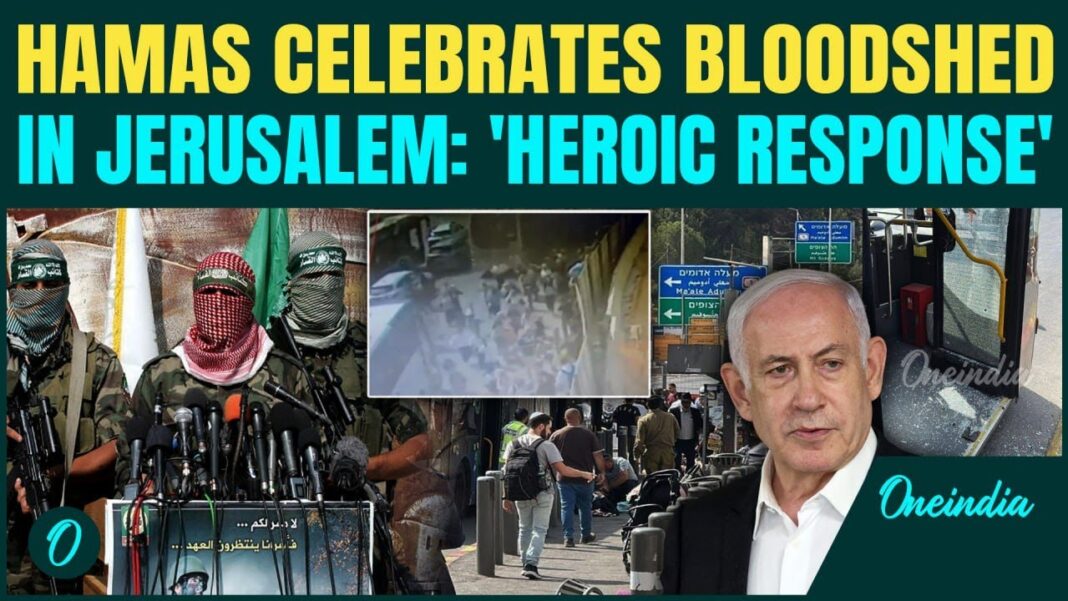
As The Algemeiner reported on Tuesday, Hamas’s military wing, the al-Qassam Brigades, openly claimed responsibility for the attack, proudly identifying the two assailants—Muhammad Taha and Muthanna Amro—as members of its organization. The group described the murders as part of its “resistance operations,” underscoring its ongoing strategy of glorifying bloodshed against civilians.
The attack unfolded in broad daylight at Ramot Junction, a busy transportation hub in northern Jerusalem. According to eyewitness accounts cited in The Algemeiner report, the two terrorists boarded a Line 62 bus caught in heavy traffic and opened fire indiscriminately on passengers and those waiting at a nearby bus stop. Panic ensued as gunmen sprayed bullets into the crowd before being killed by a swift response from a haredi Israel Defense Forces soldier and an haredi armed civilian yeshiva student who happened to be at the scene.
Among the dead were six individuals spanning generations and backgrounds: Jacob Pinto, 25, a newlywed who had immigrated from Spain and was a cousin of social media influencer Ariella Charnas; Sarah Mendelson, 60; Rabbi Israel Matzner, 28; Rabbi Yosef David, 43; Rabbi Mordechai Steintzag, 79; and Rabbi Levi Yitzhak Pash. Their murders left families and entire communities shattered. Roughly 15 others were injured, including a pregnant woman and six victims listed in critical condition with gunshot wounds.
By Monday night, Netanyahu’s government made clear that the massacre in Jerusalem, combined with the earlier killing of four IDF soldiers in Gaza, required an immediate counterblow. In a joint statement reported by The Algemeiner, Netanyahu and Katz revealed that they had “identified an operational opportunity” to strike Hamas’s leadership in Qatar. For years, Doha has provided sanctuary and diplomatic cover for the group’s most senior officials, including figures directly linked to the October 7, 2023 massacre that left 1,200 Israelis dead and more than 250 kidnapped.
“This Hamas leadership was the one that initiated and organized the Oct. 7 massacre,” Netanyahu and Katz emphasized. “They have since continued to carry out murderous attacks against Israel and its citizens, including taking responsibility for the murder of our civilians in yesterday’s attack in Jerusalem.”
According to Israeli military sources, the operation—dubbed Summit of Fire—was executed with precision munitions to minimize collateral damage, though details of casualties among Hamas’s Doha-based leadership remain unconfirmed. The strike, carried out with coordination from Israel’s Shin Bet internal security service, marked the first known instance of Israel targeting Hamas’s political bureau in Qatar since the outbreak of the war.
Qatar has long presented itself as a mediator in regional conflicts, hosting negotiations between Hamas, Israel, and international intermediaries. Yet as The Algemeiner has repeatedly pointed out, the Gulf state has simultaneously harbored Hamas leaders and funneled billions of dollars in aid into Gaza—aid that Israel and many Western analysts say has directly enabled Hamas to sustain its military infrastructure.
The attack in Doha thus signals not only Israel’s determination to pursue Hamas leadership wherever it resides but also a warning to Qatar that its dual role as both mediator and sponsor of terrorism is untenable. For Netanyahu’s government, Hamas’s open acknowledgment of the Jerusalem massacre stripped away any veneer of legitimacy surrounding its leaders abroad.
Even as the attack horrified Israelis, acts of extraordinary courage emerged from the chaos. A taxi driver named Yigal, whose dashboard camera footage circulated widely on social media, rushed to protect an elderly passenger during the assault. Abandoning his driver’s seat, he shielded the woman from the gunfire and helped extract her to safety.
Israeli President Isaac Herzog personally phoned Yigal after viewing the footage. “I am moved to speak with you, dear Yigal; you are truly an example of civilian heroism,” Herzog said, according to reports cited by The Algemeiner. “You are an exemplary citizen. I want to thank you. You bring immense pride to the State of Israel.”
This moment of bravery stood in sharp contrast to the cowardice of the attackers, who brought chaos and bloodshed to ordinary commuters. Israeli officials underscored that the swift actions of Yigal, the IDF soldier, and the armed civilian who neutralized the terrorists prevented the toll from being even worse.
Hamas’s willingness to publicly celebrate the Jerusalem killings demonstrates its enduring commitment to terror, despite suffering heavy battlefield losses in Gaza. As The Algemeiner report observed, the group’s military wing not only admitted responsibility but also called on Palestinians across Judea and Samaria to escalate their confrontations with Israel. This incitement highlights the dual challenge facing Israeli security forces: suppressing Hamas’s physical infrastructure in Gaza while countering its ideological and operational reach in Judea and Samaria.
The recovery of multiple firearms, ammunition, and a knife from the scene drew attention to the premeditated nature of the attack. Security experts noted that the terrorists appeared to have planned to prolong the assault with multiple weapons but were thwarted by the quick intervention of defenders at the scene.
Netanyahu’s speech at a U.S. Embassy event in Jerusalem on Tuesday, commemorating American Independence Day, cast the strike on Hamas leaders as part of a larger strategy of relentless pursuit. “At noon today, I convened the heads of Israel’s security organizations and authorized a surgical precision strike on the terrorist chiefs of Hamas,” the prime minister declared. “These are the same terrorist chiefs who planned, launched and celebrated the horrific massacres of October 7th.”
The prime minister linked the operation directly to the memory of October 7, warning that “much of the democratic world has shamefully forgotten” the atrocities, but “Israel will never forget.” His remarks, as noted in The Algemeiner report, framed the latest strikes as part of a broader historical shift: the era when Jews could be murdered with impunity is over, replaced by a sovereign state determined to exact justice against its enemies.
Defense Minister Katz echoed these sentiments, pledging that the IDF would continue dismantling terrorist nests across Judea and Samaria while pursuing Hamas operatives abroad. Already, IDF units were operating in villages linked to the Jerusalem attackers, mapping their homes for demolition and imposing closures aimed at preventing further violence.
The Jerusalem massacre and Israel’s subsequent strike in Doha encapsulate the complex, borderless nature of Israel’s struggle against Hamas. The attack in the heart of Jerusalem, carried out by West Bank residents but claimed by Hamas, demonstrates the terror group’s ability to inspire violence well beyond Gaza. Meanwhile, the strike in Qatar highlights Israel’s willingness to extend its military reach to the sanctuaries where Hamas leaders plot and finance their campaigns of terror.
As The Algemeiner report emphasized, Israel’s actions reflect a dual strategy: relentless pursuit of justice for the victims of October 7 and ongoing protection of its citizens from renewed waves of violence. For Netanyahu, the lesson is clear: Hamas leaders may cloak themselves in the trappings of political office or seek refuge in foreign capitals, but they remain accountable for the rivers of blood they unleash.
In the days ahead, Israelis will continue to bury their dead from the Ramot Junction massacre, families will mourn the futures stolen from them, and the government will weigh its next steps. But the message, broadcast from Jerusalem to Doha and beyond, remains resolute: Israel will not be deterred, and the architects of terror will find no sanctuary.
