



|
Getting your Trinity Audio player ready...
|
By: Fern Sidman
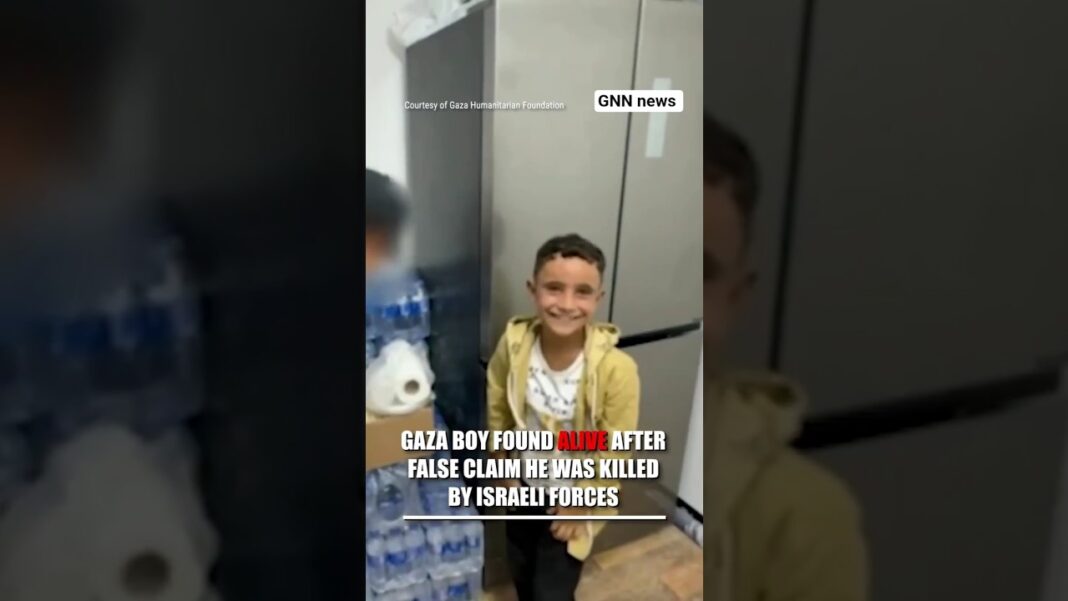
For weeks, the story of an eight-year-old Gazan boy, thought to have been killed by Israeli forces in late May, reverberated across international media and political discourse. The child, introduced under different names in viral accounts, became a symbol for critics of Israel’s military campaign. Yet as Israel National News (INN) and other outlets are now reporting, the boy is not only alive but safe, following a dramatic rescue led by the Gaza Humanitarian Foundation (GHF). The revelation casts a harsh spotlight on the spread of misinformation in conflict zones and raises critical questions about how narratives are weaponized in modern warfare.
The saga began on May 28 when Tony Aguilar, a former contractor with GHF, released body-camera footage and an emotional account describing what he claimed was the killing of a child outside a GHF aid distribution center. Aguilar called the boy “Amir” and asserted that Israeli Defense Forces (IDF) gunfire struck him moments after he had received food and thanked aid workers.
Aguilar’s account, laden with emotion and seemingly corroborated by his proximity to humanitarian operations, quickly went viral. Members of the U.S. Congress even cited his testimony, and the story was amplified by international media outlets that sought to underscore the toll of Israel’s military campaign. The boy became a rallying point in debates about humanitarian access, collateral damage, and military accountability.
But as INN frequently emphasizes, conflict narratives are rarely as straightforward as they appear.
In the weeks that followed, doubts began to surface about Aguilar’s version of events. Both Fox News and The Daily Wire launched parallel inquiries, uncovering glaring inconsistencies. Aguilar could not definitively state where the alleged shooting had taken place—alternately naming SDS 1, SDS 2, and SDS 3, GHF’s secure distribution sites. GHF records showed that his role would not have permitted the level of access he claimed, nor could he have observed the interactions he described, given the physical barriers at these facilities.
Meanwhile, GHF quietly initiated its own probe. The organization, staffed by ex-military veterans and local personnel, deployed biometric tools including facial recognition software to analyze footage of children present at the May distribution site. Cross-referencing this data, they determined that the boy in Aguilar’s viral video was in fact Abdul Rahim Muhammad Hamden, affectionately known as Abboud.
By late August, GHF teams had tracked Abboud and his mother, Najlaa, who had been in hiding after leaving the boy’s stepmother’s care. On August 23, they appeared at SDS 3, where GHF personnel quietly verified their identities. Shortly afterward, Abboud and Najlaa were extracted from Gaza and relocated to a secure, undisclosed location.
“Outside the Gaza Strip is nice,” Abboud was quoted as saying in a translated interview, his words carrying both the innocence of childhood and the weight of an ordeal that had thrust him into global controversy.
To erase lingering doubts, GHF provided Fox News Digital with footage of Abboud joyfully interacting with aid workers, including biometric cross-matches confirming his identity. INN, citing the organization’s reports, emphasized that the case calls attention to both the power of technology in humanitarian operations and the perils of weaponized disinformation.
Chapin Fay, a spokesperson for GHF, told reporters: “We will not be disclosing their whereabouts at this time for their safety and security, but we have every belief that they are on their way to a new life.”
Najlaa, speaking after their rescue, expressed profound relief and gratitude. “My son and I suffered a lot. But we thank God. I thank everyone who helped me and stood by me,” she said.
Her words resonated against the backdrop of a war where civilians often find themselves manipulated into larger political narratives. For families like hers, the priority is survival, not propaganda.
Reverend Johnnie Moore, Executive Chair of the Gaza Humanitarian Foundation, issued a sharply worded statement following Abboud’s recovery. “We are overjoyed and deeply relieved that Abboud is safe, and that this story ends in hope. That outcome was never guaranteed, and it’s thanks to the courage and persistence of our team of American heroes, veterans who never stopped working to find him and bring him to safety in the most complex environment imaginable,” he said.
Moore also criticized the recklessness with which unverified narratives had been circulated. “Too many people, including in the press and civil society, were quick to spread unverified claims without asking the most basic questions. When a child’s life is at stake, facts must matter more than headlines.”
His comments, echoed in the Israel National News report, serve as a cautionary note on the role of media and advocacy groups during wartime, when sensationalism often overshadows verification.
Aguilar, who had been dismissed from GHF in June for poor performance and erratic behavior, has continued to push his version of events online. Yet as the INN report highlighted, his credibility is now fatally compromised. GHF confirmed that no incidents of IDF fire on civilians were recorded at any secure site on May 28, directly contradicting Aguilar’s core claim.
The swift dissemination of his account—without cross-examination of facts—demonstrates how fragile truth can be in an age where digital content can catalyze global outrage in hours.
The Abboud case underscores a larger phenomenon. As INN reported, Hamas and allied groups have long manipulated humanitarian narratives to delegitimize Israel’s self-defense measures. The viral spread of Aguilar’s claims aligned neatly with propaganda strategies that portray the IDF as indiscriminate, even when evidence proves otherwise.
Moreover, the episode highlights the danger of “atrocity propaganda”—stories of murdered children, whether fabricated or exaggerated, which resonate emotionally and can shape international opinion and policy. Once these narratives take root, they are difficult to dislodge, even when proven false.
While misinformation spread rapidly, technology played a crucial role in reclaiming the truth. Biometric analysis, facial recognition software, and geolocated video allowed GHF to match Abboud’s image across different timelines, ultimately proving his survival.
As the INN report observed, this case demonstrates how humanitarian organizations increasingly rely on advanced tools to establish facts in environments where disinformation is rampant. These technologies, once reserved for military intelligence, are now indispensable for aid groups seeking to safeguard credibility and protect lives.
The Abboud saga also offers sobering lessons for journalists, politicians, and advocacy organizations. For media outlets, it is a reminder that speed cannot replace accuracy, particularly when stories involve allegations of war crimes or civilian casualties. For lawmakers, it is a cautionary tale about the dangers of citing unverified reports in policy debates.
As Rev. Moore put it: “When a child’s life is at stake, facts must matter more than headlines.”
Despite the controversy, GHF has reaffirmed its commitment to delivering aid inside Gaza, where hundreds of thousands continue to suffer the consequences of Hamas’s war against Israel. The organization’s ability to locate Abboud and his mother is a testament to the resilience of humanitarian actors in conflict zones, often working under extreme conditions to balance compassion with security.
For Abboud, the ordeal ends with safety and hope for a new life. For the broader international community, however, the story remains a cautionary parable about truth, propaganda, and the consequences of allowing narratives to outpace facts.
The case of Abdul Rahim Muhammad Hamden—once eulogized as a casualty of Israeli fire, now confirmed alive—exposes the fragility of truth in modern conflicts. As Israel National News has reported, it also reveals the resilience of those who work tirelessly to uncover facts and protect the innocent, even in the fog of war.
In the end, Abboud’s survival is both a relief and a rebuke. It is a relief because one child’s life has been spared in a conflict that has claimed too many others. It is a rebuke because it shows how quickly the world is willing to embrace unverified narratives that feed existing biases.
In a war defined as much by information as by arms, Abboud’s story will endure as a lesson: truth matters, even when it is inconvenient.
