



|
Getting your Trinity Audio player ready...
|
From the Stratosphere to the Bundestag: Germany’s $6.5B Arrow 3 Gamble Seals a New Era in Israeli Missile Defense Supremacy
By: Fern Sidman
The German Bundestag’s approval this week of a dramatic expansion to its Arrow 3 missile-defense agreement with Israel marks a watershed moment in European security cooperation, Israeli defense exports and the strategic recalibration of the continent in an era of renewed great-power rivalry. As reported on Thursday by The Jewish News Syndicate (JNS), the decision authorizes an additional contract valued at approximately $3.1 billion, supplementing an initial agreement signed roughly two years ago worth some $3.5 billion. Together, the two accords form a staggering $6.5 billion package—by far the largest defense export deal in the history of the State of Israel.
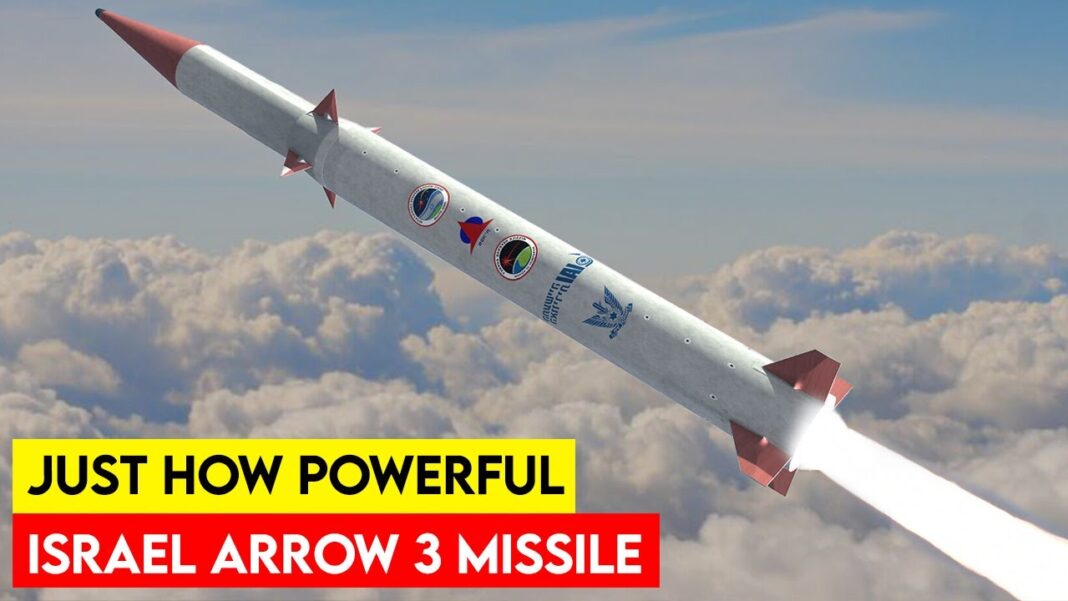
According to the information provided in the JNS report, the Bundestag’s vote underscores Germany’s growing urgency to fortify its air and missile defenses amid an increasingly volatile global landscape, as well as its deepening strategic alignment with Israel as a premier supplier of cutting-edge military technology. The Arrow 3 system, jointly developed by Israel Aerospace Industries (IAI) and the United States Missile Defense Agency, is designed to intercept long-range ballistic missiles in space—far beyond the Earth’s atmosphere—before they can threaten population centers or critical infrastructure.
Israeli defense officials, speaking through statements cited in the JNS report, characterized the expanded agreement as both a technological milestone and a geopolitical signal. Maj. Gen. (res.) Amir Baram, director general of Israel’s Ministry of Defense, described the contract as “another significant milestone in our deepening strategic partnership with Germany, our key European ally,” emphasizing that the deal reflects Israel’s broader strategy to expand defense exports while strengthening its own military-industrial base.
The Arrow 3 system has already amassed an extraordinary operational record. Since the outbreak of the multi-front war involving Israel, Hezbollah and Iran in October 2023, the interceptor has conducted hundreds of successful interceptions, neutralizing ballistic threats before they could reach Israeli airspace. JNS reported that these real-world successes have transformed Arrow 3 from a theoretical deterrent into a battle-proven shield—one whose credibility has not been lost on European capitals confronting the reality of modern missile warfare.
For Germany, the Arrow 3 acquisition represents a cornerstone of its broader European Sky Shield Initiative, an ambitious effort to create a layered, continent-wide missile defense network capable of responding to threats from state and non-state actors alike. Berlin’s decision to invest so heavily in Israeli technology reflects both confidence in Israel’s engineering prowess and a tacit acknowledgment that Europe can no longer rely solely on legacy Cold War systems or distant allies for its immediate defense needs.
Defense Minister Israel Katz echoed this sentiment in remarks cited by JNS, calling the Bundestag’s approval “a clear expression of Germany’s profound confidence in Israel, our technological capabilities, and our shared commitment to protecting our citizens against escalating threats.” Katz emphasized that the revenues generated by the deal would be reinvested into Israel’s own defense ecosystem, bolstering the Israel Defense Forces’ force posture and preserving Israel’s qualitative military edge in an increasingly hostile regional environment.
The mechanics of the agreement further highlight its strategic significance. The expanded contract, jointly signed by Israel’s Ministry of Defense and the German Federal Ministry of Defense, is expected to be formally cemented in Germany under the leadership of Moshe Patel, director of the Israel Missile Defense Organization, and Annette Lehnigk-Emden, director general of Germany’s Federal Office of Bundeswehr Equipment, Information Technology and In-Service Support. Representatives of Israel Aerospace Industries will also participate, underscoring the industrial dimension of the partnership, as detailed by The Jewish News Syndicate (JNS).
Earlier this month, Israel delivered the first operational Arrow 3 system to the German Army at a ceremony held at an air force base near Berlin—an event that JNS described as historic not only for German-Israeli relations but for the broader European defense architecture. It marked the first tangible implementation of the original agreement and offered a glimpse into a future in which Israeli technology plays a central role in safeguarding European skies.
Beyond its immediate military implications, the Arrow 3 expansion illuminates a significant shift in Israel’s defense-economic strategy. According to reporting cited from the financial outlet Calcalist, Israel has increasingly turned to large-scale international arms sales as a means of financing domestic weapons development, rather than relying exclusively on state treasury allocations. This approach allows Israel to sustain rapid innovation while mitigating the fiscal pressures associated with prolonged conflict and rising defense expenditures.
Under this model, intergovernmental defense agreements—such as the Arrow 3 deal with Germany—serve a dual purpose: they strengthen diplomatic alliances while injecting billions of dollars into Israel’s defense industrial base. Calcalist reported that Israel concluded 21 such intergovernmental arms deals in the past year alone, a figure that the JNS report noted reflects a deliberate and accelerated push to internationalize Israel’s defense sector.
The Arrow 3 contract expansion thus represents more than a transaction; it is a case study in how security, diplomacy and economics intersect in the modern era. For Germany, the purchase addresses a glaring vulnerability exposed by Russia’s war in Ukraine and Iran’s proliferation of ballistic missile technology. For Israel, it cements its status as a global security leader whose innovations are shaping the defensive doctrines of allied nations.
As JNS has emphasized, the symbolism of Germany—once the epicenter of Jewish catastrophe—now relying on Israeli technology to protect its citizens is profound. It speaks to the dramatic arc of history, from devastation to partnership, and to Israel’s transformation into a state whose scientific and military achievements command global respect.
Yet the deal is not without broader strategic reverberations. Analysts cited by JNS suggest that the Arrow 3’s deployment in Europe may alter deterrence calculations in Moscow and Tehran alike. A credible, space-based interception capability complicates the offensive planning of adversaries who have invested heavily in long-range missile arsenals, potentially raising the threshold for escalation.
For Israel, the implications are equally consequential. Accelerated Arrow production for both the IDF and export customers will enhance readiness at home while ensuring that Israeli engineers remain at the cutting edge of missile defense innovation. As Maj. Gen. Baram noted in his statement to JNS, the agreement will “channel billions into strengthening our defense industrial base and advancing next-generation air defense capabilities,” ensuring that Israel remains ahead of evolving threats.
In the final analysis, the Bundestag’s approval of the Arrow 3 contract expansion stands as a defining moment in contemporary defense cooperation. It is a deal forged at the intersection of necessity and trust—born of a world in which missile threats are no longer hypothetical, and sustained by a partnership grounded in shared values and mutual security interests.
With $6.5 billion now committed across two agreements, the Arrow 3 program has transcended its origins as a national shield to become a cornerstone of allied defense in an unstable age. For Israel and Germany alike, the message is unmistakable: in a world of accelerating danger, strategic alliances—and the technologies that underpin them—have never mattered more.