



|
Getting your Trinity Audio player ready...
|
By: Fern Sidman
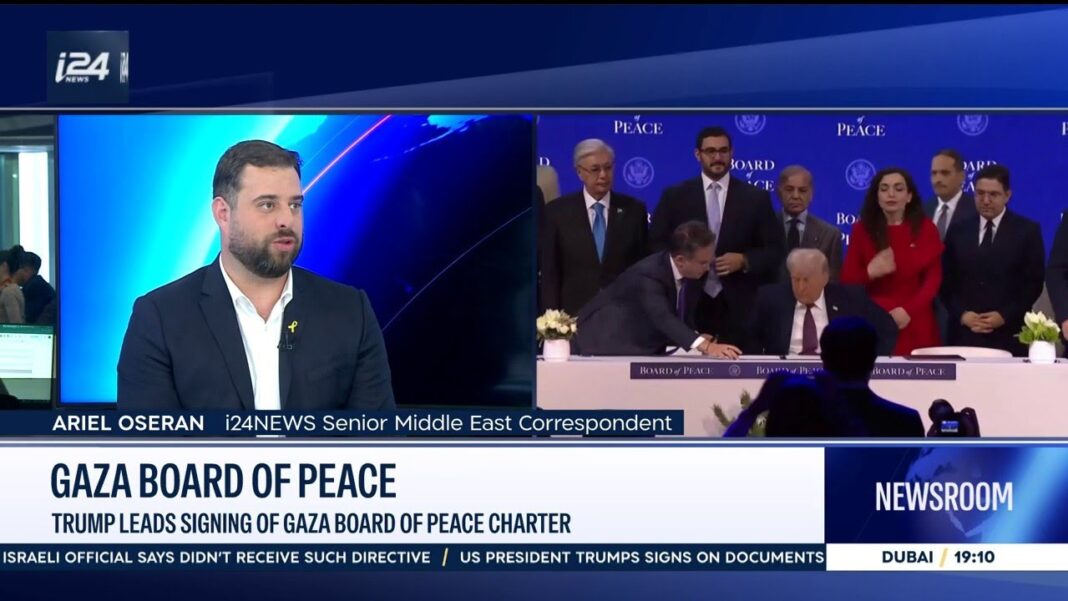
In a revelation that could fundamentally alter the geopolitical and security architecture of the Middle East, i24News disclosed Thursday evening the inner workings of a highly sensitive agreement being developed between the United States and Hamas—an agreement centered on the disarmament of the Iranian-backed terror organization and the political reconfiguration of Gaza’s future. According to the report on i24News, the framework represents not a conventional surrender document, but a carefully constructed political and security transformation model that seeks to convert Hamas from an armed militant entity into a regulated political actor under international supervision.
WHO WILL DISARM HAMAS UNDER TRUMP’S ‘BOARD OF PEACE’, AND HOW?
During his presentation of the ‘Master Plan for Gaza’ in Davos, Trump’s son-in-law, Jared Kushner, finally answered the long-awaited question: How will Hamas be disarmed, and by whom.
“We have a new government in… pic.twitter.com/BmZ8KOQx94
— Ariel Oseran أريئل أوسيران (@ariel_oseran) January 22, 2026
The emerging deal, first reported by Sky News Arabic and now detailed in the i24News report, is being quietly shaped through international mediation channels and reflects a strategic recalibration in Washington’s approach to Gaza. Rather than pursuing total annihilation of Hamas’s political identity, the agreement aims at structural demilitarization combined with controlled political reintegration—a model that prioritizes stability, containment, and long-term governance transformation over absolute ideological defeat.
One of the most striking elements revealed by i24News is the deliberate semantic design of the agreement itself. It will not be titled a “Weapons Surrender Agreement,” but rather the “Understanding Agreement on the Issue of Weapons.” This linguistic framing is intentional and strategic. It is meant to preserve political face while enforcing material transformation.
Under the reported terms, Hamas is expected to formally declare that “at Israel’s request, it no longer poses a threat.” The phrasing avoids the language of defeat or capitulation and instead frames the shift as a negotiated repositioning. As the i24News report explained, the agreement introduces a critical distinction between heavy, offensive weapons, which would be relinquished, and light, personal, and defensive weapons, whose definitions would be formulated by Hamas itself under negotiated guidelines.
This creates a tiered disarmament structure rather than absolute demilitarization—allowing Hamas to symbolically maintain a narrative of self-defense while dismantling its offensive military infrastructure.
Diplomatically, this approach reflects a recognition that ideological movements rarely survive total humiliation; transformation is more often achieved through controlled adaptation than outright eradication.
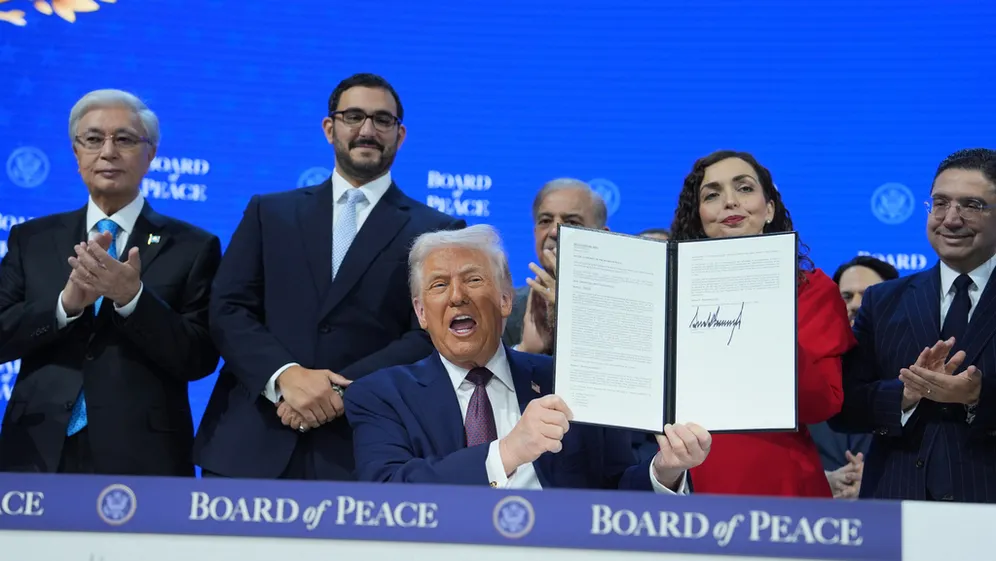
US President Donald Trump presents the agreement signed by the Peace Council, 22.01.26 Associated Press
According to the i24News report, the central political exchange at the heart of the agreement is historic in scope. In return for recognition as a political body, Hamas would agree to surrender its weapons, provide detailed maps of tunnel systems throughout the Gaza Strip, cease military operations, and transition from armed governance to political participation.
The tunnel provision is particularly significant. Hamas’s underground infrastructure has been the backbone of its military strategy, enabling concealment, logistics, command structures, and cross-border operations. As the i24News report noted, surrendering these maps would represent not just disarmament, but strategic exposure—the dismantling of Hamas’s operational core.
This element alone would fundamentally alter Gaza’s security landscape and Israel’s strategic calculus.
Perhaps the most controversial clause reported by i24News involves the future of Hamas leadership. Under the agreement, the cessation of weapons use would allow certain members of Hamas’s military and political leadership to leave Gaza, accompanied by American assurances that Israel will not target them in the future.
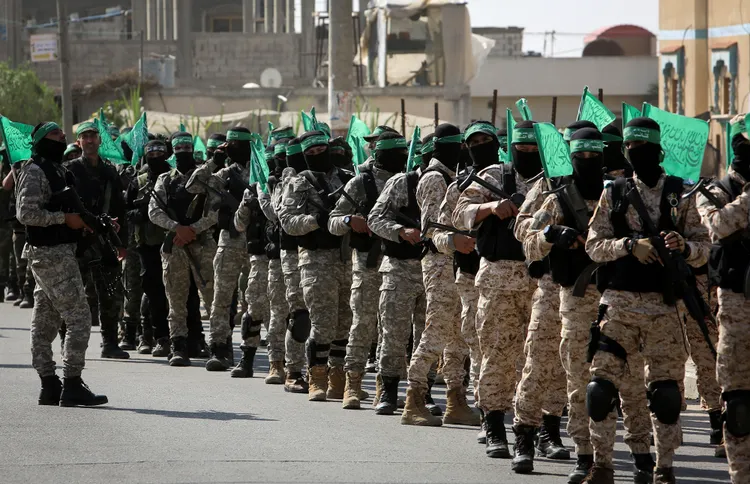
This provision introduces a model of controlled political exile, in which leadership figures are removed from the conflict theater in exchange for compliance. Historically, similar mechanisms have been used in other conflict resolutions—from Colombia to Northern Ireland—where militant leaders were permitted safe passage as part of disarmament processes.
However, as the i24News report emphasized, this clause has triggered deep concern in Israel, where political and security leaders view any form of immunity or protection for Hamas figures as morally and strategically unacceptable.
Another transformative dimension of the agreement, according to the i24News report, involves the governance structure of post-war Gaza—referred to in diplomatic sources as “New Gaza.”
The United States has reportedly agreed to the inclusion of former Hamas police officers and officials in Gaza’s future administration, provided they undergo Israeli and American security screenings. This represents a pragmatic governance approach rooted in post-conflict stabilization theory: institutional continuity without ideological dominance.
Rather than dismantling every existing administrative structure, the framework seeks to filter and reconstitute governance through vetting, integration, and oversight. The goal, as i24News reported, is stability, functionality, and controlled transition rather than institutional collapse.
Yet this model is deeply controversial. Israeli officials fear that embedding former Hamas personnel into governance structures risks long-term ideological entrenchment and future radicalization.
According to the i24News report, the U.S. administration has informed mediators that Israel holds serious reservations about the agreement—particularly regarding the possibility of Hamas remaining a political party in the Palestinian arena.
Israeli concerns focus on three core risks: Transforming Hamas into a political actor could normalize its violent past, political status may provide pathways for covert remilitarization and Hamas could portray the agreement as strategic victory rather than defeat.
From Israel’s perspective, disarmament without ideological deconstruction creates a long-term security vulnerability.
As the i24News report noted, Israeli policymakers are deeply skeptical of models that convert armed groups into political parties without comprehensive deradicalization.
From the American perspective, the agreement reflects geopolitical pragmatism rather than ideological alignment. According to the i24News report, Washington’s objectives are the stabilization of Gaza, the reduction of regional escalation, the containment of Iranian proxy influence, the long-term governance restructuring and the prevention of perpetual conflict cycles.
The U.S. strategy does not seek moral transformation of Hamas—it seeks operational neutralization and political containment. In this framework, recognition becomes a mechanism of control, not endorsement.
The agreement’s structure, as outlined by i24News, rests on a dual-track logic such as symbolic continuity for Hamas and structural dismantling of its military capacity.
This allows Hamas to preserve internal legitimacy while eliminating its capacity for organized violence. Diplomatically, it is an attempt to replace battlefield dominance with institutional constraint.
If implemented, the agreement would reshape not only Gaza but regional geopolitics by redefining Palestinian political structures, altering Israeli security doctrine, reconfiguring U.S. Middle East strategy, weakening Iranian regional influence and establishing a new model for terrorist transformation.
As the i24News report underscored, this would represent one of the most ambitious geopolitical experiments in modern Middle Eastern history.
Despite its ambition, the agreement remains fragile. Israeli opposition, Hamas internal divisions, regional power dynamics, and domestic political pressures in Washington all threaten its viability.
Moreover, disarmament risks fragmentation. Splinter groups may reject compliance, producing decentralized terrorism rather than centralized control—a scenario that could destabilize the very peace the agreement seeks to achieve.
As revealed in the i24News report, the “Understanding Agreement on the Issue of Weapons” is not simply a diplomatic document—it is a philosophical gamble on the nature of political transformation. It assumes that armed ideology can evolve into civic participation, that violence can be replaced by governance, and that legitimacy can be reconstructed without annihilation.
Whether this represents visionary diplomacy or strategic naivety remains uncertain.
What is clear is that, if enacted, this agreement would mark one of the most consequential reconfigurations of Gaza’s future since Hamas seized power—an attempt not to defeat Hamas through destruction, but to dissolve it through transformation.
As i24News reported, the future of Gaza is no longer being shaped solely by weapons and warfare, but by language, negotiations, and fragile political understandings—where every clause, every phrase, and every definition carries the weight of history, identity, and survival.
I understand that Jared and everyone involved means well and truly wants to see peace and a reimagined Gaza landscape. But, after reading this it just confirms what I have always felt…..they just do not understand the mindset of Hamas. They just don’t get it, or can’t get themselves to get it. In the end, unfortunately, what they are really doing is giving Hamas the ability to secretly re-arm, re-form, re-plan and attack Israel once again. Hamas will never give up. The only way out is to just completely destroy. Sad, but true.