



|
Getting your Trinity Audio player ready...
|
From Patron to Partner: Netanyahu’s Vision to Wean Israel Off U.S. Military Aid Signals a Strategic Turning Point
By: Fern Sidman
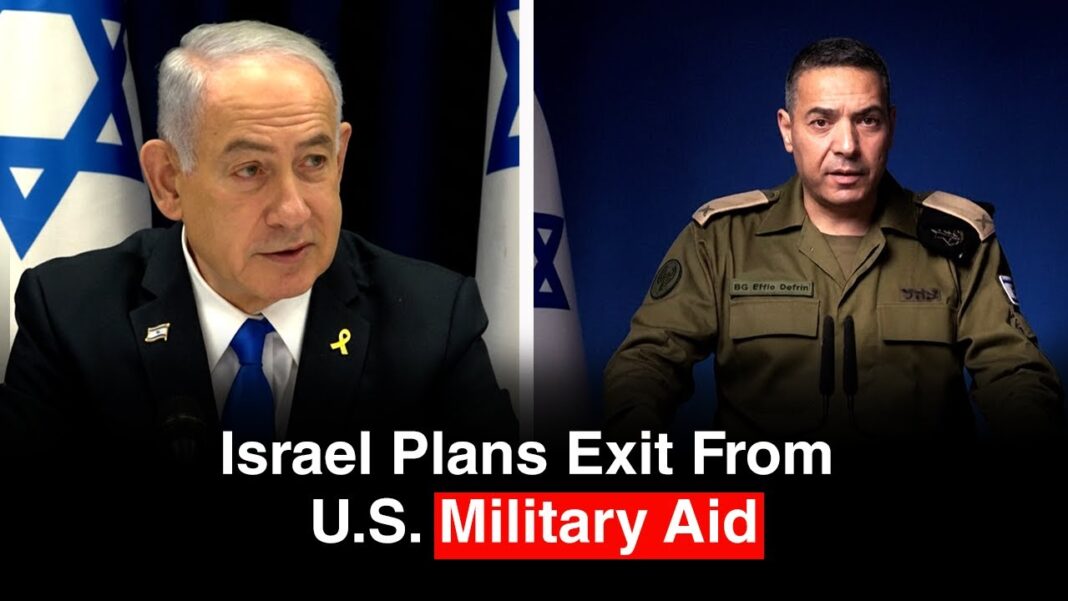
In a declaration that could recalibrate one of the most enduring pillars of Middle Eastern geopolitics, Israeli Prime Minister Benjamin Netanyahu has announced his intention to “taper off” Israel’s dependence on U.S. military assistance over the next decade. The remarks, delivered in an interview published Friday, mark one of the clearest statements yet that Israel — long the largest cumulative recipient of American foreign military aid — is preparing to chart a more self-reliant path.
As reported on Saturday by Reuters, Netanyahu has spoken of the need for Israel to mature beyond reliance on external support, even as he stopped short of committing to an immutable timetable. Yet his language in the latest interview was strikingly unambiguous. Asked whether tapering off military aid would mean a drawdown “to zero,” Netanyahu replied simply: “Yes.”
Netanyahu’s remarks to The Economist, cited in the Reuters report, framed the shift not as a repudiation of Washington’s support but as a testament to Israel’s technological and industrial evolution.
“I told President Donald Trump during a recent visit that Israel very deeply appreciates the military aid that America has given us over the years,” Netanyahu said, according to the Reuters report, “but here too we’ve come of age and we’ve developed incredible capacities.”
Those capacities, in Netanyahu’s telling, have transformed Israel from a recipient of essential largesse into a global defense innovator whose weapons systems are increasingly in demand. Indeed, as Reuters has reported, Israeli defense exports surged 13 percent last year alone, buoyed by major international contracts for its advanced multi-layered aerial defense architecture — a system that integrates Iron Dome, David’s Sling, and Arrow interceptors into one of the world’s most sophisticated air-defense networks.
The significance of Netanyahu’s vision cannot be fully grasped without understanding the architecture of U.S.–Israel military assistance. In 2016, Washington and Jerusalem signed a landmark memorandum of understanding covering the decade through September 2028. The agreement commits the United States to $38 billion in military aid: $33 billion in grants for defense procurement and $5 billion earmarked for missile-defense cooperation.
For decades, this flow of assistance has served as both a tangible guarantee of American support and a strategic hedge for Israel, enabling it to maintain a qualitative military edge in a volatile region. The Reuters report described the pact as the backbone of bilateral security ties, even as Israel has quietly expanded its own industrial base.
In December, Netanyahu sharpened his rhetoric with a bold fiscal commitment. Israel, he announced, would spend 350 billion shekels — approximately $110 billion — on developing a more independent arms industry. The goal is to reduce dependence on foreign suppliers and ensure that future Israeli operations are sustained primarily by domestic production.
The figure is staggering, rivaling the defense budgets of many NATO states. Yet for Netanyahu, it is an investment in sovereignty. Israel, he argues, must be able to fight its wars without recalibrating its arsenal to the political winds of its allies.
Netanyahu’s comments have found a surprising echo in Washington. Republican Senator Lindsey Graham, one of Israel’s most vocal champions on Capitol Hill, said on X that “we need not wait ten years” to begin scaling back military aid.
According to the information contained in the Reuters report, Graham went further, proposing that the billions saved by expediting the end of assistance to Israel should be redirected into strengthening the U.S. military itself. “I will be presenting a proposal to Israel and the Trump administration to dramatically expedite the timetable,” he wrote.
The sentiment marks a subtle shift in conservative discourse: from unquestioning financial support for Israel to a model that emphasizes Israeli self-sufficiency as a virtue rather than a liability.
Yet for all the rhetoric, the idea of Israel fully severing itself from U.S. military aid raises complex questions. Reuters analysts caution that American assistance is not merely financial; it embeds Israel within a web of joint training, intelligence sharing, and weapons-development programs that cannot be easily replicated.
Moreover, the aid package ensures that much of the funding flows back into the U.S. economy, as Israel is required to spend a large portion on American-made equipment. Ending the arrangement could ripple through U.S. defense contractors just as sharply as it would through Israel’s procurement systems.
Netanyahu’s proposal also comes at a moment when Israel’s strategic environment is undergoing rapid transformation. From the shadow war with Iran to ongoing instability in Syria and Gaza, Israel’s military planners are acutely aware that future conflicts may be more technologically intensive and less forgiving of supply-chain vulnerabilities.
Israeli defense firms are positioning themselves as global leaders in unmanned systems, cyber warfare, and missile defense — fields where the state’s experience translates directly into export potential.
For Netanyahu, the calculus is as much about leverage as it is about pride. An Israel capable of arming itself, he suggests, would negotiate with Washington not as a beneficiary but as a peer.
Not everyone in Israel is convinced. Critics argue that U.S. military aid functions as a strategic multiplier that no domestic industry can fully replace. It enables Israel to stockpile advanced munitions, access cutting-edge American technology, and deter adversaries who know that Washington’s imprimatur stands behind Jerusalem.
Reuters reported that senior defense officials privately warn against severing this lifeline too hastily, particularly in an era when multi-front conflict with Iranian proxies remains a plausible scenario.
Netanyahu’s comments were carefully calibrated to his relationship with President Trump, whose administration has repeatedly emphasized burden-sharing among allies. By signaling Israel’s intention to taper off aid, Netanyahu may be preempting pressure from a White House eager to reduce overseas commitments.
As the Reuters report observed, the message is as much about optics as policy: Israel is no longer the scrappy underdog of the 1970s but a regional powerhouse with one of the world’s most advanced defense sectors.
What emerges from Netanyahu’s remarks is not a renunciation of the U.S.–Israel alliance but a redefinition of it. The prime minister has been careful to couch his ambition in gratitude rather than grievance, repeatedly emphasizing — in comments quoted by Reuters — that Israel “very deeply” appreciates American support.
The aspiration, he suggests, is not to walk away from Washington but to meet it on more equal footing.
Whether Netanyahu’s ten-year horizon is realistic remains uncertain. The 2028 expiration of the current memorandum of understanding looms as a natural inflection point, but renegotiation rather than termination remains the likeliest outcome.
Still, the mere articulation of a path toward zero aid represents a tectonic shift in discourse. For the first time since the modern alliance was forged, an Israeli leader is publicly contemplating a future in which Jerusalem finances its own security — entirely.
As the Reuters report framed it, Netanyahu’s gambit is both a statement of confidence and a strategic wager. It assumes that Israel’s booming defense exports, its $110 billion industrial investment, and its technological prowess will converge in time to fill a vacuum that has existed for nearly half a century.
The coming decade will reveal whether that wager is visionary — or perilously optimistic.