



|
Getting your Trinity Audio player ready...
|
By: David Maybaum
Fifty-eight years after the thunder of artillery and the roar of tanks echoed across the Golan Heights during the Six-Day War, one of Syria’s largest abandoned military outposts is poised to welcome Israeli civilians and tourists for the very first time. Israeli authorities announced this week that extensive mine clearance operations have been completed at Ein Almin, a sprawling Syrian army base that once symbolized Damascus’s ambition to dominate the Golan.
As The Jewish News Syndicate (JNS) reported on Monday, the clearance marks a significant milestone in Israel’s ongoing efforts to secure and rehabilitate land scarred by decades of conflict. What had been a deadly patchwork of trenches, unexploded ordnance, and hidden mines has now been transformed into a site of education, remembrance, and recreation. The opening of Ein Almin to the public during the upcoming Sukkot holiday will represent not only a triumph of engineering and perseverance but also a poignant reminder of Israel’s precarious geography and enduring security challenges.
The Mine and UXO Clearance Authority within Israel’s Ministry of Defense spearheaded the painstaking effort to neutralize decades-old hazards across the 11-acre complex. The excavation teams uncovered and safely disposed of over 600 munitions, including grenades, mortar shells of varying calibers, RPGs, and Kalashnikov rifles. Some of the items were still live, buried beneath layers of soil and stone, and could have posed mortal danger to anyone inadvertently trespassing into the site.
Shachar Beck, head of the Clearance Authority, emphasized the dual purpose of the project: safety and development. “We invite the people of Israel to join us this coming Sukkot and see up close the work of mine clearance and, for the first time in history, enjoy an area that had been closed to the public for decades,” he said in a statement carried by JNS.
The goal, Beck explained, extends beyond historical preservation. By clearing mines and unexploded ordnance, Israel is freeing valuable land for agricultural cultivation, residential and industrial construction, and eco-tourism. “The goal is to allow the public to safely hike in various tourist sites, expand agricultural land and enable the construction of tens of thousands of industrial and residential buildings,” he told reporters.
Ein Almin was once a formidable fortress, one of Syria’s largest military complexes built before the Six-Day War. Spanning 11 acres, the outpost included 15 above-ground buildings, fortified underground bunkers, and a network of trenches designed for both defense and offensive staging.
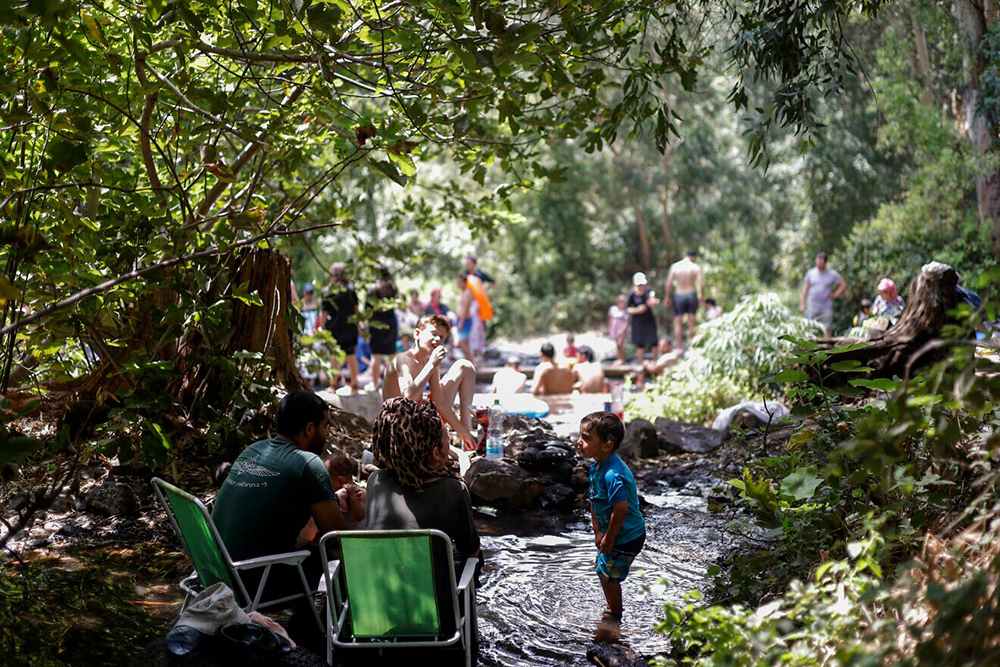
Among its most striking features is the so-called “officers’ pool,” a rectangular basin fed year-round by a natural spring. Measuring approximately 20 feet across and three feet deep, the pool was once a place where Syrian commanders and visiting dignitaries could momentarily escape the rigors of military life. Today, it stands as an eerie relic — a reminder of a time when Syrian soldiers lounged here while plotting strategies against the Israeli kibbutzim visible in the valley below.
For decades, Ein Almin remained off-limits, its grounds riddled with hidden dangers. The transformation of this once-lethal terrain into a secure public site demonstrates Israel’s technological expertise and long-term commitment to ensuring civilian access to lands reclaimed in war. As the JNS report noted, the rehabilitation of Ein Almin fits into a broader national effort to integrate the Golan Heights more fully into Israel’s cultural and historical narrative.
Sukkot: A Festival of Freedom
The timing of the site’s opening is no coincidence. Sukkot, the week-long festival commemorating the Israelites’ wanderings in the desert, begins on Oct. 6 and ends Oct. 13 this year. For Israelis, visiting Ein Almin during the holiday carries profound symbolism: a chance to reclaim a place once intended for their destruction and to walk freely where mines once lurked.
The pilgrimage-like quality of Sukkot, when Jewish families across Israel camp out in temporary booths to recall the fragility and resilience of the Israelites in the wilderness, resonates powerfully with the clearance of this outpost. As the JNS report observed, the festival encompasses the themes of survival, divine protection, and the sanctity of land — themes that are inseparable from Israel’s relationship with the Golan Heights.
The Golan Heights remain one of Israel’s most strategically significant territories. Seized from Syria in June 1967 during the Six-Day War, the plateau provided Israel with a buffer against artillery fire that had for years rained down on communities in the Galilee. In 1981, Israel formally annexed the territory, a move unrecognized by most of the international community but affirmed by the Trump administration in 2019.
As JNS reported, the Golan is not merely a military asset but also a thriving hub of agriculture, viticulture, and tourism. The opening of Ein Almin thus represents an expansion of Israel’s presence and a reinforcement of its sovereignty. By transforming a former symbol of Syrian aggression into a site for Israeli hikers and schoolchildren, Jerusalem underscores its permanent control over the region.
Even as Israel celebrates the clearance of Ein Almin, events across the border in Syria remind Israelis of the ongoing volatility. On Monday, an Israel Defense Forces (IDF) reserve officer was severely wounded in an explosion at a military outpost in southern Syria. The officer was evacuated to hospital care, and his family was notified, though details of the incident remain scarce.
The blast highlights the dangers of Israel’s continued involvement in Syria. Following the fall of the Assad regime in December 2024, Israel seized control of large swaths of southern Syria, establishing a security zone and maintaining a military presence amid sporadic clashes and airstrikes. These operations underscore the fragile balance Israel must maintain between consolidating gains and managing perpetual threats.
Prime Minister Benjamin Netanyahu, responding to speculation that Israel might relinquish its security buffer in Syria as part of a broader regional deal, dismissed such reports as fanciful. “The idea is a joke,” Netanyahu said in a recording posted to X on Sept. 22. He clarified that discussions with Damascus focus instead on demilitarizing southwest Syria and ensuring protection for Israel’s Druze allies in Jabal al-Druze.
“We’re discussing with Syria something that wasn’t even imaginable before our great victory over Hezbollah,” Netanyahu remarked. According to the JNS report, the Prime Minister emphasized that safeguarding Israel’s Druze partners remains central to any security arrangement.
The juxtaposition of Ein Almin’s opening and ongoing military operations in Syria encapsulates Israel’s dual reality: celebrating the reclamation and rehabilitation of historical sites while remaining alert to modern threats.
For historians, the clearance of Ein Almin also offers new opportunities for research and public education. The outpost, preserved in remarkable condition, provides a tangible glimpse into the pre-1967 military strategies of the Syrian army. Its bunkers and trenches tell a story of confrontation, while the newly neutralized ordnance testifies to the dangers Israelis have faced for generations.
For policymakers, the clearance is a reminder of the costs of security. Each mine removed and each shell neutralized represents not only an engineering triumph but also an investment in Israel’s future. As the JNS report noted, transforming minefields into farmland and tourist sites underscores the resilience of Israeli society and the determination to transform spaces of hostility into places of life.
The Golan Heights have long held a mythic place in Israeli consciousness. The stunning landscapes, dramatic escarpments, and fertile fields evoke both natural beauty and the sacrifices of war. The battle for the Golan during the Six-Day War and its defense during the Yom Kippur War remain etched in Israeli memory as defining tests of national survival.
By opening Ein Almin, Israel integrates another layer into the Golan’s narrative. Visitors will be able to walk the trenches where Syrian soldiers once plotted Israel’s destruction, to explore underground bunkers where weapons were stockpiled, and to witness the transformation of danger into safety. This act of public access affirms Israel’s determination to shape the memory of the Golan not as a no-man’s land of fear but as a living testament to Jewish resilience.
The rehabilitation of Ein Almin also points toward the future. Beyond tourism, cleared lands across the Golan are earmarked for agriculture, industry, and housing projects. These initiatives aim to strengthen Israel’s hold on the territory by increasing its population and economic vitality.
At the same time, regional diplomacy looms large. The JNS report said that Israel’s ongoing talks with Syria center on demilitarization rather than territorial concessions. Yet the Golan remains a focal point of Syrian national identity, and Damascus has never formally abandoned its claim. The juxtaposition of Israel’s civilian development and Syria’s diplomatic stance ensures that the Golan will continue to be a site of contention as well as opportunity.
The clearance and reopening of Ein Almin stand as a powerful symbol of Israel’s past struggles and future aspirations. What was once a Syrian bastion of hostility has been transformed into an Israeli site of memory and renewal. For families visiting during Sukkot, the experience will be more than recreational; it will be a chance to walk freely on land once laced with mines and to witness the tangible fruits of resilience.
As the JNS report has emphasized, the story of Ein Almin is part of a broader narrative: Israel’s relentless effort to turn battlefields into farmlands, bunkers into classrooms, and minefields into hiking trails. It is a story of a nation determined not merely to survive but to thrive, even amid the shadows of ongoing conflict.
With the scars of war still fresh in Syria and the future of the region uncertain, Ein Almin serves as a reminder that Israel’s greatest victories lie not only in military triumphs but in the transformation of danger into life, fear into freedom, and ruins into renewal.
