



|
Getting your Trinity Audio player ready...
|
By: Carl Schwartzbaum
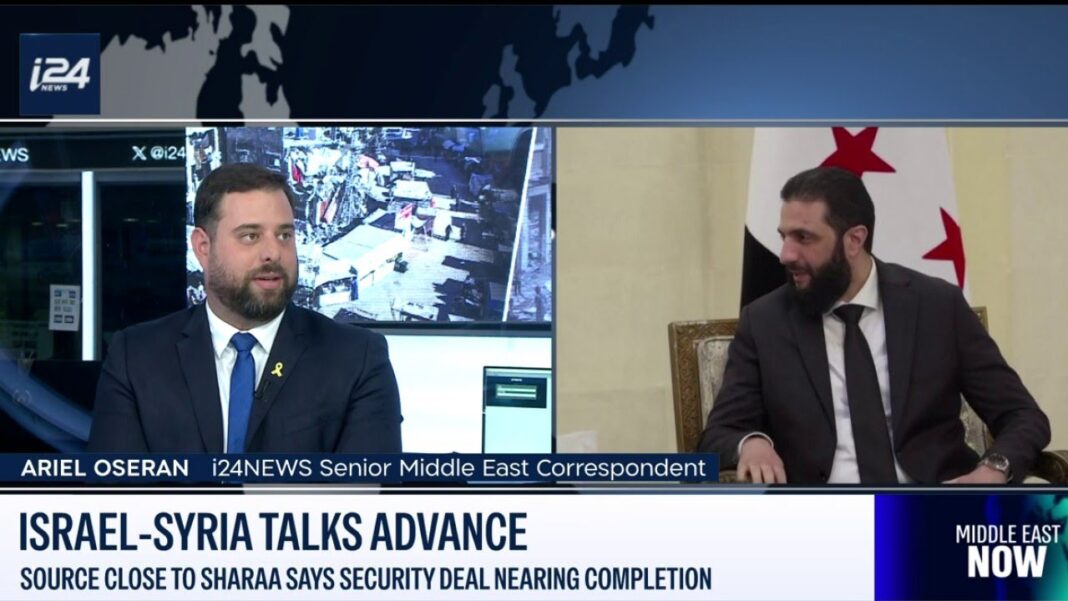
In a development that would have seemed implausible only a short time ago, talks between Israel and Syria on a potential security agreement have advanced markedly in recent weeks, raising the prospect of a formal accord between two longtime adversaries. According to a Syrian source close to President Ahmed al-Sharaa, the negotiations have reached a stage where a signing could occur in the near future—possibly even at a direct, high-level meeting between Syrian and Israeli leaders. As reported on Thursday by VIN News, the talks signal a rare and potentially transformative moment in the region’s volatile diplomatic landscape.
For decades, Israel and Syria have existed in a state of entrenched hostility, punctuated by wars, proxy conflicts, and frozen lines of disengagement. Now, amid shifting regional realities and sustained American mediation, that static hostility may be giving way to cautious engagement. VIN News reported that the breakthrough has been driven in large part by sustained pressure and involvement from President Donald Trump, who has urged both sides to move beyond rhetorical postures and toward a pragmatic security framework.
According to the information provided in the VIN News report, negotiations between Jerusalem and Damascus have been ongoing throughout 2025, largely under American auspices. While the talks were initially exploratory, recent weeks have seen what Syrian officials describe as “significant progress,” particularly on technical security arrangements and confidence-building mechanisms.
The Syrian source cited by VIN News said the emerging agreement would primarily focus on security coordination, with the potential inclusion of a diplomatic annex that could open the door to broader normalization down the line. The accord, if finalized, could be signed at a high-level Israeli–Syrian meeting in a European country—chosen, sources suggest, to provide political neutrality and discretion.
Notably, the source did not rule out the possibility of a direct signing ceremony involving President al-Sharaa and Israeli Prime Minister Benjamin Netanyahu, a scenario that would mark an extraordinary diplomatic milestone. Such a meeting would be unprecedented in modern Israeli–Syrian relations and would signal a fundamental recalibration of regional alignments.
The shape of the proposed agreement has drawn comparisons to the 1974 Disengagement Agreement that followed the Yom Kippur War, which established a ceasefire line and UN-monitored buffer zones between Israeli and Syrian forces. Syrian Foreign Minister Asaad al-Shaibani confirmed last month that Damascus envisioned a new security framework modeled on that accord, albeit with “minor modifications” and, crucially, without buffer zones.
al-Shaibani stressed that Syria hoped to reach such an agreement by the end of the year—but “not at any cost.” That caveat underscores the fragility of the talks and the deep mistrust that continues to define relations between the two sides.
From Israel’s perspective, the comparison to 1974 is both reassuring and insufficient. Israeli officials, speaking to VIN News, have indicated that while a limited security pact might reduce friction in the short term, Jerusalem is reluctant to make substantive concessions without a comprehensive peace agreement that addresses broader strategic concerns.
At the heart of the negotiations lies a familiar and combustible issue: territory. Since the collapse of Bashar al-Assad’s regime, the Israel Defense Forces have seized and continue to occupy nine strategic points inside Syrian territory, citing security imperatives amid the power vacuum and the presence of hostile militias.
Syria has demanded a full Israeli withdrawal from those positions as part of any agreement. Israel, however, has publicly rejected that demand. According to Israeli sources cited in the VIN News report, Jerusalem is willing to consider withdrawing from some of the occupied points—but only in exchange for a comprehensive peace agreement, not a narrow security arrangement.
This divergence reflects fundamentally different strategic calculations. For Damascus, the restoration of territorial sovereignty is both a political necessity and a symbol of post-Assad renewal. For Israel, relinquishing strategic positions without ironclad guarantees risks creating new vulnerabilities along its northeastern frontier.
One of the most striking elements of the current talks is the central role played by President Trump. According to Syrian officials, Trump has invested significant political capital in advancing the negotiations, viewing them as part of a broader effort to reshape Middle Eastern security dynamics.
Trump has urged both Israel and Syria to pursue dialogue despite lingering disagreements, framing the talks as an opportunity to stabilize a historically volatile theater. American mediators have worked intensively to narrow gaps on issues such as demilitarization, verification mechanisms, and the future of Israeli positions in southern Syria.
Yet despite Washington’s involvement, substantial differences remain. Demilitarization, in particular, has emerged as a contentious issue. Israel is pushing for stringent limitations on Syrian military deployments near the border, while Syria insists on preserving its sovereign right to deploy forces within its territory.
The renewed Israeli–Syrian dialogue cannot be understood in isolation. As the VIN News report noted, the Middle East is undergoing a period of profound realignment. Traditional fault lines are shifting, new alliances are forming, and long-frozen conflicts are being reassessed in light of changing threats and opportunities.
For Syria, emerging from years of internal turmoil and international isolation, engagement with Israel—however tentative—offers a pathway to regional rehabilitation. For Israel, a security arrangement with Damascus could help neutralize threats emanating from southern Syria and reduce the influence of hostile non-state actors.
At the same time, both governments face domestic constraints. In Israel, any agreement involving territorial concessions would provoke intense political scrutiny. In Syria, al-Sharaa must navigate nationalist sentiment and skepticism toward Israel while projecting strength and independence.
While the current talks are framed as a security agreement, the possibility of broader normalization looms in the background. The potential inclusion of a diplomatic annex suggests that both sides are at least contemplating steps beyond narrow military coordination.
However, Israeli officials caution that normalization cannot be decoupled from peace. As one source told VIN News, “Security arrangements can reduce friction, but they do not resolve the fundamental issues. Only a comprehensive agreement can do that.”
For Syria, normalization with Israel would represent a dramatic departure from decades of official hostility—but it could also unlock economic and diplomatic benefits, particularly if accompanied by greater Western engagement.
Despite the progress described in the VIN News report, seasoned observers remain cautious. Middle Eastern diplomacy is littered with initiatives that collapsed under the weight of mistrust, miscalculation, or political upheaval. The current talks are no exception.
The prospect of a near-term signing, whether in Europe or at a direct leaders’ meeting, underscores the urgency of the moment. Yet it also heightens the risk that unresolved disputes could derail the process at the eleventh hour.
Still, the mere fact that Israeli and Syrian officials are contemplating such a step marks a departure from the past. The talks reflect not idealism but pragmatism—an acknowledgment that perpetual hostility serves neither side’s long-term interests.
If an agreement is reached, it would not end the Israeli–Syrian conflict overnight. Deep scars, competing narratives, and unresolved territorial claims would remain. But it could establish mechanisms for managing disputes, reducing the risk of escalation, and fostering a measure of predictability in a historically volatile arena.
The coming weeks may prove decisive. Whether the talks culminate in a signed accord or falter amid unresolved disagreements, they have already altered the diplomatic conversation between Jerusalem and Damascus.
In a region where silence has long substituted for peace, even hesitant dialogue carries transformative potential. The question now is whether that potential will be realized—or whether this moment, too, will fade into the long ledger of missed opportunities in Middle Eastern diplomacy.