



|
Getting your Trinity Audio player ready...
|
By: Fern Sidman
In a sweeping, triumphant interview that underscored his renewed diplomatic centrality, President Trump told Fox News host Sean Hannity on Wednesday night that the long-awaited release of Israeli hostages from Gaza would likely occur on Monday—marking what he described as “the dawn of a new Middle East.”
According to a report on Wednesday at Israel National News (INN), Trump declared that “so much is happening to get the hostages freed,” emphasizing that the agreement brokered between Israel and Hamas would not only return the living captives but also ensure the repatriation of the deceased. “We think they’ll all be coming back on Monday,” he said, calling the development “amazing for Israel, for Muslims, for the Arab countries, and for the United States of America.”
The interview followed the announcement of a ceasefire agreement between Israel and Hamas—one that Israel National News described as “the first genuine step toward a comprehensive post-war framework” for Gaza. The deal, painstakingly negotiated over recent weeks through intermediaries in Qatar, Egypt, and Turkey, represents the first phase of Trump’s broader peace plan, which seeks to secure the release of hostages, facilitate Israeli military withdrawal from portions of Gaza, and lay the groundwork for lasting regional stability.
As Israel National News reported, Israeli and Hamas officials are preparing to implement the initial phase of what has come to be known as “The Trump Framework.” The agreement envisions a coordinated series of steps: the release of Israeli hostages, the staged withdrawal of IDF forces from key sectors of Gaza, and the reciprocal release of Palestinian prisoners held in Israeli detention.
The Security Cabinet and the Israeli government are slated to convene Thursday afternoon to ratify the deal’s first stage. According to the plan’s timeline, the Cabinet will meet at 3:00 p.m., followed by a broader government session an hour later. Once approved, the IDF will begin a 24-hour redeployment to a designated “line of withdrawal” that Trump described last weekend as the “yellow line”—a buffer boundary designed to separate Israeli-controlled and Hamas-administered zones.
Israeli sources told Israel National News that the new line is largely consistent with the one Trump outlined, albeit with “operational adjustments” negotiated between Washington and Jerusalem. As part of this maneuver, the IDF will withdraw from Gaza City, which it re-entered weeks earlier during Operation Gideon’s Chariots II, a campaign that INN reported “dealt the most significant blow to Hamas command structures since the start of the war.”
Even after the withdrawal, Israel will retain control over 53 percent of the Gaza Strip—principally the coastal corridors, border regions, and high-ground perimeters. This partial control, INN noted, is intended to ensure that Hamas cannot reconstitute its tunnel infrastructure or rearm through the Egyptian border.
Under the terms of the Trump-brokered accord, the hostage release will take place within 72 hours of the Israeli withdrawal’s completion. The entire process is to occur discreetly, “without public ceremonies,” according to the report on Israel National News, in order to minimize the risk of renewed hostilities or propaganda manipulation.
Israeli intelligence assessments cited in the INN report suggest that living hostages will be released on Sunday, while the remains of deceased captives are expected to be transferred on Monday—the day Trump predicted their return.
The deal reportedly includes no concessions on the release of Nukhba terrorists involved in the October 7, 2023 Hamas massacre, nor the four high-ranking Hamas figures whose release the group had demanded. “This line was non-negotiable for Jerusalem,” an Israeli official told INN, stressing that “justice and deterrence cannot be traded for convenience.”
Throughout his Fox News appearance, Trump marveled at what he described as a rare moment of global unity. “So many countries that you wouldn’t have even thought of… came together around this deal,” he said. “The world has come together. So many nations have sent their best wishes and their commitment to do whatever is necessary.”
That sentiment is borne out by the deal’s architecture. According to the information provided in the Israel National News report, the agreement required synchronized diplomacy among traditional U.S. partners—Egypt, Qatar, and Turkey—as well as indirect endorsements from Jordan, Saudi Arabia, and the United Arab Emirates, all of which maintain complex ties with Israel.
Egyptian sources told Al-Araby, as cited in the INN report, that the Rafah Crossing will reopen in both directions as part of the deal, with 600 trucks of humanitarian aid entering Gaza daily. The arrangement, though humanitarian in appearance, carries deep political significance: it signals Egypt’s renewed willingness to facilitate a post-war Gaza transition under international supervision, a move long advocated by Israel National News analysts as key to preventing a Hamas resurgence.
Trump’s statement to Hannity further emphasized the geostrategic scope of the initiative: “This is more than Gaza. This is peace in the Middle East,” he said, describing the accord as “the first genuine multilateral peace mechanism in decades.”
Prime Minister Benjamin Netanyahu is expected to formally endorse the Trump-brokered arrangement during Thursday’s government meeting. In remarks previewed by Israel National News, Netanyahu praised “the heroic IDF soldiers whose sacrifices made this day possible” and thanked Trump for his “unwavering commitment to the sacred mission of bringing our hostages home.”
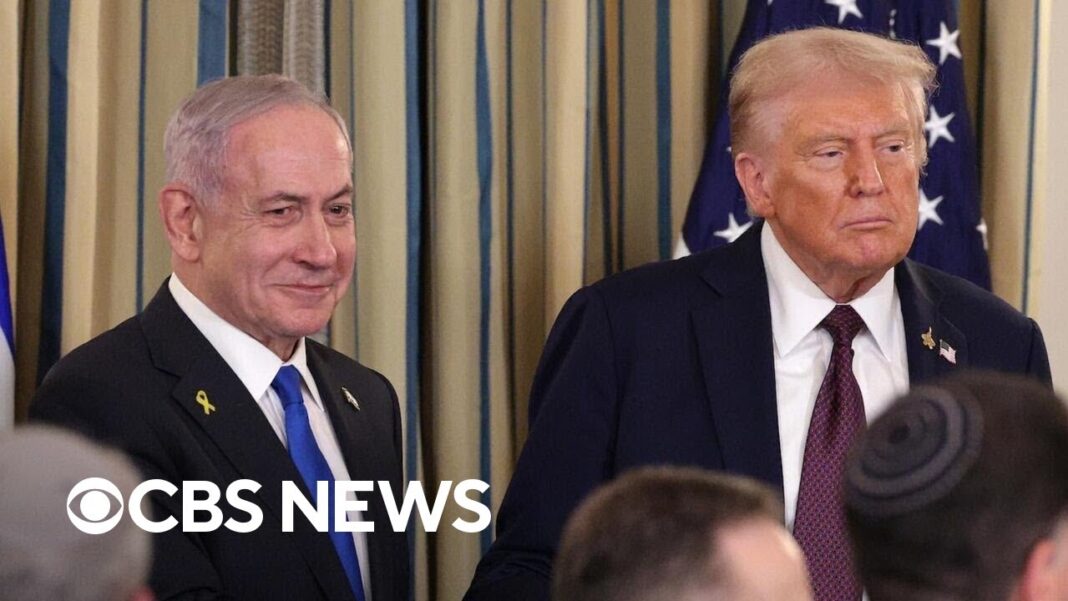
Netanyahu also reportedly held an emotional call with Trump shortly after the agreement’s announcement. According to the information contained in the INN report, the two leaders congratulated one another on the “historic achievement” and discussed Trump’s upcoming visit to Israel, during which he is expected to address the Knesset on Sunday. The appearance would mark the first time a former U.S. president has spoken before the Israeli parliament since Richard Nixon in 1974—a symbolic gesture of solidarity and continuity between Washington and Jerusalem.
“The President’s leadership has been instrumental,” Netanyahu said, according to INN’s account. “With God’s help, we will bring them all home.”
For its part, Hamas acknowledged the progress of the negotiations but insisted that certain “final details” remained unresolved. In a statement carried by Israel National News, Hamas said: “We are awaiting final agreement on the list of prisoners. We are committed to the prisoners and their families; they remain at the heart of our priorities, and we will not rest until the last prisoner is released.”
Analysts quoted in the INN report suggest the tone reflects Hamas’s internal balancing act—seeking to appear resolute to its domestic constituency while recognizing the geopolitical pressure it now faces. Following Operation Gideon’s Chariots II, Hamas’s command structure suffered severe disruption, leaving it increasingly dependent on mediators for survival.
An Israeli intelligence official told INN that Hamas’s bargaining position has “narrowed dramatically.” He noted that the group’s demand for the release of senior operatives had been “categorically rejected,” leaving Hamas with little leverage beyond the timing and logistics of the hostage transfer.
Beyond the tactical details, the ceasefire agreement represents a sweeping vindication of what Israel National News has called “the Trump Doctrine”—a strategy that prizes regional pragmatism, direct negotiation, and transactional diplomacy over abstract moral frameworks.
During the interview, Trump emphasized that the United States was “deeply proud to help make this happen,” arguing that the world had “talked about peace in the Middle East for decades without getting results.” Now, he said, “this is more than talk—it’s reality.”
The report on Israel National News noted that the framework’s structure mirrors elements of Trump’s earlier diplomatic breakthroughs, including the Abraham Accords, which normalized relations between Israel and multiple Arab states in 2020. The current initiative expands that vision from normalization to stabilization, positioning the United States not as a distant referee but as an active architect of post-conflict order.
Despite the jubilant tone, the Israel National News report cautioned that the agreement’s implementation will test both sides’ ability to maintain discipline amid mutual suspicion. The 72-hour window between IDF withdrawal and hostage release is particularly fraught. “Trust is not something easily rebuilt after October 7,” one senior Israeli official told INN, noting that “Hamas has violated every ceasefire in its history.”
The humanitarian corridor through Rafah likewise poses logistical and security dilemmas. While the daily entry of 600 trucks will address immediate civilian needs, the INN report warned that Hamas has a history of diverting aid for military purposes. Ensuring transparency and inspection at crossing points will require unprecedented coordination between Israeli, Egyptian, and international monitors.
Still, optimism dominates official circles in Jerusalem. “This is the first time Hamas has accepted a multistage framework conditioned on verifiable compliance,” an Israeli diplomatic source told INN. “That is not peace—but it is progress.”
As President Trump prepares to land in Israel this weekend, expectations are high that his visit will serve as both celebration and reaffirmation. His address to the Knesset is expected to highlight the broader geopolitical implications of the ceasefire: not merely an end to fighting, but the potential reordering of alliances across the Middle East.
“Peace requires courage, but it also requires clarity,” Trump said in closing his Fox News interview. “This deal gives the region both.”
The report at Israel National News summarized the sentiment succinctly: “What began as a mission to free hostages has evolved into a blueprint for regional renewal.”
If the coming days unfold as planned—if the hostages return, the guns fall silent, and the boundaries hold—then Trump’s claim that “this is more than Gaza; this is peace in the Middle East” may yet transcend rhetoric.
For Israelis, whose faith has been tested by two years of relentless conflict, that prospect carries profound resonance. As one Jerusalem official told Israel National News, “When the last hostage comes home, the nation will exhale—for the first time since October 7.”

Can’t have peace when Israel tries to make peace with God’s enemies. It does not work that way. All Orthodox Rabbis should know that but I guess even Orthodox Rabbis ignore the simple truth when convenient.