



|
Getting your Trinity Audio player ready...
|
By: Fern Sidman – Jewish Voice News
German Chancellor Friedrich Merz arrived in Israel on Saturday night for his first official visit since taking office in May—a trip that the Jewish News Syndicate (JNS) described in a report on Saturday as both symbolically freighted and geopolitically consequential. His presence comes at a moment when Jerusalem navigates a fragile ceasefire, an ongoing hostage crisis, and the complex diplomatic calculus of a region redefined by the events of October 7.
Merz—long positioned as one of Europe’s most unabashedly pro-Israel conservative figures—began his trip at the official residence of Israeli President Isaac Herzog, who lauded the chancellor as a “true friend” of the Jewish state, echoing language repeatedly highlighted in the JNS report. The tone was one of mutual recognition: a shared history scarred by genocide, a present shaped by terror from Gaza, and a future in which Berlin and Jerusalem imagine themselves as strategic partners facing down new and old threats.
Following their meeting, Herzog emphasized that discussions centered on the implementation of President Trump’s peace plan—an issue that has gained renewed international relevance given the United Nations Security Council’s prior endorsement of its broad framework. The plan has resurfaced in diplomatic conversations due to the erosion of other negotiating tracks and the profound discrediting of Hamas as a governing authority.
JNS reported that Herzog reiterated during his joint remarks that Hamas “must be removed from Gaza and disarmed,” a non-negotiable precondition for any sustainable post-war architecture. The Israeli president also underscored the immediate humanitarian and moral imperative: the release of Ran Gvili, the last known Israeli hostage still held somewhere within Hamas’s tunnels.
“It is impossible to discuss the next stage of Gaza without bringing home our hostage,” Herzog said, according to statements cited in the JNS report. “Israel cannot, and will not, abandon him.”
The chancellor, writing shortly afterward in Hebrew on X, echoed this moral seriousness. “I come here with deep faith and as a friend of Israel,” he posted. “We will always stand by your side.” His invocation of “faith” carried added resonance in the Israeli media landscape, repeatedly flagged in the JNS report as signaling a worldview in which the German–Israeli relationship is not merely strategic, but civilizational.
Merz’s arrival at Ben-Gurion Airport was met by Israeli Foreign Minister Gideon Sa’ar, who characterized the German leader as both a “friend” and “an important partner,” in comments amplified in the JNS report. Sa’ar emphasized that relations between the countries are “on an upward trend,” pointing to several concrete developments including Germany’s withdrawal of its partial arms embargo, explicit German opposition to anti-Israel boycotts, including BDS, and A key abstention at the UN on extending UNRWA’s mandate, a move applauded across many Israeli political factions.
Sa’ar also highlighted a landmark event noted prominently in the JNS report: the deployment of an Israeli Arrow 3 missile-defense battery in Germany—marking the first operational installation of the advanced system on European soil. This, according to the Israeli Defense Ministry, is the most significant defense export in Israel’s history. Merz’s visit therefore unfolded not only in the shadow of October 7 but in the light of a deepening military-technological alliance.
Yet the relationship is not without tension. Merz sparked controversy in August when he announced a ban on exporting “offensive” weapons to Israel. The announcement coincided—almost to the hour—with the Israeli Cabinet’s decision to expand IDF operations in Gaza. The timing, interpreted by many Israeli officials as needlessly provocative, triggered a lively debate in both Jerusalem and Berlin over whether Germany was shifting toward a more conditional form of support.
Still, the overall trajectory remains unmistakably positive. German financial and political support for Israel has increased since Hamas’s October 7 massacre, as JNS has underscored in multiple analyses, distinguishing Berlin from other European capitals whose support has wavered amid domestic protest pressures.
In remarks posted to X on Saturday night, the chancellor referenced the tenuous ceasefire underway. “The ceasefire in Gaza is stabilizing,” he wrote. “Now we must successfully move into the second phase.” According to the JNS report, Merz understands “the second phase” as the dismantling of Hamas’s political and military infrastructures and the establishment of humanitarian mechanisms for Gaza’s civilians.
This dual track—military elimination of Hamas and humanitarian stabilization—mirrors Israel’s own articulated aims and reflects Berlin’s increasingly pragmatic stance. Unlike certain European voices insisting on a premature “political horizon,” Merz has positioned Hamas’s disarmament as non-negotiable groundwork rather than an optional ideal.
Hours before his flight to Israel, Merz held a call with Palestinian Authority head Mahmoud Abbas, urging what the JNS report described as “urgently necessary reforms” inside the Palestinian Authority. German spokesman Stefan Kornelius told reporters that Berlin sees a potential role for the P.A. in post-war Gaza—but only if it meets specific benchmarks of transparency, anti-corruption mechanisms, and security cooperation.
The chancellor’s endorsement of the Trump administration’s Middle East policy—explicitly noted in an AFP report and referenced by JNS—drew considerable attention. It underscores a broader recalibration within the European center-right, which now views the so-called “Deal of the Century” as a more realistic framework than the Oslo-based model that collapsed into irrelevance long before October 7.
Merz also reaffirmed, however, that Germany formally supports a two-state solution. Yet as the JNS report pointed out, European politicians increasingly speak of the two-state idea as aspirational rather than immediately actionable—a linguistic shift reflecting the political disintegration of Palestinian institutions and the vast trauma inflicted by Hamas’s massacre.
While Merz’s political star has risen sharply since May, his rhetoric about Israel predates his premiership. On November 16, Merz spoke by phone with Netanyahu to reaffirm Germany’s place in what he described as a “renewed Western alliance.” The following day, speaking to the youth wing of the Christian Democratic Union in Stuttgart, he declared: “At Israel’s side, dear friends. I have not forgotten that.”
His invocation of memory, particularly in relation to the Holocaust, carries a weight unique to German political discourse. In his weekend remarks, Merz wrote: “The very fact that our countries established diplomatic relations within such a short time after the Holocaust remains a miracle.” The remark, widely circulated in both Israeli and German media, encapsulates the essential paradox of the modern German–Israeli relationship: borne out of catastrophe, sustained by obligation, and increasingly shaped by common threats.
Yet, as JNS reported, Germany’s policies have not always aligned neatly with its rhetoric. At times, Berlin has funded NGOs hostile to Israel, supported resolutions undermining Israeli legitimacy, and upheld distinctions between “offensive” and “defensive” arms that many Israeli leaders consider artificial in a war against a genocidal terrorist organization.
Still, Merz represents a shift—a more assertively pro-Israel posture within a Europe fractured by populist parties, surging antisemitic protests, and rising far-left hostility to the Jewish state. His visit, therefore, was not diplomatic pageantry. It was strategic messaging to multiple audiences: to Germany’s allies, its adversaries, and its own population.
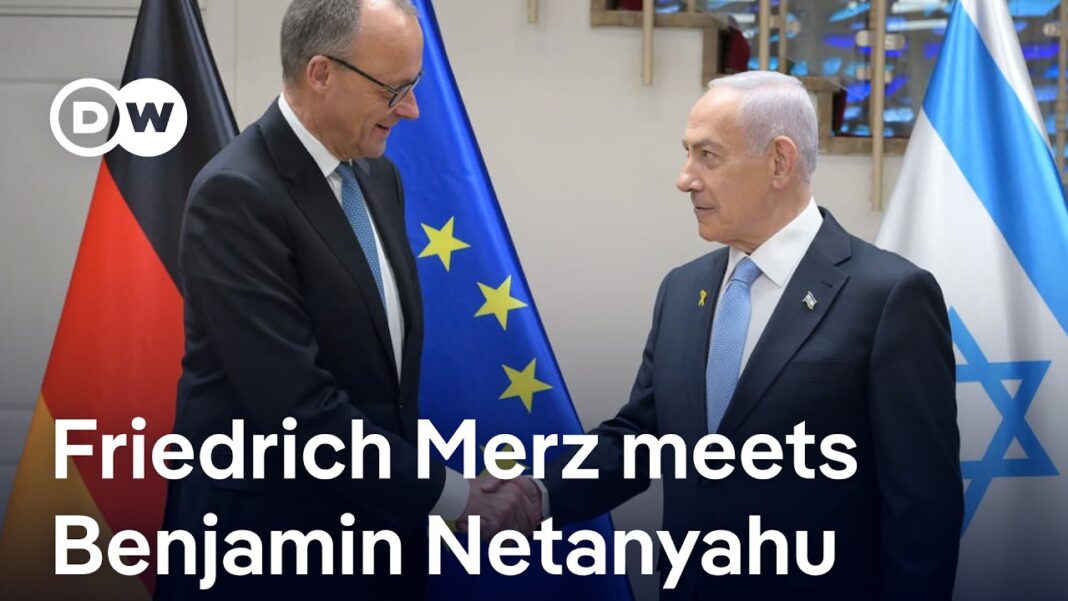
The final moments of Merz’s visit were defined less by speeches than by symbolism. The chancellor’s appearance alongside Herzog and later Netanyahu conveyed continuity and reassurance: Germany remains committed to Israel’s security—not out of penance, but out of principle.
Meanwhile, the inauguration of the Arrow 3 system on German soil is no mere military milestone. It is a geopolitical statement: Germany entrusts part of its national defense to Israeli technology, reversing the historical arc in which Jews once depended on European protection that catastrophically failed. Today, Europe increasingly depends on Israeli ingenuity.
The relationship, then, is no longer primarily about the past. It is about the architecture of a shared future.
Chancellor Friedrich Merz’s visit to Israel—his first since assuming office—arrived at a moment of profound geopolitical complexity. Yet, as reported by JNS, the trip also reaffirmed the enduring strategic, moral, and historical bond between the two nations.
It demonstrated Germany’s willingness to anchor itself firmly within the Western alliance as well as acknowledging Israel’s recognition of Germany as a critical partner in an era of proliferating threats. It also illustrated a shared commitment to dismantling Hamas, stabilizing Gaza, and envisioning a post-war order and a renewed appreciation that the German–Israeli partnership is not merely diplomatic, but civilizational.
As Gaza’s future hangs in the balance and global antisemitism surges, the Merz-Netanyahu-Herzog meetings were not merely routine statecraft—they were a declaration that the Jewish state and Europe’s largest democracy will confront the next chapter together.