



|
Getting your Trinity Audio player ready...
|
By: Fern Sidman
The return of Staff Sergeant Major Ran Gvili’s remains to Israeli soil, 843 days after the Hamas-led invasion of October 7, has reopened wounds that never healed—and, for many, extinguished illusions that had survived even the darkest chapters of Israel’s history. His recovery has not merely marked the end of a family’s long agony or the closing of one tragic chapter in a national trauma. It has ignited a profound political and moral reckoning that now reverberates far beyond the borders of Israel itself.
Following the announcement on Monday, Americans for a Safe Israel (AFSI), one of the United States’ longest-standing pro-Israel advocacy organizations, issued a declaration that cuts directly against decades of diplomatic orthodoxy. The organization asserted that the lessons of October 7, and of the 843-day ordeal endured by the Gvili family, leave no room for ambiguity: the creation of a Palestinian Arab state alongside Israel must be rejected outright, in all forms and in all territories.
For AFSI, the recovery of Ran Gvili is not only a moment of mourning—it is a moment of reckoning. A symbol of a broader truth they believe has now been irreversibly clarified: that the concept of Palestinian statehood, long promoted as a pathway to peace, has instead become a perceived existential threat to Israel’s survival.
The emotional weight of Gvili’s return was captured in a message from Israeli President Isaac Herzog, who wrote on X, “Ran Gvili, the hero, returns to his homeland’s landscape after 843 days! The Yamam fighter who went out to save lives—finally returns to his country, his family, and his land. An entire nation is moved to tears.” His words carried the language not only of grief, but of collective identity: a fallen defender returning to the soil he died protecting, a son of the nation restored to its embrace.
The symbolism was impossible to ignore. Gvili’s return did not occur in a political vacuum. It arrived in a historical moment when Israeli society is undergoing a deep internal transformation—psychological, strategic, and ideological. Long-standing assumptions about security, coexistence, and diplomatic compromise have been shaken by the unprecedented brutality of October 7 and the prolonged trauma that followed.
Only a year earlier, speaking at the World Economic Forum in Davos, President Herzog himself had articulated a shift that now appears prophetic. “The idea of the two-state solution is something which, on record, I supported in the past, many times,” he said. “But I had a wake-up call following October 7.” That statement, delivered in one of the world’s most elite diplomatic forums, signaled more than a personal reassessment—it reflected a broader transformation in Israeli political consciousness.
For decades, the two-state solution functioned as a kind of diplomatic creed in Western political discourse. It was repeated in policy papers, speeches, and resolutions with ritualistic consistency, often detached from developments on the ground. But October 7, and the cascading violence that followed, shattered that abstraction. The conflict ceased to be theoretical. It became visceral, intimate, and personal—etched into families, communities, and memory.
AFSI’s chairman, Moshe Phillips, articulated this rupture with blunt clarity. “Not surprisingly, most Israelis see the idea of a Palestinian state differently than the New York Times, NPR and the BBC,” he stated. His words pointed to a widening gulf between Western media narratives and Israeli lived experience. “Even before October 7, polls consistently showed that most Israelis feared a Palestinian state would be used as a springboard to attack Israel, especially at its most vulnerable nine-mile-wide points along the coast.”
That geographical reference is not rhetorical flourish—it is strategic reality. At its narrowest point, Israel is only nine miles wide. In military terms, this represents a vulnerability unmatched by most modern nation-states. A hostile entity operating from adjacent territory would possess not only tactical advantage, but existential leverage.
Phillips continued: “After October 7, the idea of a Palestinian state seems to most Israelis to constitute a direct threat to Israel’s existence. The best way to make sure Israeli families do not suffer for 843 days the way the Gvili family has is to prevent a Palestinian state.”
This framing transforms the debate. Palestinian statehood is no longer presented as a diplomatic question, but as a security doctrine—one tied directly to survival, deterrence, and the prevention of future national trauma. In this worldview, the two-state solution is not a peace framework but a strategic liability.
The recovery of Ran Gvili’s remains has therefore become more than a humanitarian event. It has become a moral and political catalyst. His story now embodies a narrative that extends far beyond individual heroism: the price of vulnerability, the cost of misplaced trust, and the human toll of strategic miscalculation.
AFSI’s position is rooted not only in contemporary events, but in institutional memory. Established in 1970, Americans for a Safe Israel emerged in an era shaped by the aftermath of the Six-Day War and the Yom Kippur War—periods when Israeli survival was not an abstract concept but an immediate and existential struggle. For more than five decades, the organization has functioned as a counterweight to what it views as the steady normalization of narratives that delegitimize Israel’s security concerns.
Unlike many advocacy groups, AFSI is not aligned with any political party in either the United States or Israel. Its identity is ideological rather than partisan, grounded in a consistent doctrine of Jewish self-determination, territorial security, and national sovereignty. In its view, the events of October 7 did not create a new reality—they confirmed one that had long been ignored.
The figure of Ran Gvili now occupies a symbolic space within that doctrine. His 843-day absence, and his eventual return, represent not only personal tragedy but national vulnerability. His story is framed as evidence of what happens when security assumptions collapse, when borders fail, and when deterrence erodes.
The political implications are profound. If Palestinian statehood is no longer seen by large segments of Israeli society as a path to peace, but as a platform for future violence, then the entire architecture of international diplomacy toward the conflict faces a legitimacy crisis. The language of “solution” itself becomes suspect.
What replaces it remains uncertain. But the direction of sentiment is clear. The trauma of October 7 has re-centered Israeli political thought around existential security rather than diplomatic symmetry. Concepts such as coexistence, compromise, and mutual recognition—once pillars of peace discourse—are increasingly filtered through a lens of survival.
For organizations such as AFSI, this shift represents not radicalization, but realism. They argue that peace frameworks detached from security realities become moral abstractions that ultimately produce more suffering, not less. In this interpretation, Palestinian statehood is not an unfinished peace project—it is a failed paradigm.
The return of Ran Gvili thus becomes more than closure. It becomes indictment. Indictment of illusions, of diplomatic formulas divorced from lived reality, and of international narratives that, in the eyes of many Israelis, minimize existential risk.
His name now enters a lineage of symbolic figures in Israeli history—individuals whose personal stories become national metaphors. Not as political actors, but as human anchors in a landscape of ideology and policy.
In the end, the declaration by Americans for a Safe Israel is not simply a policy position—it is a civilizational statement. It reflects a worldview in which Jewish sovereignty is non-negotiable, national security is paramount, and the lessons of history are written not in treaties, but in blood, loss, and memory.
The recovery of Ran Gvili after 843 days closes one chapter of grief. But it opens another chapter of reckoning—one in which the future of Israeli policy, regional diplomacy, and the very language of peace itself are being rewritten.
In this new reality, the question is no longer whether the old paradigms can be revived. It is whether they can survive at all.

I pray the Israeli government, officials, politicians, and everyone in the Knesset including The PM and President understand fully what needs to be done….disarming and destroying Hamas, and that there can NEVER be a Palestinian state. The world will hate us no matter what we decide, so protecting the citizens of Israel must be the #1 priority.
House Speaker Mike Johnson said it right: “Judea and Samaria [not needing mention historic Jerusalem] belong to Israel.”
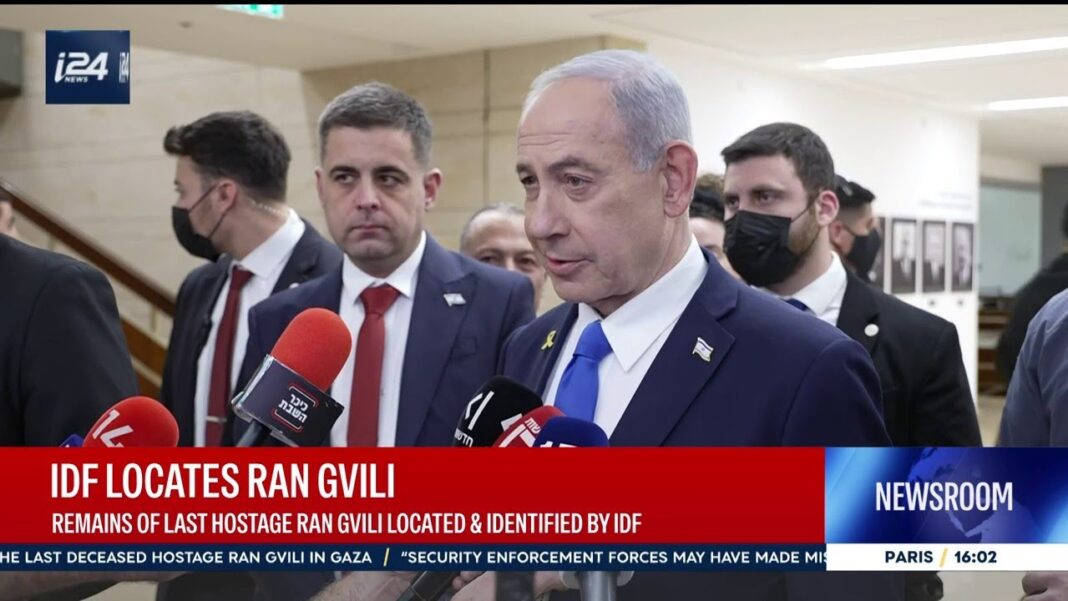
Israeli PM Binyamin Netanyahu addresses the 2nd International Conference on Combating Antisemitismhh
https://www.youtube.com/watch?v=zihVoW7QxRk
The Palestinians already have four states. When we argue against a Palestinian state we should always argue against “another” Palestinian state. We should not let the world forget that Jordan a country 3X the area of Israel is a Palestinian state. Don’t let the world conveniently forget that fact. I recommend an article titled The Four State Solution which was posted by the American Thinker. https://www.americanthinker.com/articles/2007/11/the_four_state_solution.html