



|
Getting your Trinity Audio player ready...
|
By: Fern Sidman – Jewish Voice News
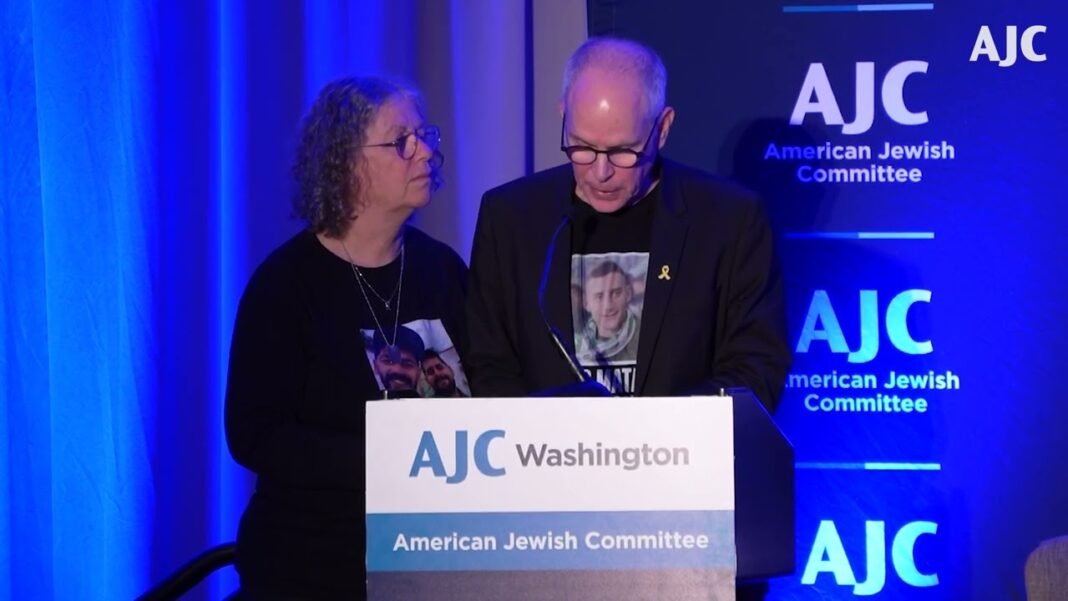
Before the solemn chamber of the United Nations Committee Against Torture (UNCAT) in Geneva, former Israeli hostages Keith and Aviva Siegel recounted this week the unimaginable cruelty they endured during their captivity under Hamas in Gaza. Their testimony, reported on Wednesday by Israel National News, was a searing indictment of systematic brutality — a glimpse into the depths of inhumanity inflicted upon civilians during one of the darkest chapters of the ongoing conflict.
The couple’s appearance marked one of the most emotionally charged sessions in the committee’s recent history, as they laid bare a litany of torture, sexual abuse, starvation, and humiliation at the hands of their captors. Their statements were not appeals for pity, as Keith Siegel emphasized, but rather a moral summons to the international community — a demand that the atrocities committed against Israeli hostages be acknowledged, condemned, and never permitted to recur.
According to the report at Israel National News, Keith Siegel, 66, spoke with quiet dignity and devastating clarity as he described the daily ordeal of dehumanization. “I am not asking for your sympathy,” he told the UN committee. “I am asking that you ensure the horrors the terrorists committed against me and others in captivity will never happen again.”
Siegel was taken hostage by Hamas terrorists during the October 7, 2023 massacre, alongside his wife Aviva, and spent many months in captivity before being released in a negotiated exchange. His testimony outlined not only the physical deprivation but also the deliberate psychological torment inflicted on him.
“Altogether, I spent about six months completely alone — a 66-year-old man, cut off from the world, terrified, not knowing the fate of my loved ones,” he said, recalling long stretches of total isolation punctuated by brief, terrifying interactions with guards.
He spoke of “humiliation for sport” — the captors’ sadistic games designed to break the human spirit. “Just for ‘fun,’ the guards compared parts of our bodies, threatened us with knives, humiliated us, and prevented us from going to the bathroom until we could no longer hold it. Every basic human right was taken away. I was starved and denied water. More than once, I was forced to strip naked in front of them while they shaved my body.”
These words, as reported by Israel National News, silenced the Geneva chamber — a setting accustomed to bureaucratic formality but not to such direct testimony of raw suffering.
Keith’s ordeal did not end with his release. His testimony revealed the emotional devastation that awaited him even after rescue. “Throughout my captivity in Gaza, I imagined the moment I would come home and visit my elderly mother,” he said. “The first thing I asked my wife when I returned by helicopter on the way to the hospital was how my mother was doing. She had died two months before my release. She never knew I came back. I never got to say goodbye.”
It was a moment of profound tragedy — the kind of intimate loss that encapsulated the broader moral collapse of a world that allowed civilians to languish as hostages in underground tunnels, unseen and forgotten.
If Keith’s testimony reflected the deliberate psychological disintegration of a man in captivity, Aviva Siegel’s account illuminated the gendered brutality and pervasive degradation that women suffered under Hamas. Speaking softly but with extraordinary composure, she described the terror, starvation, and degradation that defined her 51 days in captivity.
“When we were taken underground in Gaza,” she told the committee, “there was a boy from my community. Hamas terrorists tied his hands with plastic cuffs. He was covered in blood; we were covered in blood. Later, when one of the terrorists came to cut off the cuffs with a cutter, he cut the boy’s hand. I just wanted to scream, and I saw the terrorist smiling as he did it.”
The report at Israel National News noted that Aviva’s voice trembled as she recalled the grotesque imbalance between captor and captive — how the terrorists feasted in front of starving prisoners. “They threatened me, starved me, didn’t give me enough water. I lost ten kilograms in 51 days. I hid food for Keith. I saw him losing weight. We were starving while the terrorists gained weight. They ate and chewed in front of us while refusing to give us anything.”
Her testimony was especially critical in drawing attention to sexual abuse, a subject many survivors have struggled to discuss publicly. “One day, a young girl came out of the shower trembling,” she recounted. “I wasn’t allowed to hug her, but I did anyway. Later she told us that one of the terrorists had touched her.”
Her words, as noted in the Israel National News report, called attention to the unbearable moral dimension of captivity — that even acts of compassion were forbidden, that to offer comfort or to weep was itself an act of defiance. “The most terrible thing for me,” Aviva said, “was watching how they tortured my husband Keith and what they did to the girls. I wasn’t allowed to hug, help, or even cry. I tried all that time to hold on to my humanity.”
Aviva’s testimony also revealed the Kafkaesque nature of captivity — the microscopic control that stripped captives not only of freedom but of bodily autonomy. “They forced us to lie down from 5 p.m. until 9 a.m. the next morning. We weren’t allowed to move. My body ached. I wanted to stretch, to sit, to scream, ‘Just let me sit for five minutes.’ They didn’t allow it.”
The cruelty was relentless and often trivial in its expression, designed to dominate through fear. “One night, I took my foot out from under the blanket — a Hamas terrorist came and screamed at me that I wasn’t allowed to do that. It sounds small, but that was the level of control they had over us.”
Her account, published in Israel National News, painted a devastating picture of daily existence underground: contaminated water, chronic illness, and humiliation disguised as order. “Most of my time in Gaza I suffered from stomach pain and diarrhea because they made us drink contaminated water,” she said. “I’m 62 years old, and I had to ask permission just to go to the bathroom.”
Their testimony before UNCAT was part of Israel’s broader effort to ensure that Hamas’s treatment of hostages is officially recognized as a violation of international law, including the UN Convention Against Torture and other instruments that prohibit cruel, inhuman, and degrading treatment.
As the Israel National News report observed, the Siegel couple’s appearance served not merely as personal testimony but as a moral indictment of an international system that has been slow to confront the full scope of Hamas’s crimes. While UN agencies have routinely documented prisoner mistreatment across the globe, few have explicitly classified the ordeal of the October 7 hostages as constituting torture under international law — a silence Israel has sought to shatter through such first-hand accounts.
In closing his testimony, Keith Siegel reiterated his central plea: that the world not turn away from the suffering inflicted by terrorist organizations that weaponize human life. “These horrors must never be allowed to happen again,” he said. “I survived. But others did not.”
His words, echoed in the Israel National News report, encapsulated a broader demand for moral clarity — a call for nations to move beyond rhetorical condemnation toward concrete mechanisms of accountability.
The Siegel testimonies before the UN Committee Against Torture stand as a powerful reminder that atrocity is not abstract. It is measured in hunger pangs, in a trembling child denied a hug, in the indignity of asking permission to breathe or move. Through Israel National News’s coverage, their voices have transcended the confines of the Geneva chamber, reaching audiences around the world and forcing a reckoning with the true meaning of cruelty and survival.
Ultimately, their testimony was not only an indictment of Hamas’s barbarity but a test of the world’s conscience. Whether the UN, and the international community at large, will answer that moral challenge remains to be seen.