



|
Getting your Trinity Audio player ready...
|
By: Russ Spencer
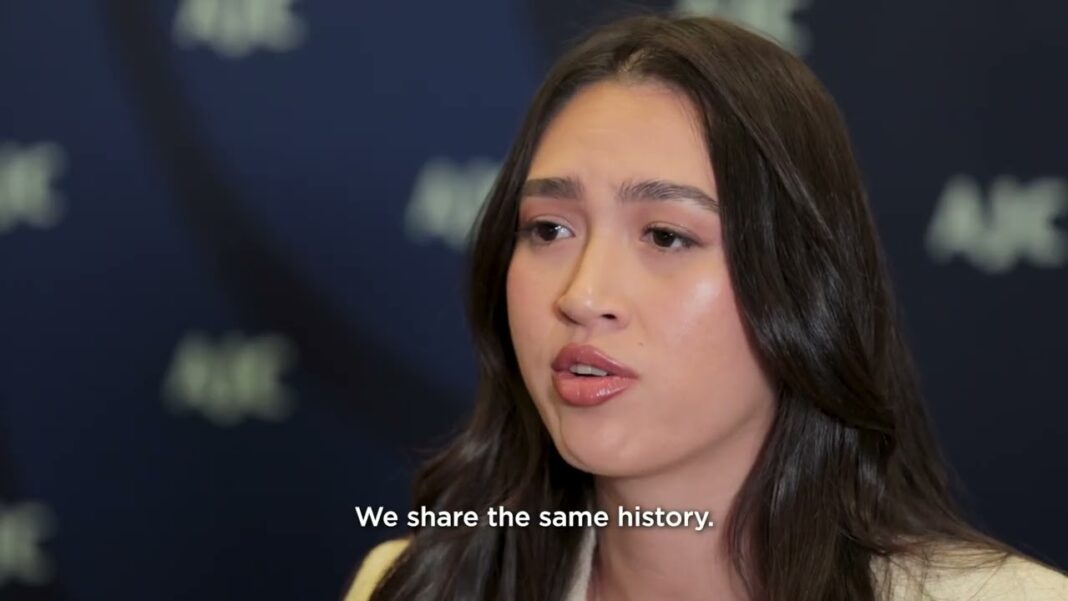
In a poignant testament to corporate solidarity amid profound human tragedy, rescued Israeli hostage Noa Argamani has publicly expressed her deep gratitude to Nvidia and its CEO, Jensen Huang, for what she described as extraordinary, unwavering support for her partner, Avinatan Or, during the nearly two years he was held captive by Hamas in Gaza. Argamani’s emotional message, posted on X late Thursday, was reported on Friday by VIN News, which has closely followed the pair’s ordeal, their rescue, and the broader implications for Israeli families affected by the October 7, 2023, Hamas attacks.
According to the information provided in the VIN News report, Argamani’s post followed her and Or’s visit to Nvidia’s U.S. headquarters, where they met Huang for the first time since Or’s dramatic release in October 2024. The meeting served not only as a moment of closure, but also as a testament to a rare form of corporate devotion—one that, as Argamani emphasized, transcended the typical boundaries of an employer-employee relationship.
“Somewhere in early 2022, Avinatan started his first job with Nvidia, a decision that would later prove to be one of the best he ever made in his life,” Argamani wrote, as reported by VIN News. She described the sense of belonging that Or had cultivated at the company, and noted that this bond endured—astonishingly—through twenty-four harrowing months during which Or was held hostage in Gaza after being abducted alongside her from the Supernova music festival near Re’im on October 7.
The fact that Or’s desk was left untouched for nearly two years may seem, at first blush, like a small symbolic gesture. Yet as Argamani recounted, this was accompanied by far more profound commitments. Employees who had never met Or personally reportedly held signs bearing his photo every day, beginning each meeting with a reference to him and a call for his safe return. These staff-led rituals became part of Nvidia’s internal culture during the crisis, reflecting a broader ethos of communal responsibility that Argamani said was cultivated with the “direct support” and active guidance of CEO Jensen Huang.
Indeed, what emerged from Argamani’s reflections—and from VIN News’s additional reporting—is a portrait of leadership defined not simply by corporate strategy but by genuine human empathy. Huang, she wrote, “personally accompanied the family and called repeatedly to ask how they were doing.” Such statements align with broader accounts of Nvidia’s involvement in supporting its Israeli workforce in the aftermath of the October 7 attacks, as previously documented by VIN News in a series of reports examining how multinational corporations with large Israeli footprints responded to the unprecedented assault.
For Nvidia, whose technology and employees are deeply connected to Israel’s tech ecosystem, the October 7 events and the months that followed represented a significant rupture. With dozens of its employees called up for reserve duty, others displaced by violence, and some taken hostage, the company’s internal fabric was directly affected. The VIN News report noted that Nvidia—unlike many global tech firms whose responses were restricted to formal statements—took a conspicuously hands-on approach, with Huang himself emerging as a quietly influential advocate for the families of hostages.
Argamani’s message on X, amplified across Israeli and international media, further strengthens this narrative.
When Hamas gunmen stormed the Supernova festival on October 7, 2023, Argamani and Or were among the hundreds captured, killed, or forced to flee amid chaos. The widely circulated video of Argamani screaming as she was seized by Hamas terrorists became one of the most searing images of the attack, emblematic of the horror inflicted on Israeli civilians.
Argamani was rescued eight months later, in June 2024, during an Israeli Defense Forces operation in Gaza. Or, however, remained in captivity for an additional four months, finally freed in October 2024 in a separate military effort. As the VIN News report noted at the time, their split rescue underscored the capricious, psychologically devastating nature of hostage situations, in which families often experience alternating cycles of relief and agony.
During those months of separation, Nvidia’s global workforce—spanning engineers, designers, executives, and administrators—became woven into the fabric of Or’s support network. According to the VIN News report, the company instituted internal reminders, vigils, and what employees described as a tacit corporate pledge not to allow their colleague’s disappearance to fade into the background of daily work. This commitment, as Argamani stated, became deeply personal for her and Or’s families, who were in regular contact with Huang and other senior leaders.
Her description of the company as “one big family” during Or’s captivity was neither corporate rhetoric nor sentimental flourish. VIN News has documented multiple instances in which Nvidia employees—Israelis and non-Israelis alike—organized volunteer efforts, coordinated participation in global awareness campaigns for Israeli hostages, and provided support to colleagues affected by the ongoing war. The company famously granted extended leave to many of its Israeli staff who were called up for reserve duty, ensuring job security and financial stability during a period of national upheaval.
Perhaps the most striking element of Argamani’s post, as emphasized in VIN News’s coverage, was her repeated reference to Huang’s involvement. Corporate CEOs are often characterized as distant figures, shielded by layers of public relations and executive bureaucracy. Yet Huang’s conduct, as described by Argamani, illustrates a different paradigm—one in which personal intervention becomes both symbolic and materially meaningful.
VIN News has previously reported on Huang’s global reputation for cultivating close relationships with his employees, often visiting local offices in person and engaging with staff at all levels. Still, Argamani’s depiction of his persistence—calling the family “repeatedly,” coordinating internal actions, and ensuring Or’s absence was never relegated to the margins—extends beyond the typical boundaries of leadership engagement.
It also reflects the evolving role of multinational corporations in moments of geopolitical crisis. As VIN News analysts have noted, companies with significant operations in conflict zones increasingly find themselves navigating the intersection of corporate responsibility and humanitarian advocacy. In Nvidia’s case, this has taken the form of both symbolic actions and concrete support, with the company openly acknowledging its commitment to employees coping with displacement, loss, and the trauma of hostage situations.
Argamani and Or’s recent meeting with Huang, documented by VIN News as a significant development, served as a culmination of this two-year saga. It represented not only a reunion, but also a moment of collective reckoning—linking personal tragedy, corporate solidarity, and the broader international discourse surrounding the October 7 attacks and their aftermath.
According to the information contained in the VIN News report, Nvidia’s support for its Israeli employees continues to be widely recognized in Israel’s tech community, where the company is viewed as having demonstrated a unique degree of empathy and constancy. The meeting also highlighted a complex interplay between technology, geopolitics, and human experience. Nvidia, whose work in artificial intelligence and advanced computing has made it one of the world’s most influential companies, found itself serving as an unlikely—but deeply consequential—lifeline for a family ensnared in one of the most brutal conflicts of the decade.
For Argamani and Or, the visit provided a rare opportunity to express gratitude not only to executives but to the broader Nvidia community. The VIN News report noted that for many of the employees who had advocated for Or’s release, the meeting was likewise a moment of emotional resonance—a confirmation that their gestures, however symbolic, had mattered to the people enduring the storm.
The story transcends the individual experiences of Argamani and Or, offering a window into the potential of corporate institutions to serve as stabilizing forces in times of upheaval. At a moment when global discourse is filled with skepticism toward large technology companies, Nvidia’s conduct—as articulated by Argamani—suggests an alternative model.
It is one in which empathy is not incidental but institutional; in which solidarity is enacted not merely through donations or public statements but through daily rituals, persistent outreach, and meaningful personal engagement. As the VIN News report emphasized, the significance of such support cannot be overstated for families navigating the trauma of hostage crises and the long shadow they cast.
For Argamani, the journey is far from over. The memories of captivity, separation, and fear cannot be easily erased.
In the end, it was not only Israeli soldiers who brought Or home, or intelligence operatives who pieced together the fragments of his whereabouts. It was also, in a quiet but powerful way, a constellation of Nvidia employees and a CEO who refused to let his name slip from the collective conscience. As Argamani wrote, Nvidia became “one big family.”