



|
Getting your Trinity Audio player ready...
|
By: Fern Sidman
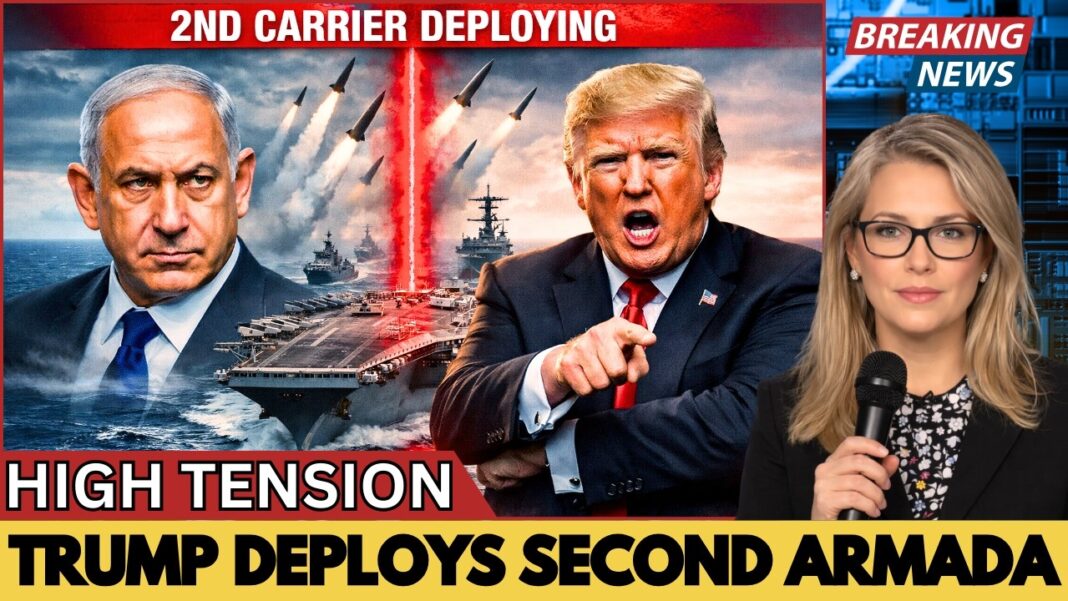
\As the delicate choreography of diplomacy unfolds between Washington and Tehran, the United States has simultaneously chosen to move pieces of overwhelming military power across the geopolitical chessboard of the Middle East. According to a report in The Wall Street Journal (WSJ) late Wednesday evening, the Pentagon has ordered the deployment of an additional aircraft carrier strike group to the region, dispatching the USS George H.W. Bush to join the USS Abraham Lincoln in waters proximate to Iran. The move is intended as part of a contingency posture for potential military action should negotiations with Tehran falter or collapse outright.
The decision, while cloaked in the language of preparedness and deterrence, represents one of the most conspicuous displays of American force in the region in years. The WSJ report framed the deployment not as routine maritime rotation but as a calculated escalation in readiness, signaling that diplomacy is being pursued alongside, and not in place of, coercive leverage. In the lexicon of modern statecraft, this is the language of “talk softly and carry a very large stick,” rendered in steel, flight decks, and carrier-based air wings.
President Trump’s own words earlier this week lent weight to the WSJ’s account. On Tuesday, he publicly acknowledged that he was considering sending additional military assets to the Middle East, a statement that, when viewed in light of the WSJ’s reporting, appears less speculative than declarative. The juxtaposition of public diplomacy and quiet mobilization underscores a governing philosophy that seeks to maximize negotiating leverage by reminding adversaries of the costs of intransigence. As the WSJ report observed of Trump-era foreign policy, the administration has favored a strategy that blends rhetorical openness to deal-making with unmistakable demonstrations of military preparedness.
The timing of the carrier deployment was especially striking given the high-level diplomatic engagement unfolding in Washington on the same day. President Trump and Israeli Prime Minister Benjamin Netanyahu convened at the White House in a meeting that, by all accounts, centered heavily on Iran. The WSJ report characterized the encounter as a consequential moment in a rapidly evolving diplomatic theater, with Netanyahu urging the American president to avoid what Israeli officials have long feared: a narrow or partial agreement that addresses only certain aspects of Iran’s conduct while leaving others—particularly ballistic missile development and regional proxy activity—untouched.
Following the meeting, Trump took to his Truth Social platform to offer a carefully calibrated public assessment. He described the encounter as “a very good meeting,” reaffirming what he called the “tremendous relationship” between the United States and Israel. The tone was conspicuously warm, signaling continuity in the bilateral alliance even amid subtle differences in strategic emphasis. Yet on the central question of Iran, Trump’s remarks were notable for their ambiguity. “There was nothing definitive reached,” he wrote, adding that he had insisted negotiations with Tehran continue to determine whether a deal could ultimately be consummated. If such a deal proved possible, he suggested, it would be preferable. If not, the consequences would be left unstated but ominously implied.
In a characteristic flourish, Trump invoked the memory of “Midnight Hammer,” referencing an episode in June 2025 in which Iran declined to accept terms and was subsequently struck by U.S. and allied forces. The historical accuracy and framing of that recollection aside, the rhetorical purpose was unmistakable. The WSJ report noted that such language functions as both reassurance to allies and warning to adversaries: reassurance that Washington is not retreating from the option of force, and warning that diplomatic failure carries tangible risks.
The decision to deploy the USS George H.W. Bush alongside the USS Abraham Lincoln introduces a formidable concentration of American naval power into a region already dense with strategic tension. Aircraft carriers are not merely symbols; they are mobile airfields capable of projecting force across hundreds of miles. The WSJ report emphasized that the presence of even a single carrier strike group dramatically alters regional military calculations. Two carriers operating in concert elevate that effect exponentially, enabling sustained air operations, layered missile defense, and rapid response to emergent contingencies.
From the perspective of American policymakers, as reflected in the WSJ analysis, the deployment serves multiple functions. It reassures regional partners—Israel foremost among them—that Washington remains committed to their security. It signals to Iran that negotiations are being conducted under the shadow of credible force. And it communicates to domestic audiences that the administration is not relying solely on diplomacy in an arena long marked by broken promises and strategic ambiguity. The WSJ report framed this posture as emblematic of a broader trend in U.S. foreign policy: an insistence on coupling engagement with deterrence, particularly when dealing with adversarial regimes whose strategic intentions remain contested.
For Netanyahu, the meeting with Trump represented both an opportunity and a challenge. Israeli leaders have long argued that Iran’s strategic threat cannot be compartmentalized into discrete policy silos. A nuclear agreement, in their view, is insufficient if it leaves untouched Tehran’s missile programs and its network of regional proxies. The WSJ has documented Israel’s persistent concern that any agreement failing to address these dimensions risks entrenching, rather than constraining, Iran’s long-term strategic position. Netanyahu’s effort to persuade Trump against a partial deal reflects this calculus, as well as Israel’s acute sensitivity to any diplomatic outcome that might be perceived domestically as conceding too much in exchange for too little.
Trump’s public comments after the meeting, while reaffirming the alliance, suggested that Washington remains open to a negotiated outcome that may not fully align with Israeli preferences. This tension—managed diplomatically but palpable beneath the surface—has been a recurring theme on U.S.-Israeli relations. The alliance, the Journal has noted, is robust, but not monolithic; it accommodates differences in threat perception and tactical priorities even as it rests on shared strategic fundamentals.
The broader regional context further complicates the picture. Trump alluded in his post to “tremendous progress being made in Gaza, and the Region in general,” even asserting that “there is truly PEACE in the Middle East.” Such declarations, while politically resonant, sit uneasily alongside the simultaneous military mobilization described in the WSJ report. The juxtaposition highlights a central paradox of contemporary American diplomacy: the aspiration to declare stability while preparing for instability, to speak the language of peace while assembling the instruments of war.
Analysts cited in the WSJ report have suggested that this dual-track approach reflects an effort to manage multiple audiences simultaneously. For domestic supporters, the administration presents itself as a peacemaker willing to negotiate. For allies, it projects resolve and readiness. For adversaries, it cultivates uncertainty, making the costs of miscalculation appear intolerably high. Whether this strategy ultimately enhances or undermines the prospects for a durable agreement with Iran remains an open question, one that the WSJ has framed as among the most consequential strategic dilemmas of the current moment.
The deployment of a second carrier also raises questions about escalation dynamics. History offers sobering reminders that large-scale military movements, even when intended as deterrent signals, can be misread by adversaries as preludes to imminent action. The margin for error in such environments is perilously thin. Misperception, miscommunication, or accidental encounters could transform posturing into confrontation with alarming speed. The administration’s challenge, therefore, lies in calibrating its signals with precision—communicating resolve without foreclosing the space for diplomacy.
As negotiations with Tehran continue, the image of two American aircraft carriers patrolling the Middle Eastern theater will loom large over every diplomatic exchange. The WSJ’s report has made clear that Washington’s message is intentionally stark: diplomacy is preferred, but force remains available. This posture encapsulates the enduring tension at the heart of U.S. policy toward Iran—a tension between the desire to resolve a protracted conflict through negotiation and the determination to prevent outcomes perceived as strategically intolerable.
In the end, the deployment of the USS George H.W. Bush alongside the USS Abraham Lincoln may come to be remembered as either a catalyst for compromise or a prelude to confrontation. The WSJ report framed the moment as one of acute inflection, in which decisions taken in quiet rooms and conveyed through public platforms may reverberate across the region for years to come. As steel hulls cut through Middle Eastern waters and diplomats exchange carefully crafted words, the world watches a familiar drama unfold: the uneasy coexistence of diplomacy and deterrence, of hope and hazard, in one of the globe’s most volatile arenas.