



|
Getting your Trinity Audio player ready...
|
By: Fern Sidman
In a sobering reminder of the ongoing dangers faced by Israeli forces operating in the Gaza Strip, five Israel Defense Forces (IDF) soldiers were killed and 14 more wounded on Monday evening after a powerful roadside bomb detonated during a ground operation in Beit Hanoun, located in the conflict-ravaged northern section of the enclave.
According to a report at World Israel News, the deadly blast struck troops from the Kfir Brigade’s Netzah Yehuda Battalion and the Gaza Division’s Northern Brigade. The troops were on foot at the time of the explosion, not inside an armored vehicle, leaving them more vulnerable to the devastating impact of the device. An initial investigation by the IDF confirmed that the explosion was caused by a concealed improvised explosive device (IED), likely planted by Hamas or another Palestinian terror faction.
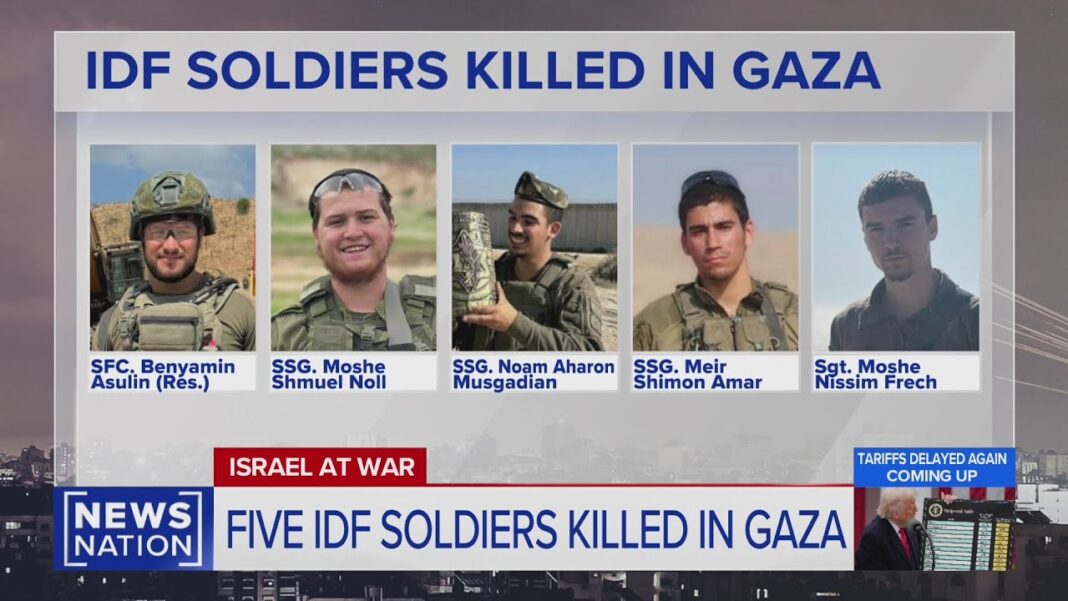
The five fallen soldiers were identified as: Staff Sgt. Meir Shimon Amar, 20, of Jerusalem, Sgt. Moshe Nissim Frech, 20, of Jerusalem, Staff Sgt. Noam Aharon Musgadian, 20, of Jerusalem, Major (Res.) Benjamin Assoulin, 28, of Haifa, and Staff Sgt. Moshe Shmuel Noll, of Beit Shemesh. Amar, Frech, and Musgadian served in the Netzah Yehuda Battalion, a specialized unit within the Kfir Brigade. Major Assoulin, who had returned to active duty as a reservist, was part of the Gaza Division’s Northern Brigade.
As reported by World Israel News, the explosion marked one of the deadliest single incidents for the IDF in recent weeks. While two of the 14 wounded soldiers are currently in serious condition, the full extent of the injuries is still being evaluated.
Following the explosion, Israeli soldiers rushed to render aid to the wounded but were met with enemy fire. It remains unclear whether Hamas militants had intentionally staged an ambush, capitalizing on the chaos and vulnerability of the Israeli rescue efforts.
The Netzah Yehuda Association, a non-profit that supports soldiers of the unit, released a statement expressing deep sorrow: “We bow our heads in honor of the fallen soldiers of the Netzah Yehuda Battalion who gave their lives in battle in the northern Gaza Strip,” the group stated. “With broken hearts, we stand alongside the families in mourning the loss of their brave sons — fighters who selflessly risked their lives for the people of Israel.”
The tragedy occurred as Israeli Prime Minister Benjamin Netanyahu was in Washington, D.C. for a high-profile working dinner with President Donald Trump. The meeting, according to World Israel News, focused heavily on finalizing a ceasefire agreement between Israel and Hamas, as well as long-term arrangements regarding the governance and reconstruction of Gaza.
President Trump, speaking to reporters prior to the dinner, emphasized that the U.S. is “expecting a ceasefire deal to be concluded as early as this week,” and noted that all parties involved “are aligned toward a common goal of ending hostilities and bringing home the remaining Israeli hostages.”
A senior Israeli official, quoted by The Jerusalem Post and cited in World Israel News, echoed the sentiment, noting that “there is full and total coordination between Prime Minister Netanyahu and President Trump, including on the issue of the hostage deal.”
According to reports, the proposed truce could be finalized “within a few days,” though sources caution that some gaps remain, particularly over Hamas’s demands regarding the release of prisoners and future territorial arrangements in the Gaza Strip.
The loss of five more IDF soldiers underscores the heavy toll Israel continues to pay in its effort to dismantle Hamas’s military infrastructure in northern Gaza. Beit Hanoun has been one of the epicenters of the fighting, with IDF troops encountering booby-trapped tunnels, sniper fire, and a dense array of IEDs.
Since the October 7 massacre that triggered the war — in which Hamas terrorists murdered over 1,200 Israelis, including children and elderly civilians — the Israeli military has been engaged in a months-long campaign to root out the group’s network of fighters and underground fortresses.
Yet, as the World Israel News report indicated, the battle has been anything but conventional. Hamas continues to embed itself within civilian areas and relies on asymmetric tactics designed to inflict maximum damage with minimal exposure — tactics that were tragically successful on Monday night.
The deaths of Amar, Frech, Musgadian, Assoulin, and Noll will weigh heavily on the Israeli public and political establishment, particularly as the Netanyahu government weighs the next phase of its Gaza strategy. Israeli Defense Minister Yoav Gallant, who was briefed immediately following the incident, described the fallen as “heroes who stood in the breach to defend the State of Israel against its most implacable enemies.”
While military officials confirmed that a full operational review is underway, there is no indication that Israel will curtail its operations in Gaza in the near term. If anything, the incident is likely to harden public resolve and fuel calls to deliver a more decisive blow to Hamas — especially if the ceasefire talks falter.
As Netanyahu and Trump coordinate diplomatic efforts to bring about a ceasefire, the tragic events in Beit Hanoun serve as a grim reminder that peace often exacts a steep price — particularly for the soldiers tasked with fighting in its name.
For the families of the five young men who fell on Monday night, however, no diplomatic breakthrough will undo their loss. Their sacrifice is now etched into the fabric of a conflict that shows no signs of ending soon, even as new avenues for peace appear on the horizon.
As President Trump and Prime Minister Netanyahu prepare to unveil a framework for a long-awaited ceasefire, the lives lost in Beit Hanoun will remain a solemn marker of the stakes — and the urgency — behind every handshake and every headline.
