



By: Fern Sidman
Israel National News has reported in detail on a striking set of figures released this week in an op-ed by The Washington Post’s Marc A. Thiessen, documenting the scale of humanitarian assistance Israel is delivering to Gaza in the midst of active conflict — and contrasting that effort with the actions of Hamas, the UN, and neighboring Arab states.
According to the op-ed, Israel on Tuesday alone provided 1,829,520 meals to Gazans through the Gaza Humanitarian Foundation, a U.S.-backed non-governmental organization created earlier this year to replace the Hamas-linked United Nations Relief and Works Agency (UNRWA). Since the Foundation began operations on May 26, it has distributed over 108 million meals.
Citing official data from the IDF’s Coordinator of Government Activities in the Territories (COGAT), the piece notes that nearly 1.9 million tons of humanitarian aid — including food, water, medical supplies, and shelter materials — have entered Gaza by land, sea, and air since the war began.
Military analysts quoted by Israel National News emphasize that there is no modern precedent for a country providing such a vast quantity of aid to the civilian population of an adversary while hostilities are ongoing. Despite these efforts, Hamas has continued its campaign against Israel, using the civilian population’s suffering as leverage in an attempt to pressure Israel to end its military operations.
The op-ed points out that this narrative has gained traction in Western political discourse and media coverage. Several governments — including France, Canada, Britain, Ireland, Spain, and Norway — have recently announced recognition of a “State of Palestine,” a move critics say rewards Hamas despite its role in prolonging the conflict and exacerbating humanitarian hardship.
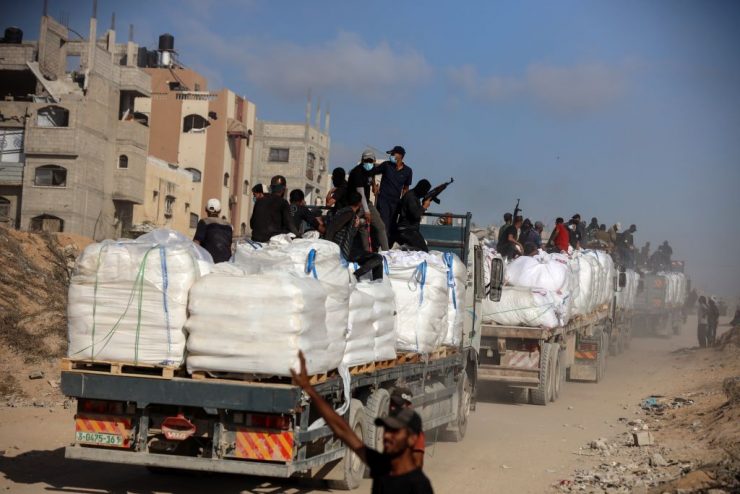
The Washington Post column, as cited by Israel National News, also sheds light on the obstruction of aid delivery within Gaza itself. Between May 19 and August 4, UN statistics indicate that 90% of the 2,545 aid trucks entering the enclave were intercepted, with tens of thousands of tons of goods looted — often resold on the black market by Hamas to finance its terrorist infrastructure.
In addition, hundreds of aid trucks remain undelivered due to the UN’s refusal to permit the Gaza Humanitarian Foundation to take over distribution. This bottleneck, combined with Hamas’s diversion of supplies, has left large segments of the population without access to urgently needed assistance despite the volume of aid arriving at Gaza’s borders.
The op-ed draws a sharp contrast between Gaza’s humanitarian situation and the refugee flows seen in other conflicts. In most wars, civilians flee to safer neighboring countries. The piece notes that more than 5 million Ukrainians have sought refuge across Europe since Russia’s invasion, with Poland hosting nearly 1 million and Germany more than 1.2 million. Similarly, during the Syrian civil war, over 4.2 million Syrians fled to Turkey, Lebanon, Jordan, and other states.
By contrast, Gazans have been denied such options. At the onset of the current war, Jordan’s King Abdullah II publicly declared: “No refugees in Jordan, no refugees in Egypt.” Egypt, meanwhile, has strengthened its border fortifications with Gaza.
Egyptian officials claim their reluctance stems from concerns that Israel might refuse to allow refugees to return after the war. However, as Israel National News reported, the deeper fear expressed by Cairo is the risk that Hamas operatives could infiltrate the refugee population and carry out attacks from Egyptian territory. President Abdel Fatah El-Sisi has warned openly of this danger, framing it as a matter of national security.
The decision by The Washington Post — a paper often perceived as critical of Israeli policy — to publish Thiessen’s op-ed is itself notable. As the Israel National News report pointed out, the piece diverges from much of the liberal press’s coverage, which often places primary blame for Gaza’s humanitarian crisis on Israel. Instead, the analysis distributes responsibility more broadly, highlighting Hamas’s diversion of aid, UN inefficiency, and the refusal of neighboring Arab states to provide refuge.
Thiessen’s reporting stresses that while the humanitarian crisis in Gaza is severe, it cannot be understood in isolation from these other factors. The article argues that acknowledging these realities is essential to any honest conversation about how to alleviate civilian suffering and bring stability to the region.
Despite the ongoing fighting, Israel’s logistical and humanitarian operations in Gaza show no signs of slowing. COGAT continues to coordinate with the Gaza Humanitarian Foundation and international partners to move massive quantities of aid through multiple entry points.
Officials have emphasized that the aid includes not only food and water, but also medical supplies critical to treating the wounded, and shelter materials to rebuild homes and public infrastructure damaged during combat. Israel National News reported that the scale of this operation requires a sustained commitment of manpower and resources, even as the IDF maintains pressure on Hamas militarily.
The op-ed concludes that the path forward for Gaza’s civilian population depends on several interconnected factors: continued and possibly expanded humanitarian deliveries by Israel and international partners, structural reforms to ensure aid is distributed efficiently and kept out of Hamas’s hands, international pressure on regional actors to play a more constructive role, including the possibility of hosting refugees temporarily in third countries and a cessation of hostilities that removes Hamas’s capacity to exploit humanitarian suffering for political and military purposes.
For now, the humanitarian operation stands as one of the largest of its kind ever undertaken during wartime. Whether it will succeed in meeting Gaza’s needs depends not only on the volume of aid, but also on the political will — both inside and outside the region — to confront the systemic obstacles that have long plagued humanitarian relief in Gaza.

Stop blaming the Arabs! They are the enemy. What else do you expect? Blame the Israeli government for sending the aid while knowing that the aid will go to Hamas. Treason? Lets not forget the ‘Great Sages’ of our generation. They sit on their fannies and say nothing. Kamtza Bar-Kamtza all over again!!! With ‘Great Sages ‘ like them – who needs enemies?