



|
Getting your Trinity Audio player ready...
|
By: Abe Wertenheim
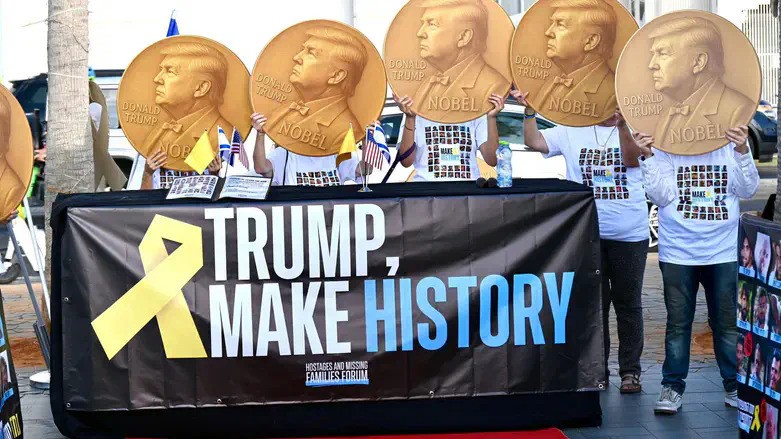
Outside the gates of the United States Embassy in Tel Aviv this week, grief-stricken families of Israelis still held captive in Gaza staged a scene laden with symbolism, hope, and political urgency. They set up a long table draped in white, atop which sat a mock “Hostage Return Agreement” and even a symbolic Nobel Peace Prize certificate — a theatrical but solemn plea directed squarely at President Donald Trump.
Their message was stark: only American leadership, and specifically Trump’s intervention, could break the deadlock, secure the release of 48 remaining hostages, and end the devastating Gaza war.
As Israel National News (INN) reported on Tuesday, the hostage issue remains one of the most emotionally searing dimensions of the conflict, reverberating through Israeli society and shaping political debates at home and abroad. Families who have endured nearly two years of waiting — since the Hamas-led atrocities of October 7, 2023 — are now betting on Trump’s penchant for dealmaking to produce what they are calling “the ultimate deal.”
Dalia Cusnir, sister-in-law of hostage Eitan Horn, delivered one of the most impassioned appeals of the day. Standing before reporters, with the symbolic “agreement” displayed behind her, Cusnir invoked both political pragmatism and emotional urgency.
“President Trump, in front of me, stands a table with an agreement to bring the hostages home and end the war,” she said. “We placed it here because this is the choice before you: a chance to make history. Imagine if today were the day that 48 hostages came home, if today were the day the war ended.”
Her remarks, cited in the report on Israel National News, framed the appeal as not merely an Israeli plea but an opportunity for Trump to solidify his legacy as a global peacemaker. “This is your moment,” Cusnir insisted, calling on Trump to use his leverage to lock all parties in a room “until the signatures are on the page.”
The families have clearly seized on Trump’s unique political persona. Cusnir called the proposal “your deal, built with American leadership, ready to be signed.” She added that Hamas had “already signaled its willingness,” suggesting that what remains is a test of Trump’s will to compel Prime Minister Benjamin Netanyahu and his government to act.
As the INN report emphasized, the choice to target Trump directly reflects widespread skepticism in Israel that its own leadership will prioritize the hostages over continued military action. The prime minister has repeatedly framed the war as an existential struggle requiring relentless military pressure. But for families living in what they describe as “limbo between hope and despair,” Trump’s intervention appears to offer the only realistic pathway to resolution.
Ruby Chen, father of hostage Itay Chen, took the podium to declare that he was speaking “not only as a parent, but as the voice for 48 hostages knowing you are the only person in the world that can end our suffering.”
He directly linked Trump’s potential action to his broader regional vision: “The bottleneck for your new Middle East vision and a Nobel Peace Prize is the release of the hostages and a Gaza War ceasefire.”
Chen, whose son is an American citizen, pressed Trump to act not only as a statesman but also as a protector of American nationals. “There are American hostages in Gaza, including my son, that you have an obligation to bring home,” he said.
For Chen and many others, the linkage between hostage release, a ceasefire, and the resumption of regional diplomacy — including the Abraham Accords — forms a coherent narrative: Trump could both resolve a humanitarian tragedy and relaunch his brand of Middle Eastern peacemaking. As the INN report observed, this linkage was not accidental but carefully crafted to appeal to Trump’s sense of legacy.
Perhaps the most dramatic moment of the press conference came from Gil Dickmann, cousin of Carmel Gat, who was executed in Hamas captivity in Rafah last year. His testimony blended raw grief with sharp political critique.
“My beloved cousin, Carmel, was executed by Hamas terrorists one year ago, as the IDF was approaching the tunnel in Rafah,” Dickmann recalled. “My family warned that invading Rafah could kill her. But Bibi did not listen. He said the war will save the hostages. But it killed 42 hostages. We must end it before it kills more.”
Dickmann then turned to Trump with a mix of flattery and urgency: “President Trump. You wrote The Art of the Deal. Tremendous book. Today we are asking you to make the ULTIMATE DEAL. The deal on the table is YOUR deal — only you can close it. Your deal will save lives, and bring all of the hostages home.”
As reported in INN, Dickmann’s rhetoric captured both the desperation of families and the political theater designed to appeal to Trump’s identity as a master negotiator. “History will remember you as the one who closed this deal,” he declared.
While the families’ appeals were directed at Trump, they contained sharp criticism of Israel’s leadership. Dickmann openly accused Prime Minister Netanyahu of sacrificing hostages in pursuit of his military strategy. “This war is bad for Israel. The war is bad for the hostages. It risks the lives of innocent people on both sides of the border,” he said, echoing growing frustrations within Israeli society, as was reported by INN.
Polls show that a majority of Israelis — and even many Likud voters — now support a deal to end the war in exchange for hostages. “Eighty percent of Israelis want this deal,” Dickmann noted, positioning Trump as the only actor capable of bridging the gap between public sentiment and government policy.
The hostage issue has become intertwined with Israel’s broader war strategy, international diplomacy, and domestic politics. For many Israelis, as Israel National News has documented, the plight of the hostages serves as a daily reminder of both Hamas’s brutality and the limitations of military power.
The October 7 massacre not only saw the brutal massacre of 1,200 people and the abduction of 251 others but also shattered Israelis’ faith in the security establishment. The prolonged captivity of dozens of hostages has only deepened this crisis of trust.
In appealing to Trump, families are effectively bypassing their own leadership and turning to an external actor whom they believe can cut through entrenched political obstacles. Whether such an intervention is realistic remains uncertain. But the symbolism of the appeal — staged at the U.S. Embassy, with a Nobel certificate on display — underscores the degree to which families see Trump as both the obstacle and the opportunity.
Hamas, for its part, has reportedly signaled willingness to discuss terms of an agreement. Yet, as the INN report noted, skepticism abounds regarding the group’s sincerity. For families, however, the time for skepticism has passed. They argue that any viable deal must be pursued now, before more lives are lost.
The hostage families’ initiative also reflects a broader trend of civil society activism in Israel since October 7. From street protests to hunger strikes, relatives of the captives have refused to let the issue fade from public consciousness. Their plea to Trump is the latest — and perhaps boldest — maneuver in a campaign that has both moral and political dimensions.
By setting up a symbolic table and Nobel Peace Prize certificate outside the U.S. Embassy, the families of hostages reframed their personal anguish into a historical challenge. They implored President Trump not simply to intervene, but to etch his name into the annals of Middle Eastern diplomacy as the leader who delivered both freedom for captives and an end to war.
As the INN report observed, the appeal was as much about legacy as it was about immediate relief. For Trump, the “ultimate deal” would not just be about freeing hostages — it would be about reshaping the trajectory of the conflict and, potentially, securing his place in history.
For the families, though, the stakes are simpler, more intimate, and infinitely more urgent: children, siblings, and parents who remain trapped in Gaza. Their message to Trump was clear: this is your deal, this is your moment, and history is waiting.

SHAME on them! In an act of ultimate selfishness they will cause future hostages and deaths. As for the so-called “poll” it is a fraud and a lie, and those “conducting” and reporting it are corrupt, and even more shameful.
And shame on Abe Wertenheim!