



|
Getting your Trinity Audio player ready...
|
By: Fern Sidman
As tensions between Jerusalem and Tehran continue to escalate toward what many analysts now describe as a dangerous strategic inflection point, a stark and sobering assessment has emerged from within Israel’s security establishment: Israel may not wait for the United States to act. According to a senior retired Israeli military commander, the Jewish state could move first — striking Iran preemptively if it concludes that the strategic balance is shifting irreversibly in Tehran’s favor.
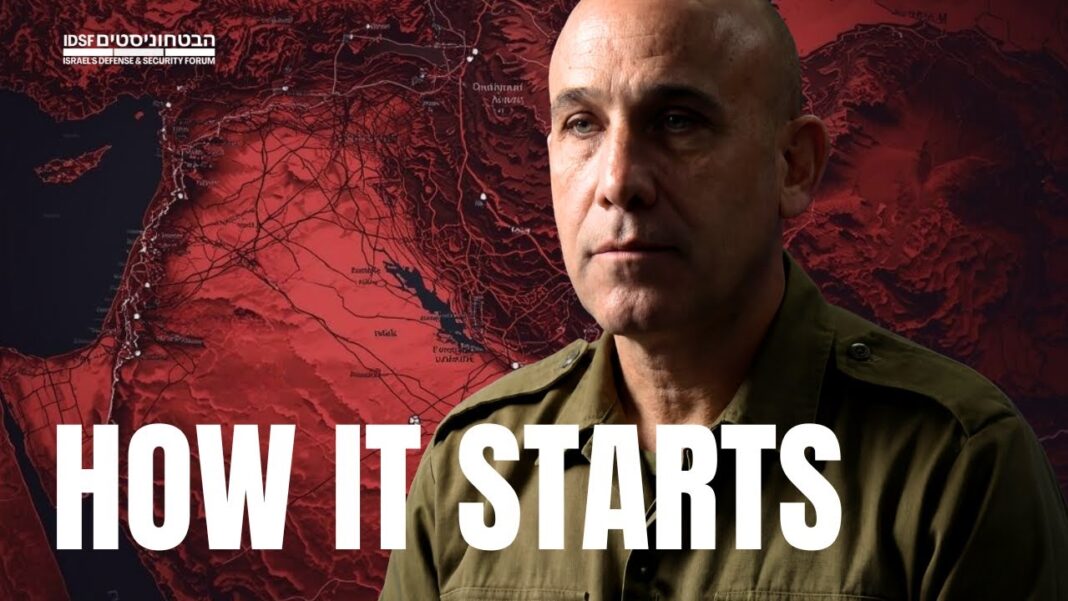
World Israel News reported on Thursday that this warning came from Brigadier General (Res.) Amir Avivi, a former senior officer in the Israel Defense Forces and the current head of the Habithonistim security advocacy group, during a high-level conference this week hosted by Israel Hayom focusing on the future of northern Israel and the evolving regional security environment. His remarks, delivered with measured gravity rather than alarmist rhetoric, underscored the degree to which Israeli strategic thinking has entered a new and more volatile phase.
According to the information provided in the World Israel News report, Avivi challenged the prevailing media narrative that a future war with Iran would likely be triggered by an American strike. While acknowledging that Washington remains a central actor in the regional equation, he made clear that Jerusalem does not view itself as merely a reactive player waiting for U.S. decisions. Israel, he suggested, is actively weighing its own independent military options.
“There could be a preemptive Iranian strike,” Avivi said. “We see the government and the security brass warning Iran. It is possible that we will launch an attack before the Americans do.” The World Israel News report noted that this statement reflects a growing sentiment within Israeli defense circles that time may not be a neutral factor — and that delay may itself carry strategic risk.
This assessment is rooted in Israel’s deep concern over Iran’s systematic efforts to rebuild and reposition its proxy network throughout the region. Hezbollah in Lebanon, Shi’ite militias in Syria and Iraq, Palestinian terror organizations in Gaza and in Judea and Samaria, and Houthi forces in Yemen collectively form what Israeli intelligence officials have long described as a “ring of fire” — a multi-directional threat architecture designed to encircle Israel and overwhelm its defenses through coordinated pressure from multiple fronts.
The World Israel News report emphasized that Avivi’s warning was not limited to the possibility of a direct Israeli-Iranian confrontation. Rather, he stressed that any war involving Iran would almost certainly manifest as a multi-theater conflict, with Iranian proxies serving as the primary instruments of escalation.
“Iran is moving its proxies to ensure they do not face us alone,” Avivi explained. “We hear in the discourse that they are weighing this option. Therefore, the probability of a major attack in Iran coinciding with fire from additional sectors is very high.”
This strategic logic reflects Iran’s long-standing doctrine of asymmetric warfare. Tehran has spent decades building non-state military infrastructures across the Middle East precisely to avoid direct conventional confrontation while retaining the capacity to project power, destabilize adversaries, and impose deterrence through proxy violence. World Israel News has repeatedly documented how this proxy strategy has evolved into one of Iran’s most potent geopolitical tools.
From Israel’s perspective, this architecture poses an existential challenge. A single-front war, while devastating, remains within Israel’s military planning parameters. A synchronized, multi-front conflict — involving Hezbollah rockets from Lebanon, terror cells from Syria, Hamas or Islamic Jihad attacks from Gaza, and potential unrest in Judea and Samaria — represents a fundamentally different scale of threat.
World Israel News reported that Avivi explicitly linked this risk to Israel’s current military posture in Lebanon, where the IDF has conducted repeated operations against Hezbollah infrastructure. These operations, he suggested, are not random or symbolic, but part of a deliberate strategic campaign to degrade Hezbollah’s capabilities before they can be fully regenerated under Iranian guidance.
“The IDF is not attacking in Lebanon constantly for no reason,” Avivi said, according to World Israel News. “This is part of a broader strategic logic.”
Yet Avivi also issued a warning to Israel’s adversaries: if Hezbollah chooses to enter a regional war against Israel, the response will be devastating. He stated unequivocally that Israel would respond with overwhelming force “until they collapse,” signaling a doctrine of decisive escalation rather than limited containment.
The World Israel News report noted that this language reflects a shift away from the restrained, incremental conflict management strategies that characterized previous rounds of fighting. Instead, Israeli military doctrine appears increasingly oriented toward rapid, overwhelming force designed to neutralize adversarial capacity at its core.
The broader geopolitical context only intensifies these calculations. The United States has dramatically increased its military presence in the region, including naval deployments and air assets, while President Trump has publicly warned Iran against further escalation and human rights abuses. Yet, as World Israel News has reported in recent days, ambiguity remains over whether Washington intends to initiate direct military action against Iran or prefers to maintain pressure through deterrence and diplomacy.
This uncertainty leaves Israel in a precarious strategic position. On one hand, coordination with the United States remains essential to Israel’s long-term security architecture. On the other, Israeli leaders have repeatedly made clear that they will not outsource existential defense decisions to external actors.
Avivi’s remarks reflect that strategic independence. World Israel News interprets his comments not as a call for immediate war, but as a signal that Israel is recalibrating its red lines. The rebuilding of Iranian proxy forces, particularly Hezbollah’s reconstitution following recent regional conflicts, is increasingly viewed in Jerusalem as a narrowing window of opportunity.
If Iran’s network becomes sufficiently entrenched and operationally coordinated, Israel may face a future conflict under significantly worse conditions. From this perspective, preemption becomes not aggression, but risk management — a logic that has shaped Israeli military doctrine since the state’s founding.
This logic echoes historical precedents, including Israel’s 1981 strike on Iraq’s Osirak nuclear reactor and the 2007 destruction of Syria’s covert nuclear facility. In both cases, Israel acted unilaterally, preemptively, and decisively — not because war was imminent, but because future risk was deemed unacceptable.
Avivi’s assessment situates current tensions within this same strategic tradition.
Yet the stakes today are far higher. Iran is not Iraq in 1981 or Syria in 2007. It is a regional power with global reach, sophisticated missile capabilities, and a deeply embedded proxy network across multiple countries. Any confrontation risks cascading escalation far beyond Israel’s borders.
At the same time, Iran itself faces internal instability. Mass protests, economic pressure, political fragmentation, and international isolation have weakened the regime’s internal legitimacy. World Israel News has extensively covered the scale of unrest within Iran and the regime’s increasingly brutal repression. These internal pressures create unpredictable incentives — including the possibility that Tehran may seek external confrontation as a tool of internal consolidation.
From Israel’s perspective, this volatility increases the danger of miscalculation. A regime under pressure may behave irrationally. A regime losing internal legitimacy may seek external enemies. And a regime that perceives itself encircled may strike first.
Avivi’s warning that “there could be a preemptive Iranian strike” reflects this fear — not simply of military aggression, but of strategic unpredictability.
In this environment, Israel’s leadership faces a grim calculus: wait and risk being surrounded by a strengthened proxy network, or act and risk regional war.
The World Israel News report emphasized that this is not a binary moral dilemma but a strategic one — rooted in assessments of force posture, intelligence projections, and long-term national survival.
What emerges from Avivi’s remarks is not bravado, but strategic anxiety. The language of inevitability — “very high probability,” “multi-front conflict,” “collapse” — signals a belief that the region is approaching a structural tipping point.
At the same time, his comments also contain an implicit deterrent message. By signaling Israel’s readiness to act independently and decisively, Israeli leaders aim to shape adversarial calculations. Deterrence, after all, is not only about military capacity — it is about credibility.
World Israel News has repeatedly documented how Israel seeks to communicate red lines clearly, even publicly, in order to prevent miscalculation. Avivi’s statements serve this function as much as they serve as analysis.
Ultimately, the warning delivered this week reflects a deeper truth about the Middle East’s current strategic landscape: the era of frozen conflicts and managed instability may be giving way to a more dangerous phase of structural confrontation.
Whether Israel strikes first, whether the United States acts, or whether Iran escalates through its proxies, the region appears to be moving toward a confrontation that is no longer hypothetical but increasingly plausible.
Avivi’s assessment should not be read as prophecy, but as diagnosis — a snapshot of a strategic environment in which time, rather than calming tensions, may be intensifying them.
In such a landscape, preemption becomes not an act of impulse, but a doctrine of survival. And restraint, paradoxically, may become the greater risk.
By: Fern Sidman
As tensions between Jerusalem and Tehran continue to escalate toward what many analysts now describe as a dangerous strategic inflection point, a stark and sobering assessment has emerged from within Israel’s security establishment: Israel may not wait for the United States to act. According to a senior retired Israeli military commander, the Jewish state could move first — striking Iran preemptively if it concludes that the strategic balance is shifting irreversibly in Tehran’s favor.
World Israel News reported on Thursday that this warning came from Brigadier General (Res.) Amir Avivi, a former senior officer in the Israel Defense Forces and the current head of the Habithonistim security advocacy group, during a high-level conference this week hosted by Israel Hayom focusing on the future of northern Israel and the evolving regional security environment. His remarks, delivered with measured gravity rather than alarmist rhetoric, underscored the degree to which Israeli strategic thinking has entered a new and more volatile phase.
According to the information provided in the World Israel News report, Avivi challenged the prevailing media narrative that a future war with Iran would likely be triggered by an American strike. While acknowledging that Washington remains a central actor in the regional equation, he made clear that Jerusalem does not view itself as merely a reactive player waiting for U.S. decisions. Israel, he suggested, is actively weighing its own independent military options.
“There could be a preemptive Iranian strike,” Avivi said. “We see the government and the security brass warning Iran. It is possible that we will launch an attack before the Americans do.” The World Israel News report noted that this statement reflects a growing sentiment within Israeli defense circles that time may not be a neutral factor — and that delay may itself carry strategic risk.
This assessment is rooted in Israel’s deep concern over Iran’s systematic efforts to rebuild and reposition its proxy network throughout the region. Hezbollah in Lebanon, Shi’ite militias in Syria and Iraq, Palestinian terror organizations in Gaza and in Judea and Samaria, and Houthi forces in Yemen collectively form what Israeli intelligence officials have long described as a “ring of fire” — a multi-directional threat architecture designed to encircle Israel and overwhelm its defenses through coordinated pressure from multiple fronts.
The World Israel News report emphasized that Avivi’s warning was not limited to the possibility of a direct Israeli-Iranian confrontation. Rather, he stressed that any war involving Iran would almost certainly manifest as a multi-theater conflict, with Iranian proxies serving as the primary instruments of escalation.
“Iran is moving its proxies to ensure they do not face us alone,” Avivi explained. “We hear in the discourse that they are weighing this option. Therefore, the probability of a major attack in Iran coinciding with fire from additional sectors is very high.”
This strategic logic reflects Iran’s long-standing doctrine of asymmetric warfare. Tehran has spent decades building non-state military infrastructures across the Middle East precisely to avoid direct conventional confrontation while retaining the capacity to project power, destabilize adversaries, and impose deterrence through proxy violence. World Israel News has repeatedly documented how this proxy strategy has evolved into one of Iran’s most potent geopolitical tools.
From Israel’s perspective, this architecture poses an existential challenge. A single-front war, while devastating, remains within Israel’s military planning parameters. A synchronized, multi-front conflict — involving Hezbollah rockets from Lebanon, terror cells from Syria, Hamas or Islamic Jihad attacks from Gaza, and potential unrest in Judea and Samaria — represents a fundamentally different scale of threat.
World Israel News reported that Avivi explicitly linked this risk to Israel’s current military posture in Lebanon, where the IDF has conducted repeated operations against Hezbollah infrastructure. These operations, he suggested, are not random or symbolic, but part of a deliberate strategic campaign to degrade Hezbollah’s capabilities before they can be fully regenerated under Iranian guidance.
“The IDF is not attacking in Lebanon constantly for no reason,” Avivi said, according to World Israel News. “This is part of a broader strategic logic.”
Yet Avivi also issued a warning to Israel’s adversaries: if Hezbollah chooses to enter a regional war against Israel, the response will be devastating. He stated unequivocally that Israel would respond with overwhelming force “until they collapse,” signaling a doctrine of decisive escalation rather than limited containment.
The World Israel News report noted that this language reflects a shift away from the restrained, incremental conflict management strategies that characterized previous rounds of fighting. Instead, Israeli military doctrine appears increasingly oriented toward rapid, overwhelming force designed to neutralize adversarial capacity at its core.
The broader geopolitical context only intensifies these calculations. The United States has dramatically increased its military presence in the region, including naval deployments and air assets, while President Trump has publicly warned Iran against further escalation and human rights abuses. Yet, as World Israel News has reported in recent days, ambiguity remains over whether Washington intends to initiate direct military action against Iran or prefers to maintain pressure through deterrence and diplomacy.
This uncertainty leaves Israel in a precarious strategic position. On one hand, coordination with the United States remains essential to Israel’s long-term security architecture. On the other, Israeli leaders have repeatedly made clear that they will not outsource existential defense decisions to external actors.
Avivi’s remarks reflect that strategic independence. World Israel News interprets his comments not as a call for immediate war, but as a signal that Israel is recalibrating its red lines. The rebuilding of Iranian proxy forces, particularly Hezbollah’s reconstitution following recent regional conflicts, is increasingly viewed in Jerusalem as a narrowing window of opportunity.
If Iran’s network becomes sufficiently entrenched and operationally coordinated, Israel may face a future conflict under significantly worse conditions. From this perspective, preemption becomes not aggression, but risk management — a logic that has shaped Israeli military doctrine since the state’s founding.
This logic echoes historical precedents, including Israel’s 1981 strike on Iraq’s Osirak nuclear reactor and the 2007 destruction of Syria’s covert nuclear facility. In both cases, Israel acted unilaterally, preemptively, and decisively — not because war was imminent, but because future risk was deemed unacceptable.
Avivi’s assessment situates current tensions within this same strategic tradition.
Yet the stakes today are far higher. Iran is not Iraq in 1981 or Syria in 2007. It is a regional power with global reach, sophisticated missile capabilities, and a deeply embedded proxy network across multiple countries. Any confrontation risks cascading escalation far beyond Israel’s borders.
At the same time, Iran itself faces internal instability. Mass protests, economic pressure, political fragmentation, and international isolation have weakened the regime’s internal legitimacy. World Israel News has extensively covered the scale of unrest within Iran and the regime’s increasingly brutal repression. These internal pressures create unpredictable incentives — including the possibility that Tehran may seek external confrontation as a tool of internal consolidation.
From Israel’s perspective, this volatility increases the danger of miscalculation. A regime under pressure may behave irrationally. A regime losing internal legitimacy may seek external enemies. And a regime that perceives itself encircled may strike first.
Avivi’s warning that “there could be a preemptive Iranian strike” reflects this fear — not simply of military aggression, but of strategic unpredictability.
In this environment, Israel’s leadership faces a grim calculus: wait and risk being surrounded by a strengthened proxy network, or act and risk regional war.
The World Israel News report emphasized that this is not a binary moral dilemma but a strategic one — rooted in assessments of force posture, intelligence projections, and long-term national survival.
What emerges from Avivi’s remarks is not bravado, but strategic anxiety. The language of inevitability — “very high probability,” “multi-front conflict,” “collapse” — signals a belief that the region is approaching a structural tipping point.
At the same time, his comments also contain an implicit deterrent message. By signaling Israel’s readiness to act independently and decisively, Israeli leaders aim to shape adversarial calculations. Deterrence, after all, is not only about military capacity — it is about credibility.
World Israel News has repeatedly documented how Israel seeks to communicate red lines clearly, even publicly, in order to prevent miscalculation. Avivi’s statements serve this function as much as they serve as analysis.
Ultimately, the warning delivered this week reflects a deeper truth about the Middle East’s current strategic landscape: the era of frozen conflicts and managed instability may be giving way to a more dangerous phase of structural confrontation.
Whether Israel strikes first, whether the United States acts, or whether Iran escalates through its proxies, the region appears to be moving toward a confrontation that is no longer hypothetical but increasingly plausible.
Avivi’s assessment should not be read as prophecy, but as diagnosis — a snapshot of a strategic environment in which time, rather than calming tensions, may be intensifying them.
In such a landscape, preemption becomes not an act of impulse, but a doctrine of survival. And restraint, paradoxically, may become the greater risk.
