



|
Getting your Trinity Audio player ready...
|
By: Fern Sidman
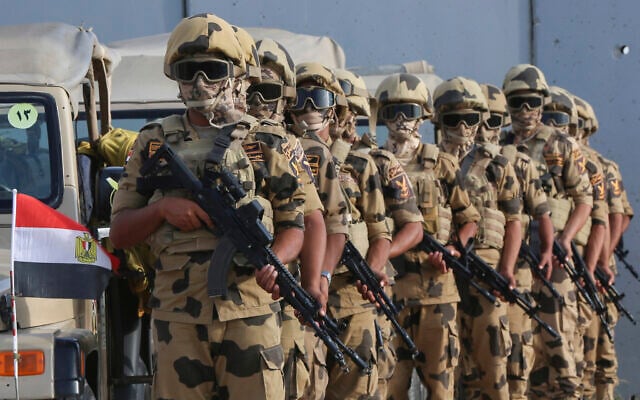
A multinational military force led by Egypt and composed of troops from several Muslim-majority nations is being organized to deploy in the Gaza Strip to enforce a delicate ceasefire between Israel and Hamas, according to a report that appeared on Tuesday at World Israel News (WIN). The proposal, which marks one of the most ambitious regional stabilization efforts in decades, is part of a broader U.S.-backed peace plan aimed at securing post-war Gaza and laying the groundwork for long-term reconstruction and governance reform.
As reported by World Israel News, the Cairo-based initiative would see 4,000 soldiers from four countries — Egypt, Turkey, Indonesia, and Azerbaijan — deployed across Gaza’s borders and urban sectors. Egypt, which has played a pivotal mediating role in multiple Israeli-Hamas ceasefires, would hold command authority over the force.
Citing sources in The National, an Emirati news outlet, World Israel News noted that the multinational force will be tasked with “enforcing the ceasefire, preventing the rearmament of Hamas, and ensuring safe conditions for humanitarian aid and reconstruction.” The plan envisions a carefully defined mandate under the auspices of a United Nations Security Council resolution, giving the operation international legitimacy while keeping the internal administration of Gaza in the hands of a new technocratic Palestinian committee.
Egyptian Foreign Minister Badr Abdelatty confirmed to The National that his government had formally requested the UN Security Council to vote on the resolution “as soon as possible.” He described the envisioned deployment as a limited but decisive peacekeeping mission, combining regional authority with international oversight.
“First, we need a Security Council resolution to adopt this plan as early as possible and to give legitimacy to the international force,” Abdelatty said, as quoted in the World Israel News report. “This is very important. Egypt is ready to participate in any framework, but under certain parameters.”
According to the information provided in the World Israel News report, the plan for Gaza’s stabilization draws directly from President Donald Trump’s 20-point peace initiative, unveiled earlier this year, which outlines a phased approach for transitioning the territory from Hamas control to an internationally supervised governance framework.
Under this plan, the Egyptian-led force would have a narrowly defined mission: enforcing the truce, maintaining security in buffer zones, and overseeing the demilitarization of militant factions. Egypt’s leadership, regional analysts told World Israel News, is considered critical because of its shared border with Gaza, deep intelligence presence in the area, and historical role as a mediator between Israel and the Palestinians.
The U.S.-sponsored “Board of Peace”, a civilian body outlined in the White House’s plan, would complement the force’s activities by coordinating humanitarian logistics and reconstruction funding. Abdelatty told reporters that this board will manage the flow of international aid, ensure that funds earmarked for Gaza’s rehabilitation are not diverted, and monitor compliance with ceasefire terms.
“Egypt’s responsibility,” Abdelatty said, “is to ensure that Gaza is not left in chaos but stabilized through a structured, internationally backed mechanism that restores security and enables reconstruction.”
On Monday, an Israeli delegation landed in Cairo for high-level talks with counterparts from Egypt, Turkey, and Qatar to discuss the proposal, World Israel News reported. These discussions are centered on security arrangements, demilitarization mechanisms, and the eventual composition of Gaza’s post-war administration.
Israeli officials have expressed cautious support for Egypt’s leadership but remain wary of Turkey’s involvement, given Ankara’s previous alignment with Hamas and its harsh criticism of Israeli military operations. The World Israel News report noted that Prime Minister Benjamin Netanyahu’s government views Egyptian command as essential to maintaining stability, while participation by Turkey or Qatar remains “a matter of ongoing negotiation and concern.”
Israel is said to be seeking explicit guarantees that the multinational force will act “neutrally and decisively” to prevent any resurgence of terrorism. An Israeli security source quoted in the World Israel News report emphasized that Jerusalem “welcomes any initiative that ensures Hamas cannot rebuild its military infrastructure” but added that Israel will retain the right to act militarily if security conditions deteriorate.
Adding further weight to the plan, Pakistan is reportedly considering contributing troops to the Egyptian-led mission, according to a report published by Politico and cited in the World Israel News report.
Both an American Defense Department official and a former U.S. security adviser confirmed that Islamabad has been in informal discussions with Washington and Cairo regarding potential participation. The Pakistani contingent would likely provide logistical and engineering support rather than direct combat operations.
The inclusion of Pakistan — a nuclear-armed Muslim nation with longstanding ties to Arab and Western powers — would, according to the report at World Israel News, symbolize a broad-based Islamic endorsement of the peace plan, strengthening its credibility across the Muslim world.
Diplomats involved in the talks have stressed that the United Nations Security Council’s approval is critical to the mission’s legitimacy. Egypt has circulated a draft resolution among Security Council members outlining the force’s structure, rules of engagement, and reporting mechanisms to ensure transparency and accountability.
Abdelatty told The National, as relayed in the World Israel News report, that Cairo wants a “clear but limited mandate” — one that gives peacekeepers sufficient authority to enforce order while avoiding direct interference in Gaza’s domestic governance. “The armed force must be seen as protectors, not occupiers,” he said.
Washington, meanwhile, is said to be lobbying Security Council members to support the measure, emphasizing that the force will operate under strict oversight from the U.S.-led Board of Peace and will coordinate closely with Israeli and Egyptian military channels.
Despite the progress, World Israel News reported that significant diplomatic and logistical challenges remain. Some Israeli analysts question whether the involvement of countries like Turkey and Indonesia — both of which have criticized Israel’s conduct during the Gaza war — could complicate coordination with the IDF.
There are also concerns within Israel’s defense establishment about how the multinational force will handle potential ceasefire violations or rogue militias that refuse to disarm. “The key question,” a senior Israeli defense official told World Israel News, “is not only who leads the force, but how its authority is defined. Egypt’s leadership is reassuring, but command unity is essential.”
Furthermore, internal Palestinian dynamics pose another layer of complexity. The technocratic committee envisioned to manage Gaza’s civil affairs will need broad legitimacy among Gazans while maintaining neutrality between competing factions. The Board of Peace, according to the report at World Israel News, seeks to prevent the return of Hamas governance while gradually introducing internationally supervised local administration.
Supporters of the initiative view it as a potential turning point in Middle Eastern diplomacy, representing unprecedented collaboration between the United States, Egypt, and key Muslim-majority nations. “If successful,” wrote World Israel News, “the Egyptian-led force could serve as a prototype for future regional peacekeeping missions — a partnership between Western powers and responsible Muslim states to confront extremism.”
The participation of Azerbaijan, a secular but predominantly Muslim nation with strong ties to Israel, adds another layer of strategic significance. Baku’s involvement reflects the growing network of pragmatic Muslim countries that recognize Israel’s right to self-defense while promoting regional stability.
While the prospect of a multinational peacekeeping force offers hope for a more secure Gaza, diplomats and defense experts caution that the operation’s success will depend on careful execution and sustained political will.
The World Israel News report emphasized that the truce remains fragile and could collapse if extremist factions view the foreign deployment as an occupation or if reconstruction efforts falter. Egypt, with its decades of experience mediating between Israel and Hamas, is seen as uniquely positioned to balance the delicate equation — enforcing security while maintaining regional credibility.
Abdelatty concluded his remarks with a mixture of resolve and realism: “Egypt is ready to lead, but we cannot do this alone. We need unity — from the region, from the international community, and from all who believe that Gaza’s suffering must end.”
For now, as the World Israel News report observed, the plan stands as a rare moment of diplomatic alignment — one where Washington, Cairo, and Jerusalem appear to share a common goal: preventing another cycle of war and ensuring that Gaza’s future is defined not by terror, but by stability, reconstruction, and peace.