



|
Getting your Trinity Audio player ready...
|
By: Fern Sidman
As Israel slowly resumes its peacetime rhythms following the war with Iran, the Druze communities of the Golan Heights remain gripped by grief and anxiety in the aftermath of a massacre that has sent shockwaves through both sides of the border. According to a report that appeared on Sunday at The Jewish News Syndicate (JNS), the July 13 massacre in Sweida — a predominantly Druze city in southern Syria — claimed the lives of hundreds of Druze Syrians and left an indelible scar on their brethren living in Majdal Shams, the largest Druze town on the Israeli side of the Golan Heights.
“This is our October 7,” Sari Halabi, a resident of Majdal Shams whose home lies just 50 yards from the border fence, told JNS on July 17. His words evoke Israel’s collective trauma from the Hamas-led attacks on October 7, a parallel drawn by many in the Druze community now mourning their own tragedy.
“Life froze. We keep watching the videos that the terrorists took of themselves butchering our families, feeling angry, anxious, and completely destabilized,” Halabi told JNS, describing a community caught between mourning, fear, and a complex geopolitical reality.
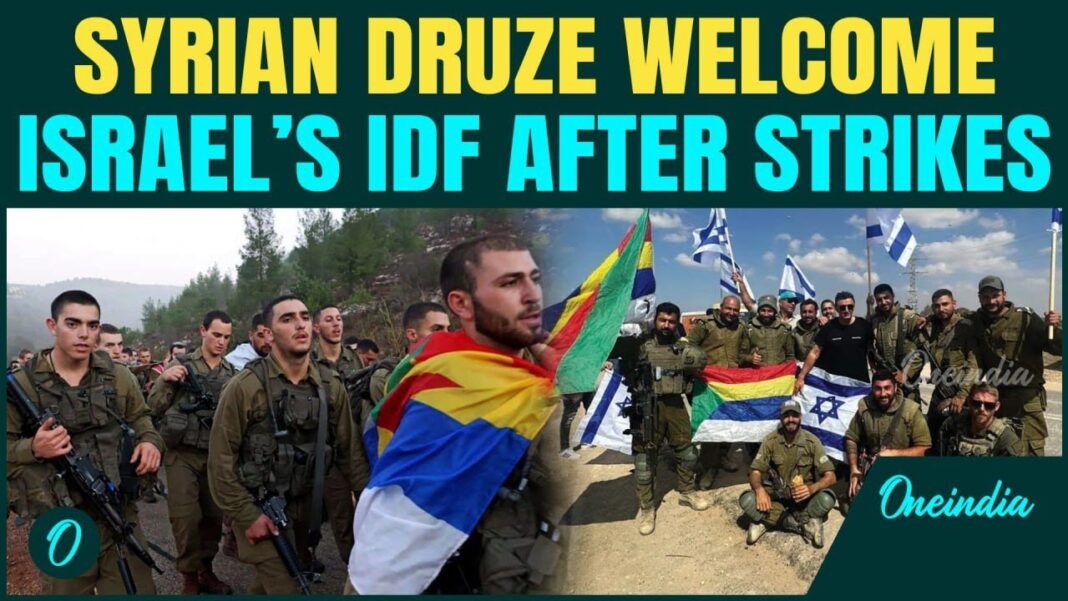
Beyond the shock and sorrow, many Druze in the Golan expressed profound gratitude toward Israel for what they saw as a decisive intervention. On July 16, just days after the massacre, the Israel Air Force struck key regime targets in Damascus — a move seen by some in the Druze community as a critical action that helped stop the bloodshed. This operation fueled a fragile optimism among Golan Druze, who now speak of possible renewed bonds between the Druze of Israel and Syria, forged in shared suffering and mutual defense.
In the chaotic days following the massacre, JNS documented instances of Druze residents on the Israeli side of the border briefly crossing into Syria without permission to check on relatives. Simultaneously, dozens of Druze Syrians entered Israel seeking safety and reunion with family members, though most eventually returned. The cross-border movements underscored the deep personal and familial ties that persist despite decades of political separation.
Elsewhere in Israel, the approximately 150,000 Druze citizens expressed their solidarity by declaring a general strike, blocking roads, and holding demonstrations demanding government action to protect their kin across the border. These protests eased following the July 16 Israeli airstrikes, which JNS reported as pivotal in prompting Syrian authorities to announce a ceasefire and deploy forces to Sweida in an attempt to end the violence.
However, the unrest laid bare the enduring impact of Syrian affairs on Israel’s Druze community — a minority distinguished by its loyalty to the Jewish state and active military service. For many, the events have catalyzed discussions about autonomy for the Druze in Syria and the potential for closer ties with Israel.
Halabi, a 38-year-old father of three, told JNS that rather than a liability, the Druze community’s attachment to Syria serves as a strategic asset for Israel. “This attachment opens the path to many things, which I think the terrible massacre has brought closer, including a Druze autonomy fighting and flourishing alongside Israel on the Syrian side of the border,” he said.
Halabi and others believe that the massacre will settle longstanding internal debates among Syrian Druze about their political future, potentially leading to stronger support for autonomy and alignment with Israel. Such an outcome would be geopolitically significant, given Israel’s interest in maintaining a stable and friendly buffer along its northeastern frontier.
Still, Halabi confessed to JNS that before considering political strategy, he, like many in his community, found himself transfixed by the brutal footage of the massacre circulating online. “I was just sitting there watching the horror videos, one by one. Just like we all did on October 7,” he said, drawing a parallel between the Syrian massacre and the Hamas atrocities that stunned Israel.
Each evening, hundreds of Golan Druze gather near the border fence in Majdal Shams — close to Halabi’s home — to mourn, fly Druze flags, exchange information, and attempt to catch glimpses of their Syrian neighbors. These gatherings have become a nightly ritual of shared grief and solidarity.
On one such evening, Druze men wearing balaclavas expelled Al Jazeera reporters from Majdal Shams, accusing the Qatari network of acting as a front for enemy intelligence. “This is not news. This is reconnaissance. They’re collecting information for the enemy,” a young Druze man told JNS, reflecting deep-seated suspicion of the network’s anti-Israel stance.
Security concerns in Majdal Shams are not hypothetical. An Hezbollah rocket attack last year killed 12 children playing soccer in the town — a tragedy still etched in local memory. The community erected a statue in a nearby square featuring a crowned soccer ball with 24 angel wings to honor the victims.
At a state commemoration for the victims of the October 7 war, Luna Rabbah of Majdal Shams performed a memorial song, a moment her father Abdullah Rabbah proudly recounted to JNS. Speaking near the border fence, Abdullah reflected on the challenges of the past year and praised Israel’s airstrikes in Damascus as an act of “brotherly courage” that saved lives, albeit belatedly.
Israeli Prime Minister Benjamin Netanyahu confirmed on July 17 that the airstrikes targeted Syrian forces south of Damascus who had entered a demilitarized zone to carry out massacres against the Druze. Netanyahu’s statement noted that the offensive included strikes on the Syrian army’s general staff headquarters and resulted in dozens of casualties, according to Syrian sources.
The strikes marked a departure from Israel’s usual policy, given that the IDF rarely intervenes militarily on behalf of non-citizens. While some see the strikes as a purely humanitarian gesture, others, like Ilham — a Druze woman in her fifties who spoke to JNS — suspect political calculations involving Netanyahu, U.S. President Donald Trump, Syrian President Ahmed al-Sharaa, and Saudi Arabia. “I don’t believe it was about the Druze,” she said.
Longstanding grievances also color the community’s reactions. Many Druze in Israel feel marginalized, particularly after the 2018 Nation-State Law reaffirmed Israel as the nation-state of the Jewish people — a law some Druze view as exclusionary.
Yet, Abdullah Rabbah expressed to JNS his belief that the strikes represented a turning point. “An unprecedented act of solidarity that will usher in a new level of integration and fraternity between Jews and Druze,” he said, predicting an increased interest among Golan Druze in acquiring Israeli citizenship.
Historically, most Golan Druze refrained from taking Israeli citizenship, holding onto their Syrian identity despite living under Israeli rule since 1967. However, recent years have seen a growing number of Druze residents naturalizing, driven by the unlikelihood of a political reversal in the Golan’s status and a desire for security.
Standing at the border in a cap bearing both the Druze and Israeli flags, Rabbah told JNS, “I’m optimistic. Just like Israel emerged from October 7 much stronger than it was before, so too will the Druze — and their eternal alliance with Israel.”
The events of July 13, as reported by JNS, have not only shaken the Druze community but may also have reset the strategic calculus in the Golan Heights. As Israel, Syria, and regional powers watch closely, the shared pain and solidarity between Israel and the Druze could signal the dawn of new political alignments along this historically tense border.

It is this virtuous courageous response by Prime Minister Netanyahu for which he is repeatedly slandered as a “MADMAN” by TJV’s lead story, above.
“Beyond the shock and sorrow, many Druze in the Golan expressed profound gratitude toward Israel for what they saw as a decisive intervention.” As well they should have.
Exposing What No One Else Will about Julani (Druze/Christian massacre)
https://youtu.be/PmDQ4WG5SlY?feature=shared