



|
Getting your Trinity Audio player ready...
|
By: Fern Sidman
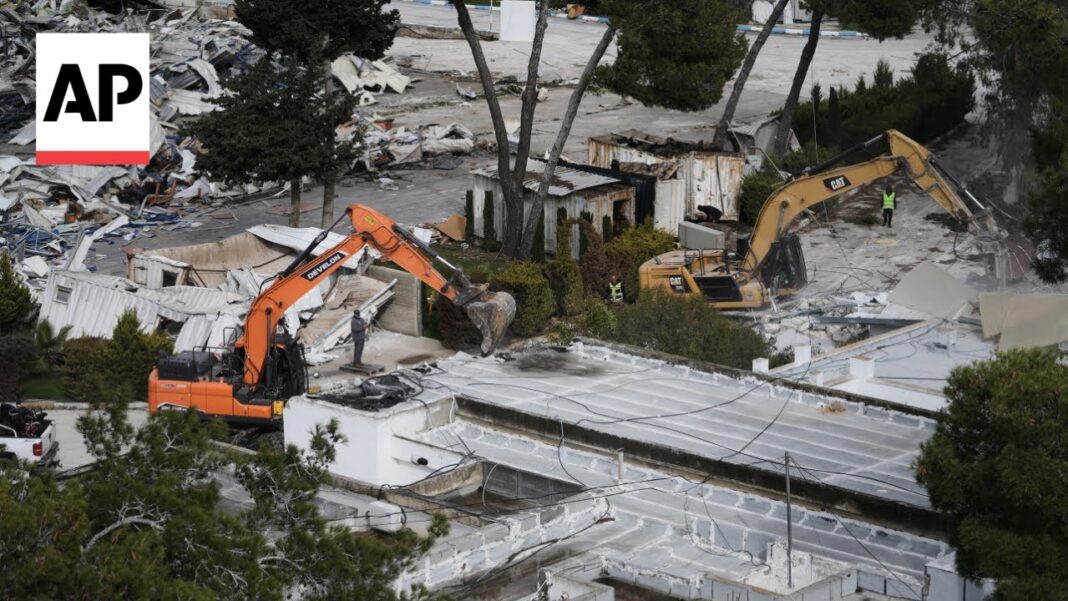
In a move freighted with political symbolism and strategic consequence, Israeli authorities on Tuesday began the demolition of the United Nations Relief and Works Agency (UNRWA) compound at Ammunition Hill in Jerusalem, formally closing a controversial chapter in the organization’s decades-long presence in the Israeli capital. The operation followed the recent passage of legislation barring UNRWA from operating within Israel’s sovereign territory, a development that Israeli officials have described as both a national security imperative and a moral reckoning.
According to a report by Israel National News, heavy engineering vehicles and construction crews arrived at the site early Tuesday morning under the supervision of the Israel Land Authority and law enforcement personnel. Within hours, structures that had housed UNRWA offices and logistical facilities were reduced to rubble, bringing to an end what critics have long characterized as a hub of politicized activity masquerading as humanitarian relief.
The demolition was accompanied by a clear and unmistakable message from Israeli officials: the era in which UNRWA functioned with broad latitude inside Israel has decisively concluded.
At the center of the drama stood Knesset Member Yulia Malinovsky of the Yisrael Beytenu party, the principal architect of the legislation that paved the way for Tuesday’s action. Present at the site as bulldozers began their work, Malinovsky framed the demolition as the culmination of a protracted struggle to remove a dangerous and destabilizing presence from Jerusalem.
“UNRWA’s terror headquarters in Ammunition Hill was removed this morning, and at this moment, it is being destroyed before the State of Israel takes over the land,” Malinovsky declared, as quoted by Israel National News. “This is happening thanks to the laws that I initiated to remove UNRWA from Israel.”
Her words captured the combative spirit that has animated Israeli political discourse surrounding UNRWA for years. Successive governments and security officials have correctly accused the organization of enabling anti-Israel incitement, facilitating Hamas influence, and perpetuating rather than alleviating the Israeli-Palestinian conflict.
The new law, approved earlier this year, prohibits UNRWA from operating in Israel and grants authorities the power to reclaim property previously used by the agency. Tuesday’s demolition represented the most tangible application of that statute to date.
The Israeli Foreign Ministry moved swiftly to contextualize the operation, emphasizing that the Jerusalem compound in question is legally owned by the State of Israel and that UNRWA had already vacated the premises prior to the enforcement action.
“The State of Israel owns the Jerusalem compound in which the Israel Land Authority is operating today,” the ministry said in a statement cited in the Israel National News report. “Even prior to the passage of legislation in January 2025, UNRWA had already ceased its operations at this site and no longer had any UN personnel or UN activity there.”
This point, officials stressed, was crucial. Contrary to claims from critics that the demolition represented an aggressive seizure of a diplomatic facility, the Foreign Ministry asserted that the property never enjoyed any special immunity under international law.
“The compound does not enjoy any immunity,” the statement continued, “and the seizure of this compound by Israeli authorities was carried out in accordance with both Israeli and international law.”
According to the information provided in the Israel National News report, Israeli officials emphasized that the demolition was not an abrupt or ad hoc measure, but rather the orderly implementation of domestic legislation already enacted by the Knesset. The move, they argued, simply formalized a reality that had been in place for months: UNRWA was no longer functioning at the Ammunition Hill location.
While Tuesday’s demolition centered on a single site in Jerusalem, Israeli leaders made clear that their objections to UNRWA extend far beyond real estate.
In unusually blunt language, the Foreign Ministry used the occasion to issue a sweeping condemnation of the agency’s conduct, alleging deep and systemic ties between UNRWA personnel and Palestinian terrorist organizations.
“UNRWA employees participated in the October 7th massacre and the kidnapping of Israelis,” the ministry asserted in comments reported by Israel National News. “Numerous employees within the organization are Hamas and Palestinian Islamic Jihad terrorists, and the organization’s infrastructure has been used for tunnel construction, rocket fire, and terrorist activities.”
The statement went further, accusing UNRWA of abandoning any pretense of neutrality. “UNRWA-Hamas has long ceased to be a humanitarian aid organization, serving instead as a greenhouse for terrorism,” the ministry declared.
These allegations, long advanced by Israeli intelligence agencies and political leaders, gained renewed urgency after the Hamas-led assault on southern Israel on October 7, 2023. In the months that followed, a growing body of evidence emerged revealing that a number of UNRWA employees had direct involvement in the attacks or provided logistical support to Hamas.
Israel National News has extensively documented Israeli concerns that UNRWA facilities in Gaza and elsewhere were used as cover for terrorist infrastructure, including weapons storage and underground tunnels. Those reports have fueled mounting calls within Israel to sever all ties with the agency.
The choice of the Ammunition Hill site as the focal point of Tuesday’s demolition carried profound historical resonance. The neighborhood is home to one of the most iconic battlefields of the 1967 Six-Day War, where Israeli paratroopers fought a fierce engagement that paved the way for the reunification of Jerusalem.
For many Israelis, the presence of UNRWA offices at such a location had long been viewed as an affront — a reminder that an organization that is clearly hostile to Israel maintained a foothold at a place synonymous with Jewish sovereignty and sacrifice.
By leveling the compound, Israeli authorities effectively reclaimed not only a physical space but also a symbolic one.
“This is more than a bureaucratic decision,” a senior government official told Israel National News on condition of anonymity. “It is a statement that Jerusalem belongs to the Jewish people and that no international body will be allowed to undermine that reality from within our capital.”
Unsurprisingly, the demolition is likely to reverberate far beyond Jerusalem. UNRWA has long enjoyed substantial international support, particularly from European governments and humanitarian organizations that argue the agency plays an indispensable role in providing services to Palestinian refugees.
However, Israel’s case against UNRWA has gained increasing traction in recent years, especially following revelations about the extent of Hamas infiltration within the organization.
Several Western governments temporarily suspended funding to UNRWA after the October 7 attacks amid investigations into employee misconduct. Although some of that funding has since resumed, confidence in the agency remains deeply shaken.
Israel National News reported that Israeli diplomats have launched a concerted campaign to persuade allies that UNRWA is beyond reform and must ultimately be replaced by alternative mechanisms for delivering humanitarian aid.
Tuesday’s demolition, Israeli officials hope, will add momentum to that effort.
With the Ammunition Hill compound now reduced to debris, attention is turning to the future of the site and to the broader implications of Israel’s UNRWA ban.
Officials have indicated that the land will be redeveloped for public or governmental use, though no specific plans have yet been announced. Some lawmakers have suggested the area could be converted into educational or commemorative facilities connected to Jerusalem’s historical heritage.
More broadly, the Israeli government faces the complex challenge of ensuring that humanitarian needs in Palestinian communities are met without relying on UNRWA’s infrastructure.
Israel National News noted that Israeli ministries are exploring partnerships with alternative international organizations and local NGOs to fill any gaps left by UNRWA’s departure, particularly in areas such as education and social services.
At the same time, Israeli leaders remain adamant that national security considerations must take precedence.
“We will not allow any organization, under any flag, to endanger the lives of Israeli citizens,” Malinovsky said at the demolition site, according to the Israel National News report. “This is a matter of sovereignty, justice, and basic self-defense.”
For supporters of the decision, Tuesday’s events marked a long-awaited corrective to decades of international indulgence toward an agency that perpetuated conflict under the guise of compassion.
For critics, it represented another blow to already fragile Israeli-Palestinian relations and to the global humanitarian system.
Yet within Israel, the prevailing mood among government officials was one of resolve rather than regret.
As the Israel National News report noted, the demolition at Ammunition Hill was not merely the clearing of buildings but the dismantling of an institution Israelis know is incompatible with their security and their sovereignty.
Whether the move ultimately advances peace or deepens division remains to be seen. What is beyond dispute is that, on a chilly Jerusalem morning, a longstanding symbol of perpetuation of the Israeli-Palestinian conflict was consigned to history.