



|
Getting your Trinity Audio player ready...
|
By: Fern Sidman
President Donald Trump has delivered what Israeli leaders are describing as the clearest ultimatum ever issued by an American president to Hamas: disarm completely or the peace process is over before it begins. According to a report on Sunday, The Jewish News Syndicate (JNS), Prime Minister Benjamin Netanyahu has been “unequivocal” that Trump’s 20-point peace initiative for Gaza is conditioned on the total demilitarization of the Iranian-backed terrorist organization.
“This is a necessary and fundamental condition for the implementation of his 20-point plan,” Netanyahu told reporters in Jerusalem on Sunday, ahead of the weekly Cabinet meeting, in remarks carried by The Jewish News Syndicate. “He made no concessions on this and showed no flexibility on this matter.”
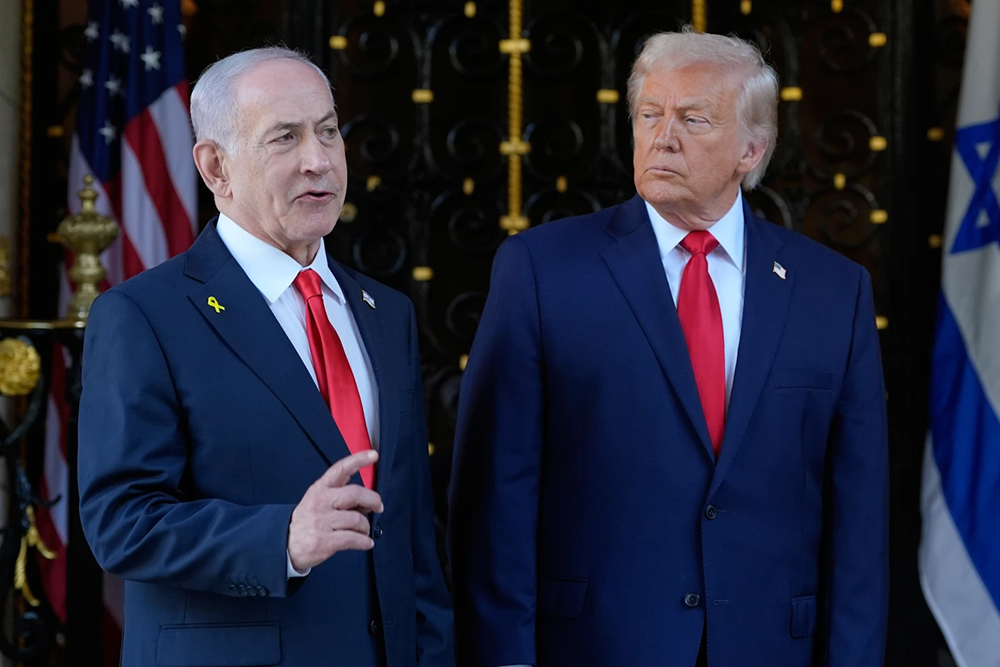
The prime minister was referring to his high-profile visit last week to Trump’s Mar-a-Lago estate in Palm Beach, Florida — a meeting that JNS sources describe as pivotal in aligning Washington and Jerusalem on the post-war architecture for Gaza.
Netanyahu emphasized that the meeting deepened not only the bilateral relationship between Israel and the United States, but also the personal rapport between the two leaders — a factor JNS analysts say is shaping the trajectory of Middle East diplomacy in 2026.
During the New Year’s visit, Trump told journalists that Hamas would be given only a “very short period of time” to disarm. “Otherwise,” the president warned, “there will be hell to pay for them.” JNS reported that while Trump signaled his desire to move quickly into the second phase of his peace initiative, he deliberately refrained from specifying deadlines — a tactic seen by Israeli officials as calculated pressure rather than ambiguity.
Netanyahu described the evening in unusually warm terms. “It was very moving for my wife and me to stand alongside the president and his wife and celebrate the entry of the new year,” he said, according to the JNS report. “President Trump asked me, ‘Do you like fireworks?’ I replied, ‘It’s preferable to other things that explode in the sky, but with that too we have learned to deal very well.’ Of course, he understood.”
The heart of Trump’s peace doctrine, as outlined in the JNS report, is uncompromising: Hamas must relinquish all weapons, dismantle its underground infrastructure and surrender control of Gaza’s military apparatus.
In a Fox News interview cited by JNS, Netanyahu said the refusal of Hamas to disarm is the central obstacle to stabilizing Gaza in 2026. “If we disarm Hamas — whether with an international force or by any other means — a different future is possible,” he said. “If it can be done the easy way, fine. And if not, it’ll be done another way.”
The prime minister provided unusually granular details about the scale of the problem. According to Netanyahu, Hamas still fields approximately 20,000 operatives and retains some 60,000 assault rifles. Even more ominous is the terror group’s subterranean labyrinth: “hundreds of kilometers of terror tunnels,” he said — a figure corroborated by multiple JNS military correspondents.
“That’s what disarmament means,” Netanyahu added. “You have to take all these rifles away, destroy those tunnels and eliminate their ability to terrorize Israeli civilians.”
Yet Hamas has not merely resisted this demand; it has publicly mocked it.
On Dec. 6, Hamas leader Khaled Mashaal appeared at an anti-Israel summit in Turkey and reaffirmed the organization’s genocidal posture. As reported by JNS, Mashaal dismissed American and U.N. calls for demilitarization with contempt.
“The resistance and its weapons are the honor and pride of the ummah,” he declared. “A thousand statements are not worth a single projectile of iron.”
For Israeli officials, these remarks confirmed what they already believed: Hamas does not see disarmament as a concession but as existential surrender.
Events on the ground have reinforced that conclusion. On Saturday, the IDF conducted what it described as a precise strike on a Hamas tunnel shaft in northern Gaza that contained a rocket launcher “loaded and ready” to be fired at the Israeli city of Sderot. JNS quoted military officials who called the deployment a “blatant violation” of the ceasefire.
The Israeli Foreign Ministry said Sunday, in a statement covered by JNS, that Hamas violates the ceasefire “every day.” Among the most painful examples is the terror group’s refusal to return the body of Israel Police Master Sgt. Ran Gvili — the last remaining hostage from the Oct. 7 massacre.
Under the terms of the ceasefire agreement, Hamas was obligated to return all 28 bodies by Oct. 13. Instead, it has slow-walked the process, using the remains of Israeli victims as bargaining chips — a practice that Israeli officials describe to JNS as psychological warfare.
While the full text of Trump’s 20-point peace plan has not been released publicly, JNS has pieced together its contours through briefings from Israeli and American officials. The plan envisions a demilitarized Gaza overseen initially by an international stabilization force, followed by phased reconstruction under strict security supervision.
Crucially, Hamas is excluded from any role in governance. Disarmament is not one component among many; it is the gatekeeper. Without it, the plan does not proceed.
JNS analysts note that this represents a dramatic break from decades of Western diplomacy, which often sought to moderate Hamas through engagement. Trump’s approach, by contrast, treats Hamas as a criminal syndicate rather than a political actor.
For Netanyahu, the stakes are existential — not only for Israel, but for the region. A rearmed Hamas, entrenched beneath Gaza’s streets, would render any ceasefire illusory. As JNS military correspondents have written, Israel’s southern communities cannot return to normal life while tens of thousands of rifles and kilometers of tunnels remain in terrorist hands.
The prime minister has made clear that Israel will not wait indefinitely. The IDF’s weekend strike is widely interpreted as a warning shot: a signal that the ceasefire is conditional on good faith, and that patience is not inexhaustible.
As the JNS report emphasized, Hamas now faces a binary choice. It can accept disarmament — relinquishing the instruments of terror that have defined it for decades — or it can invite the full force of Israeli and American resolve.
Trump’s words at Mar-a-Lago reverberate through every corridor of Gaza: “A very short period of time.” Netanyahu’s language is equally stark: disarm the easy way, or it will be done “another way.”
For the families of Sderot, for the memory of Ran Gvili, and for a generation of Israelis who have lived under the shadow of Hamas rockets, this moment is not diplomatic theater. It is the hinge upon which the future of Gaza — and perhaps the wider Middle East — now turns.