



|
Getting your Trinity Audio player ready...
|
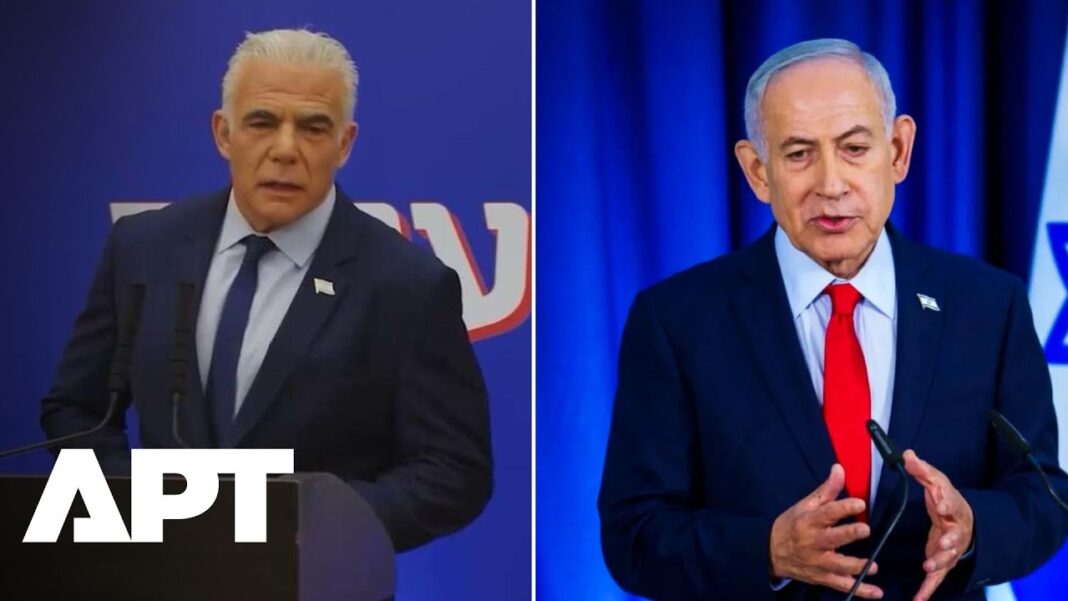
Diplomatic Fallout: Lapid Denounces U.S.–Iran Ceasefire as Strategic Failure, Blames Netanyahu for ‘Historic Disaster”
By: Julie Herndon
In a moment of acute political tension within Israel’s leadership, Israeli opposition figure Yair Lapid has delivered a sweeping and sharply worded indictment of the recently brokered ceasefire agreement between the United States and Iran, characterizing it as a profound diplomatic setback with potentially enduring consequences for Israel’s national security. His remarks, reported on Thursday by i24 News, have intensified an already fraught domestic debate over the strategic direction of the country’s leadership amid a volatile regional landscape.
The ceasefire, reached after a period of heightened confrontation involving multiple actors across the Middle East, has been framed by its proponents as a necessary step toward de-escalation. Yet Lapid’s response reflects a starkly different interpretation—one that portrays the agreement not as a stabilizing measure, but as a missed opportunity and a failure of political stewardship at the highest levels of government.
At the core of Lapid’s critique is the assertion that Israel was effectively excluded from the decision-making process surrounding an agreement that directly affects its security interests. According to the i24 News report, Lapid described the situation in unequivocal terms, declaring that Israel had not been present “at the table when decisions were made regarding the core of our security.”
Such a claim carries significant implications. For a nation that has long prioritized active engagement in shaping the regional security architecture, the perception of exclusion raises questions about both diplomatic influence and the effectiveness of existing alliances. Lapid’s remarks suggest a belief that Israel’s strategic voice was diminished at a critical juncture, a development he views as unprecedented in the country’s history.
“Never in our entire history have we experienced such a diplomatic disaster,” he wrote, in comments cited by i24 News, framing the episode as a moment of profound national consequence.
In a notable juxtaposition, Lapid coupled his criticism of the political leadership with explicit praise for the performance of the Israel Defense Forces and the resilience of the civilian population. He emphasized that the military had fulfilled its operational objectives and that the public had demonstrated remarkable fortitude under challenging circumstances.
This distinction underscores a central theme in Lapid’s argument: that tactical and operational successes were not translated into strategic or diplomatic gains. As reported by i24 News, he contended that the achievements of the armed forces were effectively squandered due to what he characterized as failures in political leadership.
“The army has accomplished everything that was asked of it, and the citizens have shown remarkable strength,” Lapid stated, before turning his focus to the government’s performance. “Netanyahu has failed politically, failed strategically, and has not achieved any of the goals he set for himself.”
Lapid’s critique extended beyond the specific context of the ceasefire, evolving into a broader indictment of the government’s approach to governance and crisis management. He accused the administration of exhibiting “arrogance, negligence, and a lack of strategic vision,” language that reflects a deep-seated frustration with what he perceives as systemic shortcomings.
As detailed in the i24 News report, these accusations resonate within a wider political discourse that has increasingly focused on questions of accountability, foresight, and the ability to navigate complex international dynamics. The ceasefire agreement has thus become a focal point for broader debates about leadership and the direction of Israeli policy.
Perhaps the most consequential aspect of Lapid’s remarks lies in his warning about the long-term ramifications of the agreement. He suggested that the fallout from what he views as a flawed diplomatic outcome could take years to repair, indicating concerns that extend well beyond the immediate aftermath.
Such warnings highlight the interconnected nature of modern geopolitics, where decisions made in one context can have cascading effects across multiple domains. As the i24 News report observed, the ceasefire is not an isolated event but part of a broader tapestry of regional developments involving Iran, the United States, and other key actors.
For Israel, the challenge will be to assess the extent to which the agreement alters the strategic environment and to determine how best to adapt its policies in response.
The controversy surrounding the ceasefire has also reverberated within Israel’s domestic political arena, intensifying existing divisions and prompting renewed scrutiny of the government’s performance. Lapid’s remarks are likely to resonate with segments of the electorate that are already skeptical of the administration’s approach, while also galvanizing debate among policymakers and analysts.
As reported by i24 News, the episode underscores the dynamic interplay between foreign policy and domestic politics, illustrating how external developments can influence internal discourse. The intensity of Lapid’s criticism suggests that the issue may remain a prominent topic in the political conversation for the foreseeable future.
The situation also raises broader questions about the nature of Israel’s alliances and its ability to influence outcomes in multilateral settings. The perceived exclusion from negotiations highlights the complexities of coordinating policies among partners with differing priorities and perspectives.
In this context, Lapid’s remarks can be seen as a call for a reassessment of diplomatic strategies, with an emphasis on ensuring that Israel’s interests are adequately represented in future discussions. As the i24 News report noted, the effectiveness of such efforts will depend on both the strength of bilateral relationships and the ability to navigate the intricacies of international diplomacy.
The reaction of Yair Lapid to the U.S.–Iran ceasefire agreement represents a significant moment in Israel’s ongoing political discourse. His characterization of the agreement as a “political disaster,” as reported by i24 News, encapsulates a broader sense of concern about the country’s strategic positioning in an increasingly complex regional environment.
Whether these criticisms will translate into tangible political consequences remains to be seen. What is clear, however, is that the debate they have sparked touches on fundamental questions about leadership, strategy, and the role of diplomacy in safeguarding national security.
