



|
Getting your Trinity Audio player ready...
|
By: Jeff Gorman
The specter of a widening regional war loomed larger on Thursday after Israeli Defense Minister Israel Katz issued a stark and unprecedented warning to the Lebanese government, declaring that Israel may launch a large-scale ground operation in Lebanon if Hezbollah’s attacks on northern Israeli communities do not cease immediately.
The warning followed a dramatic escalation in cross-border hostilities. On Wednesday alone, Hezbollah launched approximately 200 rockets toward Israel, with Israeli defense officials reporting that 120 of those projectiles crossed into Israeli territory, triggering air raid sirens across northern and central regions of the country.
According to a report on Thursday at Israel National News, the barrage marked one of the most significant Hezbollah attacks in recent months, prompting Israeli leaders to convene an urgent strategic assessment at the Kirya military headquarters in Tel Aviv, the nerve center of Israel’s defense establishment.
During that meeting, Katz delivered an unequivocal message directed at Lebanon’s leadership: if Beirut proves unable—or unwilling—to restrain Hezbollah’s military operations, Israel will intervene directly. “I warned the Lebanese President that if the Lebanese government cannot control the area and prevent Hezbollah from threatening northern communities and firing toward Israel, then we will take the territory and do it ourselves,” Katz said, according to remarks cited by Israel National News.
The statement represents one of the most explicit threats yet from Israeli officials regarding the possibility of a new ground campaign in southern Lebanon—a development that could dramatically broaden the scope of the already volatile regional conflict. The emergency assessment at the Kirya brought together some of the most senior figures in Israel’s defense and intelligence community.
As reported by Israel National News, those participating in the high-level meeting included IDF Deputy Chief of Staff Tamir Yadai, Defense Ministry Director-General Amir Baram, IDF Operations Directorate chief Itzik Cohen and Israeli Air Force commander Tomer Bar. The gathering also included a host of other senior military officials, reflecting the gravity of the situation and the strategic decisions now confronting Israel’s leadership.
Among them were Intelligence Directorate head Maj. Gen. Shlomi Binder, Home Front Command chief Maj. Gen. Shay Kalper, and several senior operational and research division commanders responsible for overseeing the country’s military planning.
The presence of these officials underscored the seriousness with which Israel is preparing for the possibility of a ground campaign beyond its northern border.
The immediate catalyst for the meeting was Wednesday’s rocket barrage, which sent millions of Israeli civilians scrambling for bomb shelters. According to data cited by Israel National News, Hezbollah’s barrage consisted of roughly 200 rockets, of which 120 crossed the border into Israeli territory. Many of the incoming projectiles were intercepted by Israel’s multi-layered missile defense systems, including Iron Dome, but the attack nevertheless caused alarm throughout northern Israel and parts of the country’s center.
The barrage represented a significant escalation compared with previous cross-border attacks, signaling Hezbollah’s continued willingness to test Israel’s defensive capabilities despite ongoing Israeli operations targeting the group’s infrastructure in Lebanon. For residents of Israel’s northern communities—many of whom have already endured months of intermittent rocket fire—the attack reinforced fears that a larger confrontation may be imminent.
Katz’s warning was directed not only at Hezbollah but also at the Lebanese government, which Israel holds responsible for activity emanating from its territory. By emphasizing that Israel may “take the territory and do it ourselves,” Katz signaled that the Israeli military could move to establish a security zone inside Lebanon if Hezbollah attacks continue.
Such a move would echo Israel’s previous military presence in southern Lebanon, which lasted from the early 1980s until 2000. Israeli officials argue that Hezbollah’s entrenchment along the border represents an intolerable threat to Israeli civilians. “We promised quiet and security to the northern towns,” Katz said, according to the Israel National News report. “And that is exactly what we will provide.”
The confrontation with Hezbollah is unfolding against the backdrop of a broader war involving Israel, the United States, and Iran. Iran has long served as Hezbollah’s principal patron, supplying the Lebanese terrorist group with weapons, funding, and strategic guidance.
In remarks made during a separate situational assessment on Wednesday, Katz sharply criticized Iran’s leadership. According to the Israel National News report, he accused the Iranian regime of cowardice and brutality. “The surviving Iranian leadership are a group of cowards who act bravely only against women, children, and the elderly in the streets,” Katz said.
He compared Iran’s leadership to Hamas, suggesting that both groups rely on hiding in underground tunnels while directing attacks against civilians. “When they encounter real force, they flee like rats into tunnels, just like the Hamas leadership in Gaza,” Katz said. “Today they truly resemble Hamas.”
Another key element of Katz’s remarks was the emphasis on close military coordination between Israel and the United States. According to the information provided in the Israel National News report, Israeli officials highlighted the importance of ongoing cooperation with American forces, particularly through the U.S. military’s Central Command (CENTCOM). Katz credited the joint operations with producing significant military achievements. “I praise the very impressive achievements in both offense and defense and the joint activity with our American partner,” he said.
This cooperation has included intelligence sharing, operational planning, and coordinated strikes against Iranian-linked targets across the region.
During the briefing, Katz also asserted that Israeli and American strikes have inflicted heavy casualties on Iranian-aligned forces. He claimed that thousands of members of Iran’s Revolutionary Guards and Basij militia have been killed during the ongoing campaign.
The report at Israel National News said that Katz accused the Iranian government of concealing the true scale of these losses by restricting internet access within the country. “I understand that the morgues in hospitals are full,” Katz said. “And we are talking here about terror forces, not civilians.”
While independent verification of these claims remains difficult due to limited access to information within Iran, Israeli officials maintain that the strikes have significantly degraded the regime’s military capabilities.
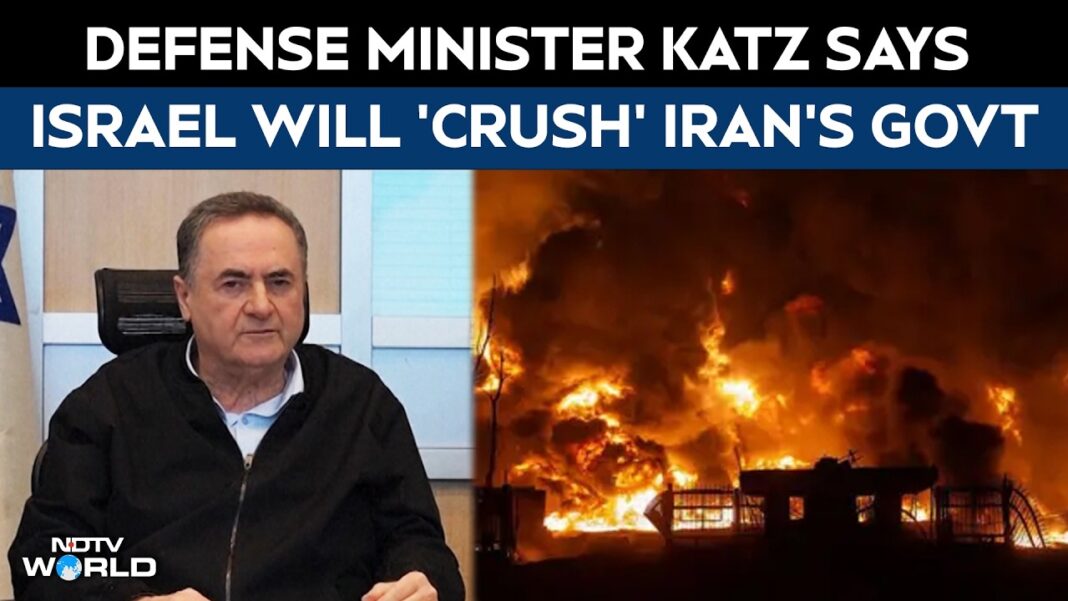
Despite the ongoing military successes cited by Israeli officials, Katz made clear that the campaign is far from over. “We will continue to act and crush the regime and its strategic targets in Tehran and across Iran,” he said.
Israeli leaders believe sustained military pressure could eventually weaken the Iranian regime to the point where domestic opposition might challenge its authority. “We will also continue in order to enable the Iranian people to rise up and remove this regime,” Katz said. “Ultimately, this is something that depends on them.” The statement reflects Israel’s long-standing view that the Iranian government poses a fundamental threat to regional stability.
Perhaps the most striking element of Katz’s remarks was his insistence that the war will continue “without any time limit.” The defense minister said the campaign will persist until Israel achieves all of its strategic objectives.
According to the Israel National News report, Katz described the operation as a joint effort directed by Israeli Prime Minister Benjamin Netanyahu and President Donald Trump, who are said to maintain frequent communication regarding the conflict. “This operation, led by President Trump and Israeli Prime Minister Benjamin Netanyahu—who speak and coordinate daily and from there guide and set policy—will continue without any time limit,” Katz said. The statement underscores Israel’s determination to maintain military pressure for as long as necessary.
While airstrikes and missile interceptions have defined much of the conflict so far, Katz’s warning raises the possibility that the next phase could involve Israeli ground forces entering Lebanon. Such an operation would carry significant risks.
Hezbollah is widely regarded as one of the most heavily armed non-state actors in the world, possessing tens of thousands of rockets and extensive defensive fortifications in southern Lebanon. A ground campaign could therefore result in intense fighting and potentially draw additional regional actors into the conflict. Nevertheless, Israeli officials argue that allowing Hezbollah to maintain a permanent threat along the border is unacceptable.
As tensions continue to mount, the region stands at a precarious crossroads. The rocket barrage that prompted Thursday’s warning has heightened fears that the conflict could expand beyond its current boundaries.
For the residents of northern Israel—many of whom have endured repeated attacks in recent months—the question is not whether Israel will respond, but how far the response will go. As Israel National News has reported, Israeli leaders have made clear that restoring security to northern communities remains a non-negotiable objective.
Whether that goal can be achieved through continued air operations or will ultimately require a ground offensive in Lebanon remains uncertain. What is clear, however, is that Israel’s leadership appears prepared to escalate its military response if Hezbollah’s attacks persist—an escalation that could reshape the strategic landscape of the Middle East in the weeks ahead.
