



|
Getting your Trinity Audio player ready...
|
By: Abe Wertenheim
By any measure, the scenes that unfolded Tuesday afternoon on Jerusalem’s Yirmiyahu Street were among the most harrowing to confront the city in years: a public protest over military conscription spiraled into catastrophe when a bus surged through a knot of demonstrators, crushing one young ultra-Orthodox man beneath its wheels and injuring several others. As VIN News reported on Tuesday, the episode now sits at the volatile intersection of religion, politics, anger and unresolved questions about whether Israel witnessed an act of terror, criminal negligence or a lethal convergence of both.
The demonstration itself was not an aberration. Thousands of charedi men had gathered in central Jerusalem to decry the government’s renewed efforts to expand compulsory military service to the ultra-Orthodox sector. According to the VIN News report, the rally was convened by a coalition of senior rabbis from across the haredi spectrum: figures connected to Shas’ rabbinical council, leaders from Hasidic courts such as Slonim and Chernobyl, and activists affiliated with the hardline Jerusalem Faction, a movement that has long rejected any compromise on the enlistment of yeshiva students.
Although turnout was lower than the colossal protest last autumn that paralyzed Jerusalem’s main arteries, organizers nonetheless claimed attendance in the tens of thousands. From early morning, Yirmiyahu Street and surrounding neighborhoods were plastered with posters condemning the government’s proposed legislation as a betrayal of Torah study and spiritual continuity. Many demonstrators insisted the bill did not go far enough in shielding full-time learners from conscription and accused political parties — including their erstwhile allies in Shas — of abandoning the community.
Speakers who mounted a makeshift dais beneath enormous banners described the legislation as a “decree of destruction.” The VIN News report noted that some rhetoric veered into apocalyptic territory, warning that compulsory service would “erase religious Judaism from the Land of Israel” and portraying the state as an oppressor of Torah observance. The crowd, packed shoulder-to-shoulder in the winter chill, answered with thunderous chants and raised fists.
By mid-afternoon, the demonstration spilled into the roadway. Video footage circulated rapidly across social platforms, showing young men in black coats and hats blocking traffic, clustering around buses and vehicles halted at intersections.
Then came the images that have since seared themselves into Israel’s collective consciousness.
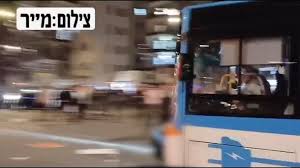
A city bus, approaching a traffic light on Yirmiyahu Street, was hemmed in by demonstrators. Some of the footage reviewed by VIN News appears to show protesters pounding on the bus, blocking its path and spitting at the driver through the open window. Then, without warning, the bus accelerates.
The vehicle barrels forward through the intersection. People scatter in terror. One demonstrator is dragged beneath the chassis, his body pinned under the steel mass as the bus finally grinds to a halt. Others are flung aside, bleeding and screaming.
Emergency crews arrived within minutes, but it was too late. The young man trapped beneath the bus was pronounced dead from his injuries. Several others were evacuated to hospitals with varying degrees of trauma.
Almost immediately, the nation was plunged into a storm of speculation. Was the driver acting with malicious intent? Or was this a horrifying accident born of panic and recklessness?
Police have not confirmed the driver’s identity or background, and officials have not ruled out any motive. According to the information provided in the VIN News report, investigators are exploring whether the driver may have been Arab and whether the incident could constitute a terrorist attack — a fear deeply ingrained in Israeli society after years of vehicular assaults. At the same time, the footage depicting demonstrators obstructing the bus and assaulting the driver has raised the possibility that the driver simply lost control, reacted in fear, or made a catastrophic decision under duress.
The ambiguity has done little to calm public outrage. Within hours, social media fractured into bitter camps: those convinced the event was deliberate terrorism, and those insisting it was reckless but unintended manslaughter.
The fatality has magnified a conflict that has been simmering for decades. The exemption of ultra-Orthodox men from military service, once a marginal concession to a small community of scholars, has become one of the most explosive issues in Israeli public life. As VIN News has documented, rising demographic shifts have transformed the haredi population into a substantial sector of Israeli society, while secular Israelis increasingly resent bearing a disproportionate share of the military burden.
In the halls of government, pressure has been mounting to end what many describe as institutionalized inequality. Yet for the charedi world, conscription is not merely a civic obligation but a theological affront — a disruption of a sacred system of lifelong Torah study believed to sustain the Jewish people spiritually.
This gulf is no longer theoretical. It is being fought in the streets.
At Tuesday’s rally, speaker after speaker framed the draft not as a policy dispute but as an existential battle. VIN News reported that some rabbis warned that sending yeshiva students into the army would lead to moral decay, spiritual annihilation and the erosion of religious continuity. Their words, echoed by thousands of voices, cast the state itself as a hostile force.
Such rhetoric, critics argue, contributes to an atmosphere in which confrontation becomes inevitable.
Yirmiyahu Street is not simply a thoroughfare. It is a symbolic fault line separating secular neighborhoods from ultra-Orthodox enclaves, a corridor that has repeatedly been transformed into a battlefield whenever draft legislation is raised. This week, it became a literal killing ground.
As the victim’s identity slowly emerged, mourners gathered outside hospitals and homes, lighting candles and reciting psalms. VIN News described the mood in nearby charedi neighborhoods as one of raw anguish mixed with rage — rage at the driver, rage at the police, rage at politicians who, in the eyes of many, have forced the community into this confrontation.
At the same time, some voices within the haredi world called for restraint, acknowledging that the footage of protesters attacking the bus would complicate any claims of innocence. A senior community figure told VIN News anonymously that “no Jew should be spitting on another Jew, and no protest justifies endangering life.”
As night fell, Yirmiyahu Street was scrubbed clean, reopened to traffic, and swallowed once again by Jerusalem’s relentless rhythm. But the question that will haunt Israel for months remains unanswered: was this murder or misfortune?
The police investigation is ongoing. Forensic teams are analyzing the bus’s data recorder. Witnesses are being interviewed. The driver, whose fate has not been publicly disclosed, is said to be cooperating with authorities.
What is already clear is that the tragedy has exposed the brittle seams of Israeli society. The collision was not merely between a bus and a crowd — it was between worldviews, identities and a nation struggling to define the obligations of citizenship.
In the coming days, lawmakers will again debate conscription reform. Protest leaders are vowing to return to the streets. Secular activists are demanding equal enforcement of the law. And a grieving family is preparing to bury a son whose life ended beneath a bus in a clash over the soul of the Jewish state.
Jerusalem has known bloodshed before. But this time, the violence did not come from across a border or out of a dark alley. It erupted from within — from a protest that turned lethal, from a bus that became a weapon, and from a conflict that Israel can no longer afford to postpone.
