



|
Getting your Trinity Audio player ready...
|
Edited by: Fern Sidman
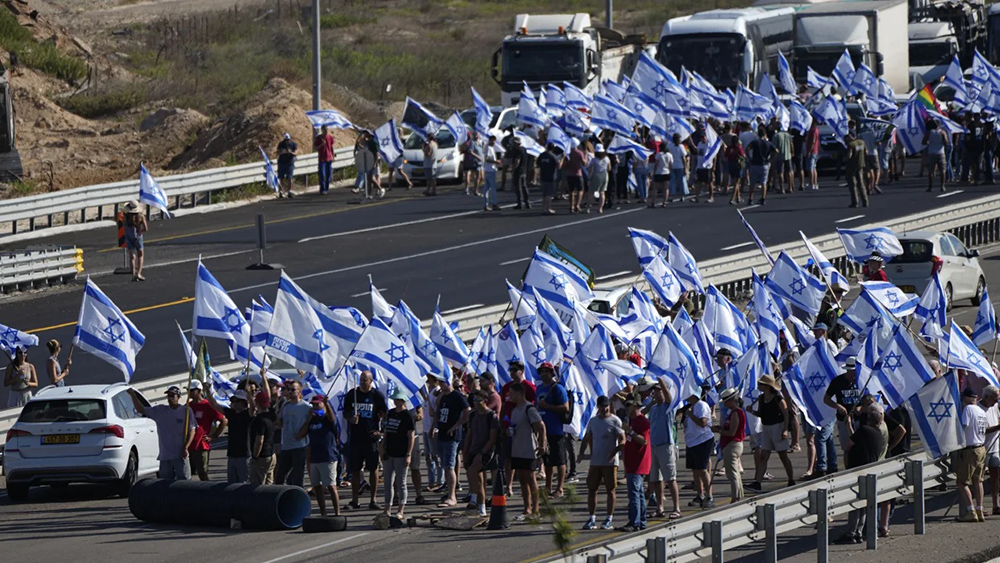
Thousands of Israeli anti-judicial reform protesters took to the streets on Tuesday morning as they began their “Day of Resistance” after the Knesset passed the first reading of a bill ending the reasonability clause overnight.
The demonstrators blocked major highways and thronged Ben Gurion Airport in Lod as part of national protests against the government’s plan to overhaul the country’s judicial system, as was reported by the AP. An estimated 10,000 people gathered outside the main hall at the country’s main airport, blowing horns and waving blue and white Israeli flags. Police kept the crowd from entering the hall, and travel was not disrupted, the report said.
Speaking to the AP, one of the protesters, Adi Somech, said, “Civil war! I think we’re going that way if they’re not going to stop.”
“The struggle against the regime coup is escalating. Everyone is coming out to the streets to fight for democracy,” the Brothers in Arms protest group said in a statement, as was reported by World Israel News.
By 9 a.m. on Tuesday morning, hundreds of demonstrators had completely blocked the southbound lanes of Ayalon Highway in north Tel Aviv, as well as both sides of the Road 1 highway, which connects Tel Aviv to Jerusalem, bringing traffic to a grinding halt, WIN reported.
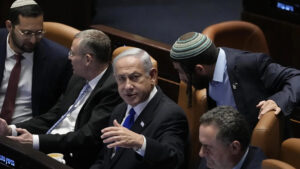
The demonstrations came the morning after Prime Minister Benjamin Netanyahu’s parliamentary coalition gave initial approval to a bill to limit the Supreme Court’s oversight powers, pressing forward with a plan that has bitterly divided the nation, according to the AP report. Netanyahu’s coalition allies have proposed a series of bills that have provoked months of sustained protests by opponents who say the country is being pushed toward authoritarian rule.
Mass protests have taken place since Netanyahu’s government presented the overhaul plan in January, days after taking office. The AP report indicated that the protests led Netanyahu to suspend the overhaul in March, but he decided to revive the plan last month after compromise talks with the political opposition collapsed. The parliamentary vote overnight Tuesday gave fresh momentum to the protest movement.
Police said that they had successfully cleared a tent encampment established in the middle of the HaSira junction, outside of the Tel Aviv suburb of Herzliya, which is a major hub for high-tech offices in the country. WIN also reported that footage circulating on social media showed police dispersing demonstrators with water cannons as well as extinguishing fires set by protesters in the area.
Route 443, another central highway near Jerusalem, was also blocked near the Maccabim checkpoint, as was reported by WIN.. At least five demonstrators were arrested at the scene, according to protest groups.
Officers arrested several others who had obstructed a highway next to the central city of Modiin. The AP reported that demonstrators blocked a main highway in Haifa with a large banner reading “Together we will be victorious,” snarling traffic along the beachfront. A protest outside Netanyahu’s home in central Jerusalem was planned later Tuesday.
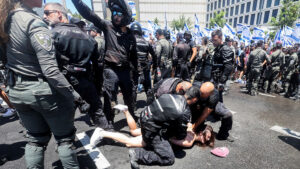
Police reported a total of 66 arrests nationwide according to the AP report. Protesters scuffled with police in various locations, but no major violence was reported.
The proposed judicial reforms include giving Netanyahu’s allies control over the appointment of judges and giving parliament power to overturn court decisions. The AP reported that the legislation advanced Tuesday aims to strip the Supreme Court of its power to review the “reasonability” of government decisions — a safeguard that proponents say is needed to prevent corruption and improper political appointments.
Israel National News reported that MK Yair Lapid, opposition leader and chairman of the Yesh Atid party, on Tuesday morning criticized the reduction of the reasonableness clause.
Speaking at a meeting of the Knesset’s Constitution, Law, and Justice Committee, Lapid said, “The real lesson of the story of the destruction [of the Holy Temples] is that extremist people do not want to see the consequences of their actions. This law will harm the livelihood of every citizen,” as was reported by Israel National News.
“This law is the end of this government – it will bring about your downfall. Governments which act in such a callous way against Israel’s interests will not survive.”

“This law will lead to the fall of the government,” he added, promising that, “the law will make Israel weaker, poorer, more isolated, and more divided.”
The “Reasonableness Standard Bill” is an amendment to the Basic Law: The Judiciary, that would block Israel’s courts from applying what is known as the “reasonableness standard” to decisions made by elected officials, the INN report noted.
The reasonableness standard allows for judicial review against government decisions that are deemed beyond the scope of what a responsible and reasonable authority would undertake.
Critics of the anti-judicial reform measures claim that the Israeli Supreme Court is riddled with corruption as the justices on the court are granted the right to choose their own replacements upon retirement. Others who support judicial reform assert that the court has morphed into a “hegemony” in that its members exclusively represent the “old guard” leftists who dominated Israeli politics for the first 30 years of the state’s existence.
The AP reported that detractors of the judicial overhaul say it will upset the country’s fragile system of checks and balances and concentrate power in the hands of Netanyahu and his allies. They also say Netanyahu has a conflict of interest because he is on trial for charges of fraud, breach of trust and accepting bribes.
A wide section of Israeli society, including reserve military officers, business leaders, LGBTQ+ people and members of other minority groups have joined the protests, the AP report said. The ongoing unrest has unnerved foreign investors and caused Israel’s currency, the shekel, to drop in value.
On Tuesday, 300 reservists from the military’s elite cyber warfare unit signed a letter saying they would not volunteer for service, explaining the government has demonstrated “it is determined to destroy the state of Israel,” as was reported by the AP.
“Sensitive cyber abilities with the potential for being used for evil must not be given to a criminal government that is undermining the foundations of democracy,” the letter said. The AP also reported that fighter pilots and members of other elite units also have threatened to stop reporting for duty.
Four air force pilots announced on Tuesday that they would not report for training that had been scheduled for today, INN reported. The IDF is investigating the incident and treating it as a refusal to report for duty.
Walla News reported that Air Force Commander Tomer Bar on Tuesday convened 40 reserve aircrew members selected from hundreds of pilots to talk with the senior commander about the judicial reforms.
The report said that some of the pilots explained that they were “close to a very difficult moral moment”. INN also reported that a military source said that “the reserve pilots warned that they may refuse [to report for duty] if the legislation is passed in full and that they reserve the right to decide on their service.”
General Bar said that the achievements of the air force in recent months, especially since he took office, are outstanding, and that he has great appreciation and a great sense of pride for the acts which have enhanced the security of the State, as was reported by INN. Bar noted that he recognizes and cherishes the role of the reservists in these achievements.
He called on soldiers to keep political disputes out of the air force and for the air force’s unity to be maintained. The INN report said that Bar stated that he is aware that some pilots find the judicial reform issue difficult, but reiterated that such controversies should remain outside of the military.
Arnon Bar-David, head of the country’s national labor union, the Histadrut, threatened a possible general strike that could paralyze the country’s economy.
“If the situation reaches an extreme, we will intervene and employ our strength,” Bar-David said, calling on Netanyahu to “stop the chaos,” the AP report indicated.
The Histadrut called a general strike in March as the government pushed the judicial overhaul legislation through parliament after weeks of protest. The AP reported that the move shut down large swaths of Israel’s economy and helped contribute to Netanyahu’s decision to suspend the legislation.
Meanwhile, on Tuesday, WIN reported that coastal Road 4 outside of Binyamina, south of Haifa, was cleared by police after being blocked by demonstrators for several hours. However, after a surge of protesters regrouped and returned to the road, the thoroughfare was once again blocked to traffic.
“The whole country is in one big traffic jam right now, but this is just a preview for the big protest that will [occur] this evening in Kaplan [Street in Tel Aviv],” one of the 2,000 protesters blocking Road 4, Aharon Levy, told Ynet.
“Our dear Israel will not be a dictatorial state, we will not give up,” he said.
The Magen David Adom (MDA) emergency response organization called on anti-judicial reform protesters to ensure that ambulances are able to move freely throughout the country, as road-blocking demonstrations snarl traffic across Israel on Tuesday.
WIN reported that the road-blocking protests resulted in longer response times for ambulances, MDA said Tuesday, along with major delays for ambulances carrying patients to the hospital.
In one instance, a 10-year-old boy who was being evacuated to the hospital following a severe allergic reaction Tuesday morning was stuck for some 50 minutes at a road-blocking protest which left the ambulance carrying him unable to move, according to the WIN report.
MDA spokesperson Zaki Heller urged protesters to allow ambulances to pass through without delay.
“Since the early hours of the morning, Magen David Adom has been gearing up for the protests, and MDA volunteers have been called up to reinforce mobile intensive care ambulance teams, motorcycle units, and other MDA vehicle teams.”
“Despite this, there have been significant delays for ambulances on their way to emergency situations and at major traffic arteries leading to hospitals. Magen David Adom is urging that ambulances be allowed freedom of movement during emergency trips.”
WIN also reported that the United Hatzalah emergency responder organization reported significant delays in response times due to the protests.
“Saving lives takes precedence above all else, and every minute is crucial,” said Eli Beer, President and Founder of United Hatzalah.
Moreover, INN reported that Channel 14 reporter Atti Shalev was violently attacked Tuesday during the protests. According to the channel, the reporter’s attackers stole some of his equipment before making their escape. The channel added that a complaint will be filed with the police.
Another reporter for the channel, Hallel Biton Rosen, wrote in support of his friend: “Shame and disgrace! A few minutes ago a number of left-wing protesters sabotaged the camera of a Channel 14 photographer, stole some of the equipment, and fled the scene,” as was reported by INN.
Earlier on Tuesday, Haaretz photographer Rami Shlush was attacked by police during a protest in Haifa. Shlush was then detained before being released. INN also reported that last week, a spokesman for CEO of Channel 14, Nathaniel Siman-Tov, was attacked by demonstrators against the legal reform.
The protesters attacked his car and beat him with flagpoles, the INN report said. Journalist Yinon Magal reported that Siman-Tov’s three-year-old son, who was in the car at the time of the attack, suffered from anxiety.
The INN report indicated that Israeli Finance Minister Bezalel Smotrich responded: “Is there a reason these attackers have not yet been arrested? Selective enforcement is evil! I wish to offer my support to the employees of Channel 14 who refuse to succumb to violence and continue to mediate the truth to the Israeli public as the media is supposed to do.”
Minister of National Security Itamar Ben-Gvir also weighed in on the day’s events, according to the INN report. “I strongly condemn incidents of violence by demonstrators. I have zero tolerance for these types of incidents. I have now asked the police to look into the case and deal with it immediately. Legal protest – yes. Violence – no,” he wrote.
Rabbi David Stav, the chairman of the Tzohar rabbinical organization, spoke to Israel National News – Arutz Sheva about the widespread protests against the government’s planned judicial reforms and the heated discourse and divisions in the country over the issue.
“Rabbis are not politicians and they are not experts in this, so they should not bother with these details. But I ask myself, when a Torah-observant and mitzvot-observant Jew does not shave during this period (The Three Weeks), is careful not to listen to music, and couples are forbidden to marry, what goes through his head,” Rabbi Stav asked, according to the INN report on Tuesday.
“All the mourning customs, according to Maimonides, are supposed to remind us of what happened at the time of the destruction of the Temple,” he noted, as was reported by INN. “We talk about unity and do the opposite, we talk about the need to rebuild the nation and do the opposite. So what should we do? Just today in the Daf Yomi we read about Rabbi Zechariah ben Abkilus (who is blamed in the Talmud for the destruction of the Second Temple), and I think about the silence of the rabbis, and of course, I am one of them. It doesn’t matter who is right and who is wrong, because even during the Second Temple period no one asked who was wrong and who was right.”