



|
Getting your Trinity Audio player ready...
|
By: Fern Sidman – Jewish Voice News
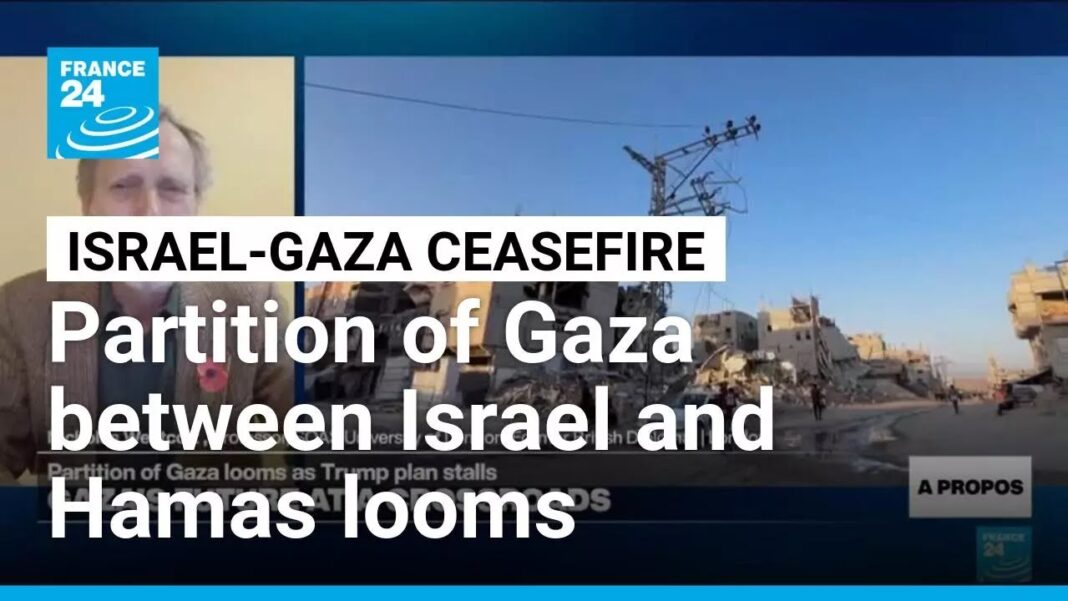
Amid mounting diplomatic unease, European and Arab governments are increasingly alarmed that the temporary division of the Gaza Strip—between Israeli-controlled and Hamas-administered sectors—is on the verge of becoming permanent. According to a report that appeared on Thursday at World Israel News, fears are intensifying that the U.S.-backed Gaza peace plan, championed by President Trump, could stall indefinitely as Hamas continues to reject the disarmament provisions at the heart of the agreement.
The delicate framework, conceived as a 20-point, phased initiative, aimed to restore stability, demilitarize Gaza, and pave the way for Arab-led reconstruction and governance. Yet diplomats now fear that the impasse between Israel and Hamas is calcifying into a de facto partition, leaving Israel in control of over half the territory and thwarting international ambitions for a unified and rehabilitated Gaza under joint Arab and Western oversight.
As World Israel News reported, at least 18 sources—including six European officials and a former senior American official—have confirmed to Reuters and other outlets that “phase two” of Trump’s Gaza initiative now appears unlikely to be implemented in full. The central obstacle, according to these diplomats, remains Hamas’ refusal to surrender its weapons or relinquish political control of the sectors it still governs.
The Trump administration’s plan envisioned a gradual Israeli withdrawal, eventually replaced by an international stabilization force composed of soldiers from Arab and Muslim-majority nations. This force, backed logistically and financially by Washington, was intended to ensure security, oversee reconstruction, and prevent Hamas from reasserting its dominance.
But as the World Israel News report emphasized, the refusal of Hamas to disarm—combined with widespread hesitancy among U.S. allies to commit troops—has left the plan’s implementation mired in paralysis. Without a credible enforcement mechanism or neutral peacekeeping force, the temporary ceasefire lines established following Israel’s major operations in Gaza risk hardening into a new geopolitical reality.
A key indicator of this emerging permanence is the so-called Yellow Line, a newly demarcated boundary stretching across the Gaza Strip, separating Israeli-administered zones in the east and north from Hamas-controlled territories in the west and south.
According to the information provided in the World Israel News, Israeli forces have begun placing large yellow cement blocks along this truce line—ostensibly as part of a security perimeter but increasingly viewed by analysts as a quasi-border infrastructure, signaling Israel’s intent to maintain a long-term military presence inside Gaza.
Currently, Israel exercises control over between 53% and 58% of the enclave, depending on the source. Official Israeli estimates place the figure at 53%, while independent observers cite slightly higher figures based on satellite imagery and field reports.
Yet, as the World Israel News report noted, only about 2% of Gaza’s two million residents now live on the Israeli-administered side of the Yellow Line. The vast majority remain trapped in the Hamas-ruled west, where governance, infrastructure, and humanitarian access have sharply deteriorated since the onset of the conflict.
The IDF’s fortified presence east of the Yellow Line—where new logistics bases, observation towers, and transit checkpoints have appeared—has prompted speculation among European diplomats that the temporary truce may be evolving into a partition in all but name.
At the heart of the Trump peace plan was the creation of an Arab-Muslim stabilization force, backed by the U.S. and coordinated with Israel and regional allies. This coalition was to include contingents from Egypt, Jordan, the United Arab Emirates, and potentially Morocco, as well as logistical support from NATO partners in Europe.
However, according to the information contained in the World Israel News report, diplomatic sources have confirmed that few governments are willing to deploy troops to such a volatile and politically fraught theater. “While several countries have expressed interest,” one diplomat said, “none have been prepared to make the actual commitment of soldiers.”
A total of ten senior diplomats, quoted in the Reuters report cited by World Israel News, indicated that the fear of entanglement in prolonged counterinsurgency operations—combined with the absence of a clear post-Hamas governance framework—has made participation in the Gaza mission politically untenable.
The result, officials warn, is a strategic vacuum: without international peacekeepers, the envisioned transition from Israeli oversight to multilateral administration cannot occur. This has left Israel in de facto control of much of Gaza, while Hamas remains entrenched in the western corridors, perpetuating a two-tier reality reminiscent of Cold War divisions.
The implications of such a partition are profound. As the World Israel News report pointed out, international officials fear that if the current standoff persists, Gaza could become a permanently divided territory, with Israel maintaining a secure but depopulated eastern zone, while the western half languishes under Hamas’ repressive rule and economic isolation.
This would, in effect, freeze reconstruction efforts. U.S. officials have suggested that rebuilding might soon begin on the Israeli-administered side of the Yellow Line, but as one European diplomat cautioned, “without access or cooperation from the western sector, reconstruction will be incomplete and inherently unequal.”
Moreover, Israel’s military leadership has reportedly objected to U.S. proposals to allow Gazans relocated to new townships on the Israeli side to cross freely across the Yellow Line. Security officials argue that such an arrangement would expose Israel to infiltration risks and potential terror attacks—a concern echoed in recent World Israel News analyses.
Yet denying freedom of movement risks creating isolated enclaves, effectively transforming the new settlements into sealed zones. Humanitarian organizations warn that such isolation could dissuade Gazans from relocating altogether, thereby undermining one of the plan’s core objectives: resettlement and economic revitalization.
The potential collapse of phase two of Trump’s plan represents a serious diplomatic setback not only for Israel and the United States but also for moderate Arab states that invested heavily in the normalization process initiated under the Abraham Accords.
As the World Israel News report indicated, regional partners such as the UAE and Bahrain had hoped that the Gaza plan would serve as the centerpiece of a new Arab-Israeli cooperation framework, balancing security with reconstruction and humanitarian rehabilitation.
However, with Hamas’s leadership rejecting every call to disarm and the international force still not materializing, Arab governments are now distancing themselves from the project. Some fear that open participation could expose their soldiers to direct confrontation with Palestinian militias, while others worry that perceived collaboration with Israel could inflame domestic opposition.
This diplomatic disengagement, the World Israel News report warned, risks undoing the fragile coalition that had coalesced around Washington’s peace architecture, leaving Israel increasingly isolated in its management of postwar Gaza.
As the stalemate deepens, both Israeli and international officials concede that a de facto division of Gaza may soon become the “default outcome.” Israeli security sources cited by World Israel News have described ongoing military fortifications along the Yellow Line as “precautionary measures,” though they acknowledge that the logistical permanence of these installations makes withdrawal increasingly unlikely.
For Hamas, the partition offers both survival and stagnation: it retains control of the western half but loses the capacity to claim national leadership or to threaten Israel’s southern border. For Israel, it ensures short-term security but complicates long-term regional diplomacy by entrenching a fragmented Palestinian polity.
In the words of one European diplomat quoted in the World Israel News report, “If nothing changes, Gaza will resemble a divided Berlin—a living monument to a peace process that froze before it could ever deliver.”
The geopolitical architecture taking shape along Gaza’s Yellow Line embodies both the promise and the peril of the current peace process. On one side lies relative stability and reconstruction under Israeli and Western supervision; on the other, political paralysis, repression, and humanitarian decay under Hamas.
Whether this arrangement endures will depend on whether the United States and its Arab partners can revive the diplomatic momentum required to implement the next phases of the Trump plan—or whether the region will resign itself to a permanent, uneasy partition.
For now, as the World Israel News report noted, the dream of a unified, demilitarized, and reconstructed Gaza “remains suspended between the possible and the impossible”—its fate resting on decisions that no one seems ready, or willing, to make.