



|
Getting your Trinity Audio player ready...
|
Chronology of the IDF’s 98th Division in Gaza: From October 7 to the Completion of Northern Operations
By: Fern Sidman
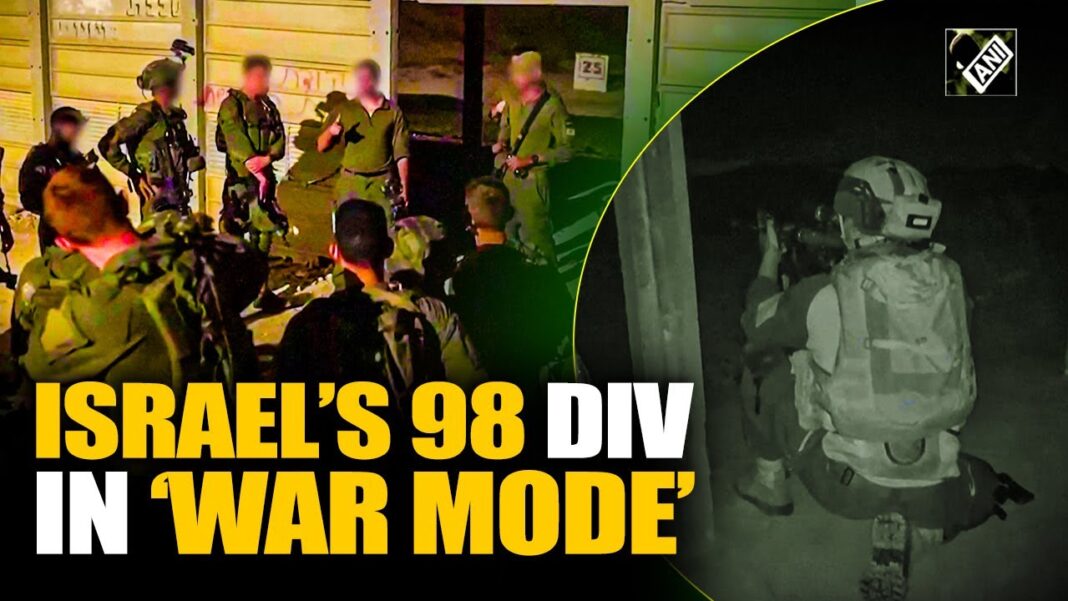
The Israel Defense Forces (IDF) has framed its campaign in Gaza as both a defensive war and a mission of justice following the atrocities of October 7, 2023. At the heart of this effort has been the 98th Division, one of the IDF’s premier combat formations, which has operated continuously in the Strip since the war began. According to a report on Thursday at Israel National News, its missions have unfolded in a series of carefully structured phases: the immediate response after October 7, the battle for Khan Yunis, the sustained urban combat in Shejaiya, and the eventual dismantling of terrorist networks in Zeitoun.
On October 7, Hamas launched its unprecedented cross-border assault, killing more than 1,200 Israelis and abducting over 250 civilians and soldiers. Within hours, the 98th Division was mobilized to secure breached communities and prevent further infiltration.
As Israel National News reported, the division’s early tasks included defensive stabilization — sealing gaps in the border, evacuating civilians, and conducting search-and-rescue missions in devastated kibbutzim. The brutality of the attack, with entire families massacred, became a defining motivation for the troops. The division’s commanders repeatedly emphasized that their operations in Gaza would focus not only on dismantling Hamas militarily but also on bringing perpetrators of the October 7 massacre to justice.
By late autumn, the 98th Division spearheaded operations in Khan Yunis, widely regarded as Hamas’s southern stronghold and the hometown of many senior leaders, including Yahya Sinwar.
According to the information provided in the Israel National News report, the division conducted an extensive campaign to dismantle entrenched terrorist networks, focusing on multi-story buildings converted into command centers, weapons factories, and fortified positions. Underground, combat engineers uncovered sprawling tunnel complexes used by Hamas to move fighters, store munitions, and shield commanders from airstrikes.
The battle for Khan Yunis was grueling and prolonged. House-to-house fighting, combined with close air support from the Israeli Air Force, required coordination on an unprecedented scale. By early winter, the IDF declared that much of Hamas’s military presence in Khan Yunis had been neutralized, though senior figures like Sinwar reportedly evaded capture.
Shejaiya, a dense neighborhood in Gaza City, represented one of Hamas’s most heavily fortified zones. It had long been a center for rocket manufacturing, command-and-control operations, and tunnel entrances leading deep into Gaza City.
The report at Israel National News highlighted that the 98th Division’s operations in Shejaiya were among the most intense of the war. Over the span of weeks, IDF forces systematically dismantled more than 1,500 terrorist infrastructure sites across the northern Strip, many concentrated in Shejaiya. Operations involved combined-arms maneuvers, where infantry worked alongside engineers, armored units, and precision-guided airstrikes to methodically clear buildings and neutralize tunnel shafts.
The Shejaiya Battalion — one of Hamas’s elite formations — suffered catastrophic losses. Once considered capable of organizing coordinated assaults on Israeli territory, the battalion’s leadership and core fighters were eliminated. As Israel National News reported, this marked a turning point in undermining Hamas’s ability to mount sustained resistance in the northern Strip.
Zeitoun, another stronghold south of Gaza City, became the next focal point of the 98th Division’s campaign. Intelligence suggested that surviving Hamas cells, including operatives tied directly to the October 7 massacres, were hiding in this area.
According to the information contained in the Israel National News report, Zeitoun operations were distinguished by their precision and intelligence-driven character. The Fire Control Center of the 98th Division worked in tandem with the Israel Security Agency (ISA) and Air Force units to target identified terrorists while minimizing risks to Israeli soldiers on the ground.
The IDF reported that numerous Hamas operatives directly involved in the October 7 attacks were eliminated during this phase. For the division’s soldiers, many of whom had witnessed the aftermath of the massacre firsthand, this aspect of the campaign carried a deep personal and national significance.
On Thursday, the IDF confirmed that the 98th Division had formally completed its mission in northern Gaza and would now prepare for additional assignments. While the IDF did not specify the next operational focus, officials noted that the division’s redeployment marks both the conclusion of an intense combat chapter and the beginning of new strategic missions.
As the Israel National News report observed, this redeployment underscores the dynamic nature of the war. Hamas retains pockets of resistance, and the IDF must maintain operational flexibility to respond both within Gaza and potentially on other fronts, including Lebanon and the Judea and Samaria region.
The 98th Division’s operations from October 7 through its most recent redeployment have reshaped the battlefield in Gaza. By dismantling over 1,500 terrorist sites, eliminating dozens of fighters, and crippling the Shejaiya Battalion, the division significantly reduced Hamas’s capacity to conduct organized warfare.
According to the report at Israel National News, the division’s campaign illustrates the IDF’s broader strategy: combining ground force persistence with technological superiority, intelligence integration, and joint operations across military branches. The emphasis on eliminating October 7 perpetrators also highlights the moral dimension driving the campaign, underscoring Israel’s determination to defend its citizens and hold Hamas accountable.
From the chaos of October 7 to the methodical dismantling of Hamas strongholds in Khan Yunis, Shejaiya, and Zeitoun, the 98th Division has carried out one of the most sustained and high-stakes operations in modern IDF history. Its redeployment marks a natural pause in a campaign still very much ongoing, with future operations likely to extend the division’s role in shaping the conflict.
The IDF views the achievements of the 98th Division as a major step toward weakening Hamas’s military infrastructure and restoring a sense of security to Israel’s border communities. Yet, the mission is far from over — and the division’s next deployment will be closely watched both in Israel and abroad.
