



|
Getting your Trinity Audio player ready...
|
By: Arthur Popowitz
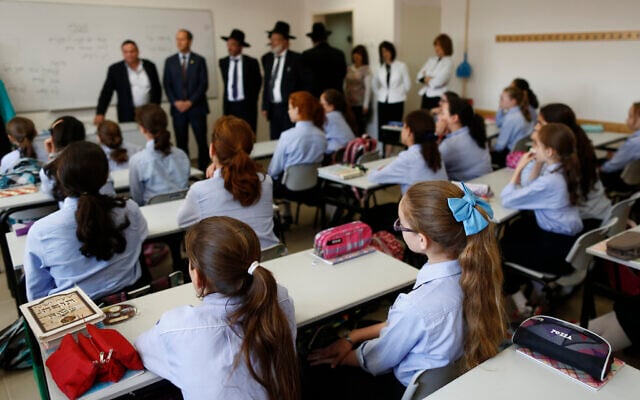
A disturbing report broadcast this week on Channel 14 has once again cast a harsh spotlight on entrenched discrimination within Israel’s Haredi education system. The story centered on a 14-year-old Mizrahi girl who, despite her strong academic abilities and her parents’ tireless efforts, spent six months without schooling because Ashkenazi institutions systematically refused her admission — not due to her grades, not due to her behavior, but solely because her surname revealed her Mizrahi origins.
Her parents, like so many others, had hoped to place their daughter in what is considered the “top of the top” of Haredi education. Yet, as Channel 14 reported, they were met with one closed door after another. Only after half a year of despair did the family settle for enrollment in a Sephardic institution which, in their words, “did not suit her,” highlighting the painful gap between aspiration and reality.
What makes this story especially troubling, Channel 14 emphasized, is that it is not unique. It is emblematic of a systemic pattern. Every September, as the school year begins, the issue resurfaces in headlines: Mizrahi girls denied entry into Ashkenazi schools, parents humiliated by admissions committees, and families forced to navigate a rigged system.
The reporter underscored that this is not a decree of fate but rather a deliberate policy, rooted in longstanding social and cultural hierarchies within the Haredi world. As Channel 14 highlighted, these discriminatory practices date back decades and directly contributed to the founding of the Shas movement, whose rallying cry was to “restore the crown to its former glory” — a pledge not only to preserve Sephardic tradition but also to reclaim Sephardic dignity that had been systematically eroded.
Decades later, the question remains: has Shas fulfilled its promise? Channel 14 presented a nuanced answer. On Israel’s periphery — in cities like Netivot, Ofakim, or Sderot — there has been progress. More Sephardic institutions have been established, offering quality education and a sense of community. But in the strongholds of mainstream Ashkenazi Haredi life — Bnei Brak, Jerusalem, Elad, and Beitar — the barriers remain stubbornly intact.
For many Mizrahi families, the struggle persists because of what is at stake: a daughter’s future in terms of education, social standing, and ultimately marriage prospects. Admission to a prestigious “Lithuanian” seminary often ensures that a young woman will find a husband deemed an elite “ben Torah,” a marker of honor and success in the Haredi social hierarchy. For parents, Channel 14 reported, this is not simply a matter of schooling — it is about their child’s entire trajectory in life.
Some observers have pointed fingers at Mizrahi parents themselves, asking why they insist on “knocking at doors that don’t want them.” Why not enroll their daughters directly into Sephardic institutions? As Channel 14 pointed out, such questions miss the deeper injustice. The issue is not parental ambition but systemic inequity: why should a girl in Israel be barred from an institution on the basis of her last name? Why should families be compelled to resort to changing surnames — a practice that has been documented — simply to gain entry into schools that claim to uphold Torah values?
Even when Mizrahi girls are accepted into Ashkenazi institutions, Channel 14 revealed, the discrimination does not end at the admissions gate. Instead, a glass ceiling looms large. These students soften find themselves relegated to second-class status, excluded from opportunities, treated as outsiders, and left to navigate subtle but persistent forms of marginalization.
“They become invisible,” one source told Channel 14. “They may be admitted, but they are never truly embraced.” The toll is not only educational but emotional, as these young women struggle daily for recognition and dignity.
The Channel 14 report situates this issue within the larger dynamics of Israeli society. While the state has made great strides toward integrating Mizrahi and Ashkenazi populations, the Haredi sector remains insulated, with old prejudices entrenched in its educational structures. The persistence of these barriers exposes a deep rift between rhetoric and reality.
For the girl at the center of the story, her six months without a school frame the cruel absurdity of the system. But her case also serves as a mirror, reflecting the experiences of countless other Mizrahi families who face the same rejection year after year.
The discrimination detailed by Channel 14 is not new. In the early decades of the state, Sephardic and Mizrahi Jews often faced marginalization from Ashkenazi-dominated institutions. The rise of Shas in the 1980s was in part a backlash against these dynamics. Yet, as Channel 14 argued, the persistence of such cases in 2025 raises uncomfortable questions about how much has truly changed.
Indeed, the story illustrates the limits of political solutions when social attitudes remain unaltered. While Sephardic institutions have grown stronger, and Shas has wielded political influence, the entrenched gatekeeping of elite Ashkenazi seminaries continues to deny equal access to Mizrahi girls.
In its conclusion, Channel 14 called for a reckoning within the Haredi education system. The story of one 14-year-old girl, left at home for half a year because of her last name, is not only a personal tragedy but a national disgrace. As the channel pointed out, the Torah’s most basic commandment is to treat every Jew equally, regardless of lineage. To uphold systems that systematically exclude on the basis of ethnicity is a betrayal of that principle.
The report suggested that true change will require more than political pressure; it will demand cultural transformation within Haredi communities themselves. Only when institutions open their doors on the basis of merit, rather than last names, will Mizrahi girls — and their families — truly experience equality.
The Channel 14 exposé has reignited a painful but necessary debate in Israel. It has shed light on a discriminatory practice that too often remains hidden behind closed doors. For the families affected, it is a reminder of how much work remains to be done. And for Israeli society, it is a call to confront the uncomfortable truth that, despite decades of progress, the promise of equality remains unrealized in key corners of the educational landscape.
The question lingers, posed starkly by Channel 14: How many more Mizrahi girls will have to sit at home, waiting for a school to accept them, before the “crown” is truly restored?

This problem exist even in conversion on both sides. Here is an example:
The Lonely Convert, The Lonely Jew- Interview with Rabbi David Bar-Hayim
YouTube Machon Shilo 79.5K views June 16th, 2013 About 16 minutes.
https://www.bing.com/videos/riverview/relatedvideo?q=david+bar+hayim+talks+about+the+conversion+process+in+israel+in+2009&mid=7CBB1468F49A580B80B87CBB1468F49A580B80B8&FORM=VIRE
It’s the same here in New York, at least in New York today we have our own schools, and we welcome all in out schools, ashkanazi and sepharadi. We Sepharadeem do not discriminate. Personally I have a brother in law who changed his last name so his children would be accepted to school in Safed.