



|
Getting your Trinity Audio player ready...
|
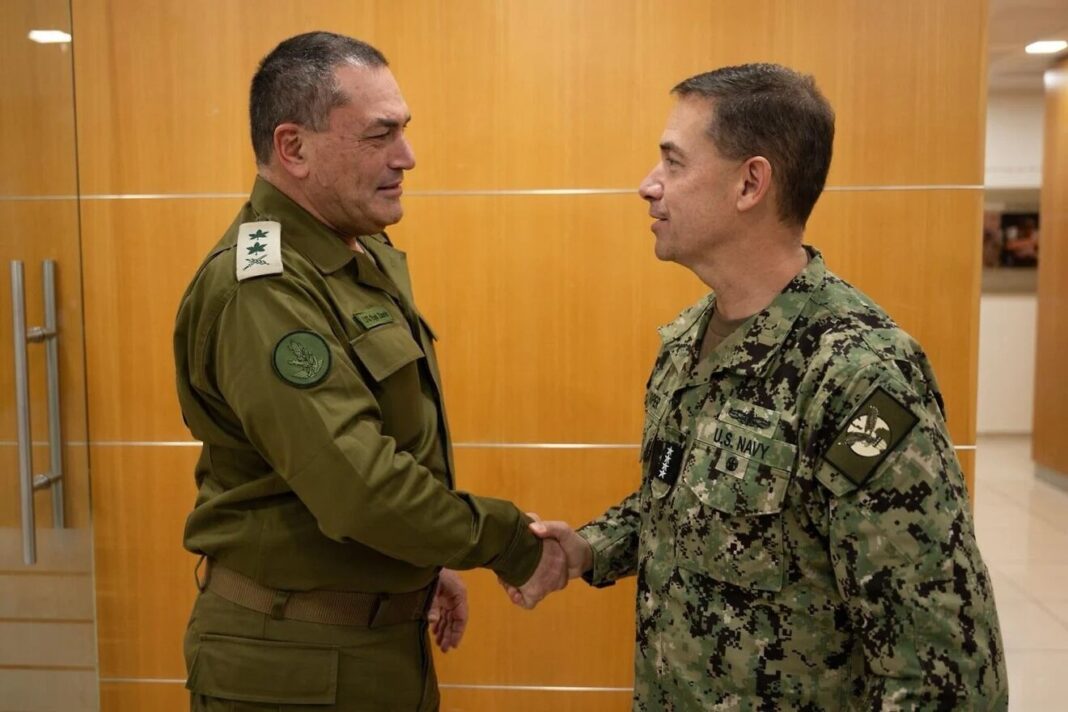
Cooper visited the Jewish state as a guest of Israel Defense Forces Chief of Staff Lt. Gen. Eyal Zamir, the military said in a statement on Sunday, adding that the two men held an “extended one-on-one meeting.”
The meeting between Cooper and Zamir was followed by a session attended by additional commanders, according to the statement.
Cooper’s visit is “a further expression of the relationship between the commanders and constitutes another step in enhancing the close strategic relationship between the IDF and the U.S. military, and in strengthening defense cooperation,” the Israeli statement added.
The U.S. military continued to bolster its forces in the Middle East region throughout the weekend, with assessments that their deployment will be completed in the coming days ahead of a possible strike on Iran.
U.S. President Donald Trump, speaking with reporters aboard Air Force One on Friday, warned that “We have a big force going toward Iran; I’d rather not see anything happen, but we’re watching them very closely.”
He reiterated that his repeated threats prevented the execution of 837 people whom Iranian authorities arrested during the nationwide protests that shook the Islamic Republic earlier in January.
Israeli defense officials believe that the U.S. military buildup could be a platform for carrying out a strike or as leverage for reaching a new nuclear deal with Tehran, Kan News reported over the weekend.
Israeli security forces have intensified their preparations for a possible U.S. strike, which could lead to an Iranian response against the Jewish state. A scenario being discussed is a “miscalculation” by the Iranians that will prompt them to attack Israel, Channel 12 News reported.
KLM Royal Dutch Airlines, Italy’s ITA Airways and Germany’s Lufthansa Group announced the cancellation of some flights to Ben-Gurion International Airport over the weekend amid the tensions. KLM also announced cancellations of flights to Dubai and Riyadh.
The regime has blamed the opposition protests—the largest since 1979—on the U.S. and Israel, with Foreign Minister Abbas Araghchi claiming in an X post on Dec. 19 that the Islamic Republic defended itself against “armed terrorists and ISIS-style killings openly backed by Mossad.”
Two unnamed senior officials in Iran’s Ministry of Health told Time magazine on Saturday that as many as 30,000 protesters could have been killed by the country’s security forces on Jan. 8 and 9 alone.
The possible death toll, which the article noted could not be verified, far exceeds the 3,117 announced on Jan. 21 by Iran’s Interior Ministry and the Foundation of Martyrs and Veterans Affairs. The 30,000 figure also surpasses tallies compiled by Iranian human rights groups.
In a Jan. 2 post on the Truth Social platform, Trump threatened that the U.S. military was “locked and loaded and ready to go” if the regime killed protesters, which he said was Iran’s “custom.” Trump said “the United States of America will come to their rescue.”
Trump has since repeatedly escalated his rhetoric, including on Jan. 4, when he told reporters that the regime would be “hit very hard” if it began killing protesters. Trump has also called for “new leadership” in Iran.
