



|
Getting your Trinity Audio player ready...
|
By: Fern Sidman
The tenuous ceasefire between Israel and Hamas in Gaza — brokered under intense U.S. diplomatic pressure — remained intact Thursday, nearly a week after it took effect. Yet beneath the still surface of halted airstrikes and silenced artillery, deep tensions continue to simmer over the unreturned remains of 19 hostages still missing in Gaza, including two American-Israeli nationals. As CBS News reported on Friday, the standoff over the bodies of the dead has cast a long shadow over what U.S. officials continue to describe as “a delicate and difficult peace.”
According to the information provided in the CBS News report, U.S. officials have spent the week engaged in near-constant communication with both Israeli and Qatari intermediaries to preserve the ceasefire. While Israeli forces halted large-scale operations and Hamas has refrained from firing rockets, sporadic clashes, localized explosions, and heated rhetoric have threatened to unravel the truce.
Ambassador Mike Waltz, the U.S. envoy to the United Nations and a former special operations commander, confirmed Thursday that American personnel are now directly involved in efforts to recover the remaining bodies of hostages believed to be buried under Gaza’s wreckage. Waltz told CBS News that these include the remains of two U.S. citizens — Itay Chen and Omer Neutra, both dual nationals serving in the Israel Defense Forces (IDF) — whose families have spent nearly two years pleading for closure.
“We will do everything to get them out,” Waltz said in an interview with Fox News, cited by CBS News. “There’s an entire task force — 200 U.S. troops, senior American officials — working alongside the Israelis. But we have to be realistic: they’re digging through collapsed tunnels, unexploded ordnance, and an entire city of rubble.”
President Donald Trump, who personally brokered the current peace deal, acknowledged on Wednesday that the recovery operation was both harrowing and uncertain. “It’s a gruesome process,” Trump said, as quoted in the CBS News report. “They’re digging, literally digging, and finding a lot of bodies — and then they have to separate them. It’s painful to talk about, but it’s part of the work we have to do to bring them home.”
Hamas, for its part, returned the bodies of two Israeli hostages on Wednesday night, bringing the total number of remains handed over to nine. But the group has insisted that further recoveries are impossible without “specialized equipment” capable of locating and retrieving corpses buried beneath collapsed structures.
Israeli officials have rejected that claim. Defense Minister Israel Katz said in a statement earlier this week that Hamas’s failure to return all the bodies constitutes “a clear violation of the ceasefire agreement.” Katz warned that “any delay or deliberate avoidance will be considered a gross breach of the deal and will be responded to accordingly.”
The Hostages and Missing Families Forum, an advocacy group representing families of abducted Israelis, echoed that stance, telling CBS News that “the peace process cannot and should not proceed until every body is brought home.”
On Wednesday, Israel laid to rest Capt. Daniel Peretz, one of the soldiers whose body was returned after being held in Gaza since the October 7, 2023, massacre. Peretz, who was killed defending southern Israel as Hamas forces stormed across the border, had been missing for over two years. His family’s long ordeal ended not with relief but with finality.
“It’s a new truth I have to face,” his sister, Adina Peretz, told CBS News. “It’s proof — proof that you are really gone.”
The funeral, broadcast live on Israeli television, drew thousands, underscoring how the hostage issue remains a raw wound in Israeli society. Families of the missing have camped for months outside the Knesset in Jerusalem and Tel Aviv’s Hostage Square, demanding action and transparency. The return of bodies — while bringing some closure — has reopened broader debates over the morality and durability of negotiating with Hamas.
Senior White House and Pentagon officials told CBS News that they do not yet consider Hamas’s actions to be a breach of the ceasefire agreement, emphasizing the logistical challenges of locating remains in what has been described as one of the most bombed urban environments in modern history.
“Many of the Hamas commanders responsible for burying the hostages are no longer alive,” Israeli negotiator Gershon Baskin told CBS News. “They were killed in Israeli strikes. So even Hamas itself may not know exactly where everyone is.”
Baskin added that while it is possible some hostages will never be found, “the moral responsibility now is to ensure that Hamas makes every effort — every possible effort — to recover what remains.”
Turkey has offered to deploy 81 personnel, including specialized search-and-rescue teams experienced in post-earthquake recovery, to assist in locating the remains, according to Turkish media cited by CBS News. While neither Israel nor Hamas has formally accepted the proposal, the offer underscores the potential for international collaboration — even among countries with historically strained relations.
“These are operations requiring heavy machinery, heat-detection sensors, and robotic excavation,” Waltz told CBS News. “It’s not just about digging; it’s about doing so safely, in areas full of booby traps and collapsed tunnels.”
However, the presence of U.S. and allied personnel in Gaza’s ruins could itself become a flashpoint. Analysts told CBS News that any perception of American involvement on the ground risks inflaming anti-U.S. sentiment in the region and could be exploited by Hamas for propaganda purposes.
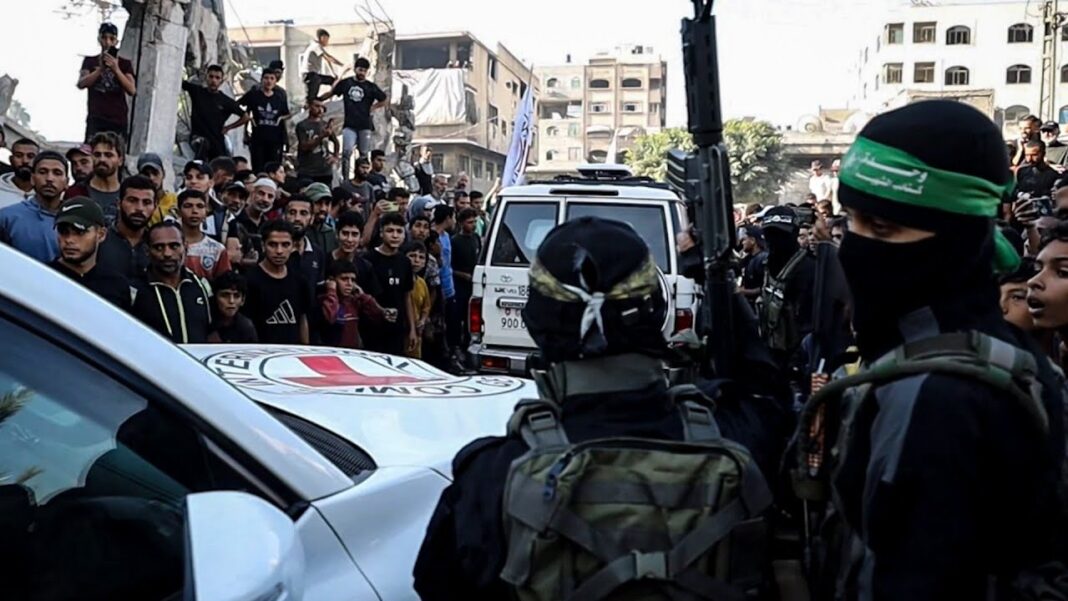
As part of the ceasefire agreement, Israel has agreed to return the bodies of 15 Palestinian combatants for each Israeli hostage — living or deceased — handed back by Hamas. The International Committee of the Red Cross (ICRC) has been overseeing these exchanges, transporting remains through the Kerem Shalom crossing.
But this process, too, has become embroiled in controversy. Palestinian officials in Gaza have accused Israel of returning mutilated bodies bearing signs of execution and torture — allegations the Israeli government has categorically denied.
“We saw with our own eyes clear signs of torture and execution,” said Sameh Hamad, a member of the committee responsible for receiving the bodies at a hospital in Khan Younis, in remarks reported by the Associated Press and cited in the CBS News report. “Their hands and feet were cuffed, their eyes blindfolded.”
Hamas echoed those claims in an official statement Thursday, accusing Israel of “field executions” and “mutilation of corpses,” and called for the United Nations to open “an urgent and comprehensive investigation.”
The Israel Defense Forces (IDF) responded to a CBS News request for comment on Friday, stating unequivocally that “the IDF operates strictly in accordance with international law — in stark contrast to the murderous terrorist organization Hamas, which slaughtered civilians, desecrated bodies, and broadcast their atrocities online.”
The IDF further clarified that all Palestinian bodies returned thus far were those of combatants killed during fighting in Gaza, not prisoners taken alive and executed. “The IDF did not tie any bodies prior to their transfer,” the statement said.
The controversy over the handling of remains has reignited debate over the false moral equivalence drawn by some international actors between Israel and Hamas.
Hamas’s record of targeting civilians, from the massacre at the Nova music festival to the abduction of elderly Israelis and children, remains well-documented. Survivors have spoken to CBS News about torture, sexual violence, and psychological abuse in captivity.
Former hostage Keith Siegel, who spent over a year in Hamas tunnels before being freed, told CBS’s 60 Minutes in March that he witnessed “unspeakable acts of brutality,” including the sexual assault of female captives. “They wanted to break us — physically, emotionally, spiritually,” Siegel said. “They celebrated our pain.”
By contrast, Israeli actions during wartime are subject to military oversight, legal review, and global scrutiny. Israeli officials argue that the country’s democratic accountability stands in stark contrast to Hamas’s “culture of impunity.”
For now, the ceasefire endures — held together by a fragile combination of diplomacy, exhaustion, and the sheer human need for reprieve. Yet as CBS News reported, every body recovered and every ceremony of mourning threatens to pull at its seams.
The humanitarian situation in Gaza remains dire. The United Nations estimates that more than 55 million tons of debris still blanket the enclave, much of it unexploded ordnance or tunnel collapse zones. U.S. search and rescue experts are expected to join the recovery efforts in the coming days, though no timeline has been confirmed.
In Jerusalem, Prime Minister Benjamin Netanyahu has faced growing domestic pressure to ensure the full recovery of all hostages and remains. “Every name, every face is a story we cannot abandon,” he said in a statement quoted in the CBS News report. “We will not rest until everyone — living or dead — comes home.”
Nearly two years after the Hamas massacre that shattered Israel’s sense of security, the echoes of that day still reverberate through every policy debate, every negotiation, every moment of silence. The ceasefire, for all its fragility, represents the first sustained pause in a war that has redrawn both geography and conscience.
As CBS News observed in a recent broadcast, “For Israelis, the war began in an instant of horror. For Gazans, it has lasted through months of devastation. And for the families of the hostages, it is not over at all — it will never truly be over until every trace of their loved ones is found.”
Whether this truce will hold — or fracture under the weight of grief, accusation, and distrust — remains uncertain. But amid the ruins of Gaza and the solemn processions in Israel, one truth endures: the war’s end is written not in treaties, but in the slow, painful return of the missing.
And as CBS News poignantly concluded in its nightly broadcast, “The ceasefire may have silenced the guns — but it has not quieted the sorrow.”

At least the PM of Israel should make it clear to Hamas: No aid until all bodies are returned – period.