



|
Getting your Trinity Audio player ready...
|
By: Fern Sidman – Jewish Voice News
In a stark illustration of the fragility underpinning the current ceasefire arrangements in Gaza, the Israel Defense Forces (IDF) on Saturday eliminated a Palestinian gunman who crossed a designated humanitarian corridor before opening fire on Israeli troops—a move the military described as a “blatant violation” of the truce. As reported on Saturday at The Jewish News Syndicate (JNS), the incident triggered a rapid and decisive retaliatory response involving the IDF, the Israel Security Agency (Shin Bet), and the Israeli Air Force (IAF), culminating in the targeted killing of five senior Hamas terrorists.
The confrontation unfolded along what the IDF identifies as the “Yellow Line”—a delineated boundary established under the ceasefire’s operational framework. The line marks the perimeter beyond which Gazan individuals and vehicles may not cross without violating the terms negotiated by Israel, the United States, and other regional intermediaries. Humanitarian routes, reopened as part of the ceasefire agreement, were intended to facilitate aid distribution and civilian movement—not to serve as avenues for militant exploitation.
Yet, as the JNS report underscored, the terrorist on Saturday used precisely such a humanitarian passage to stage his attack.
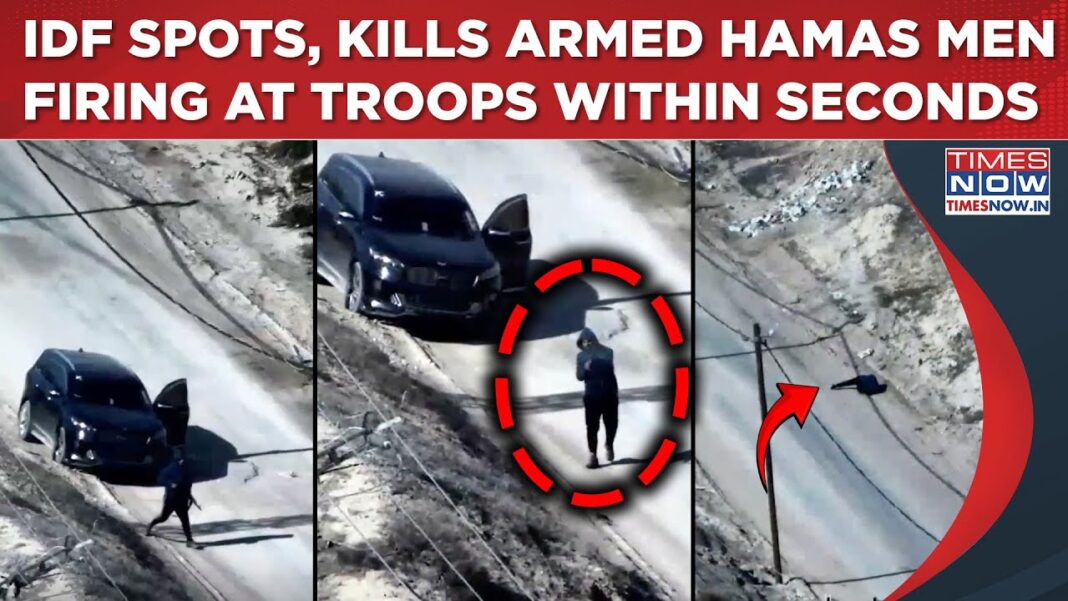
According to the IDF Spokesperson’s Unit, the incident began when a black jeep traveling along the humanitarian corridor crossed the Yellow Line—an immediate violation. The gunman, who had apparently been concealed inside the vehicle, exited and fired directly at IDF troops positioned in southern Gaza. Footage released by the IDF and analyzed by The Jewish News Syndicate (JNS) shows the Palestinian attacker stepping out of the jeep, raising his weapon, and unleashing a burst of gunfire toward Israeli positions.
Israeli forces, operating under strict ceasefire rules of engagement, identified the threat within moments and neutralized him. The video shows return fire striking the gunman, who collapses to the ground within seconds.
While no Israeli casualties were reported, the IDF characterized the assault as a grave breach—not only because it involved active gunfire but because the attacker exploited a humanitarian lane specifically designed to protect civilians. “The terrorist opened fire at IDF forces deployed in southern Gaza, without causing any casualties,” the military said. “Immediately upon identification, forces of the Southern Brigade fired and eliminated the terrorist.”
As the JNS report noted, this marked the first time a Gazan gunman has used a civilian-access humanitarian zone as a launching point for an attack during the current ceasefire.
Israel’s response, carried out within hours, was swift and uncompromising. Guided by high-level intelligence from the Shin Bet and supported by aerial surveillance and precision firepower from the IAF, Israeli forces targeted Hamas command nodes across the Gaza Strip. According to an official statement from the Prime Minister’s Office (PMO) in Jerusalem—reported in detail by JNS—Israel successfully killed five senior Hamas terrorists.
“Israel has fully honored the ceasefire; Hamas has not,” the PMO declared. “Throughout the ceasefire, dozens of Hamas terrorists have crossed the Israeli lines to attack our troops, while they execute Palestinian civilians in Gaza.”
This dual-track pattern of ceasefire violations—targeting Israeli soldiers while simultaneously harming Palestinians attempting to flee conflict zones—has been a recurring theme in IDF briefings and JNS reporting. Israeli officials stressed that the violations are systematic, not incidental.
The PMO used the incident to amplify its calls for international mediators—including the United States, Qatar, and Egypt—to enforce stricter compliance on Hamas. Central to this demand is the immediate return of the bodies of three deceased hostages still held in Gaza: Dror Or, abducted from Kibbutz Be’eri, Israel Police Sgt. Maj. Ran Gvili, killed defending Kibbutz Alumim and Sudthisak Rinthalak, a Thai agricultural worker taken from Be’eri.
“Hamas must immediately return the three deceased hostages it is still holding and complete its disarmament and enable the total demilitarization of Gaza,” the PMO emphasized, citing what JNS has repeatedly described as Israel’s adherence to President Trump’s comprehensive 20-point ceasefire plan.
The PMO’s phrasing reflects Israel’s growing frustration with Hamas’s continued noncompliance—and with international actors whose leverage, Israeli officials say, has not been adequately exercised.
According to Axios reporter Barak Ravid—whose reporting was further contextualized by JNS, the Trump administration signaled full U.S. support for Israel’s retaliatory actions. A senior American official, speaking anonymously, affirmed that Israel had acted in accordance with pre-established rules.
“The attack was carried out in an area of recently reopened humanitarian aid,” the official said. “Israel has a policy, agreed upon with the mediators, that ceasefire violations will be met with immediate response.”
The endorsement reflects a broader trend tracked by JNS: Washington has grown increasingly aligned with Israel’s insistence on strict enforcement of ceasefire guidelines, particularly after multiple documented Hamas violations.
While Saturday’s incident was uniquely alarming due to the use of a humanitarian route, JNS has documented multiple violations by Hamas since the ceasefire took effect on October 10. These ranged from sporadic gunfire to infiltration attempts across various sectors of the front line.
At present, IDF forces have withdrawn to a line cutting through northern, eastern, and southern Gaza—holding approximately 58% of the enclave’s territory on the eastern side. The withdrawal was intended to reduce friction and allow for humanitarian operations, but Hamas fighters have repeatedly attempted to use the reduced IDF footprint to stage attacks.
Most prior breaches involved small groups of fighters crossing the Yellow Line on foot. Saturday’s vehicular infiltration represented a tactical evolution—and a major escalation.
In a separate operation, the IDF announced the conclusion of a 24-hour manhunt in eastern Rafah targeting a group of 17 Hamas operatives who attempted to escape their subterranean infrastructure.
IDF troops, primarily from the Nahal Infantry Brigade’s combat battalions, identified and engaged the fugitives. Eleven were killed during firefights, while six were apprehended and transferred to Shin Bet custody for interrogation.
This operation took place parallel to the ceasefire, underscoring the complex and contradictory dynamics on the ground: even as Israel honors its commitments to pause offensive operations, it continues to respond to direct threats and prevent terrorist movements into civilian areas.
An IDF spokesperson stated, “Troops in the Southern Command remain deployed in accordance with the ceasefire agreement and will continue to operate to remove any immediate threat.”
One of the most disturbing implications of Saturday’s attack is the exploitation of a humanitarian passage. These corridors, designed to allow aid trucks, medical teams, and civilians to move safely, represent fragile lifelines for Gaza’s population.
As JNS has reported, Israel has gone to considerable lengths to maintain humanitarian access—even during intense military operations. Any abuse of these routes inevitably triggers operational recalibration, potentially jeopardizing civilian aid flows.
Israeli officials fear that Hamas may now be probing these corridors for weaknesses, testing whether humanitarian zones can be used for tactical advantage. If so, Israel may be forced to alter or curtail aid pathways—an outcome Hamas would likely weaponize for propaganda.
Taken together, the infiltration attack, the retaliatory strikes, the manhunt in Rafah, and the accumulating ceasefire violations present a troubling picture of a truce under continual stress. As JNS has documented consistently, Hamas appears to be using the ceasefire less as a pathway toward stabilization and more as a strategic intermission—a window to regroup, redeploy, and test Israel’s vulnerabilities.
Israel, for its part, remains resolute. It insists that while it will honor every comma of the ceasefire agreement, it will not permit even the slightest threat to go unanswered.
Saturday’s events illustrate a harsh truth: ceasefires with Hamas are inherently unstable because the parties approach them with fundamentally different intentions. For Israel, a ceasefire is a mechanism to reduce hostilities and facilitate humanitarian relief. For Hamas, it is a tactical pause—a shield behind which it can reposition and rearm.
The swift elimination of the gunman who violated the ceasefire, the targeted killing of five senior Hamas operatives, and the completion of the Rafah manhunt all reflect Israel’s determination to enforce the terms of the truce while securing its operational freedom to neutralize threats.
As mediators continue working to stabilize the situation, Saturday’s incident will likely be remembered not simply as another breach, but as a warning: so long as Hamas remains armed, entrenched, and ideologically committed to Israel’s destruction, no ceasefire can be more than temporary—and no humanitarian corridor is guaranteed safe.
Israel, as the JNS report indicated, is navigating a ceasefire held together by vigilance, deterrence, and the hope that clarity—not distortion—will eventually shape the path forward.