



|
Getting your Trinity Audio player ready...
|
By: Fern Sidman
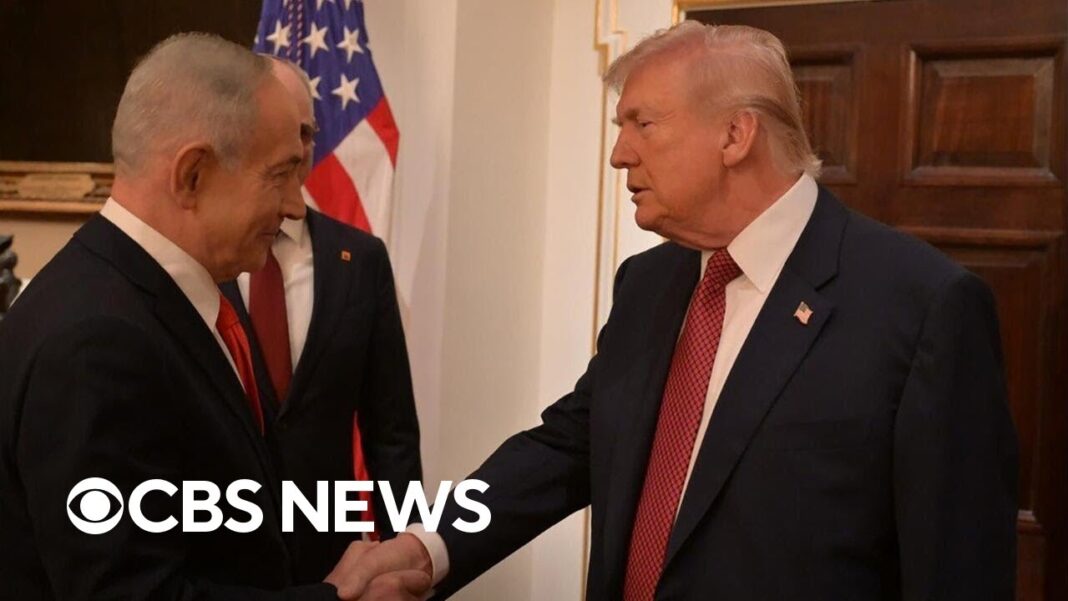
In the opaque corridors of international diplomacy, where words are often weighed with the gravity of potential war, a report emerging this week has shed new light on the private assurances exchanged between President Donald Trump and Israeli Prime Minister Benjamin Netanyahu. According to an account first published by CBS News and closely followed by VIN News, Trump told Netanyahu during a December meeting at his Mar-a-Lago residence that he would support Israeli military action against Iran’s ballistic missile program should diplomatic efforts to restrain Tehran’s ambitions ultimately fail.
The disclosure, though unaccompanied by public confirmation from either leader, has reverberated across policy circles, underscoring the enduring convergence between Washington and Jerusalem on the question of Iran and the uneasy balance between diplomacy and deterrence.
VIN News reported on Sunday that U.S. officials familiar with the conversation indicated that Trump’s message was not merely rhetorical. The president is said to have conveyed openness to providing logistical support should Israel elect to carry out strikes against Iranian missile infrastructure. While the contours of such assistance were not specified, the suggestion alone carries significant strategic implications.
Logistical backing from the United States—ranging from intelligence sharing to operational coordination—has historically been a force multiplier in Israel’s capacity to project power beyond its borders. The prospect of such support, even if conditional and hypothetical, signals to Tehran that Israeli red lines may be buttressed by American resolve.
The timing of the reported exchange is particularly salient. Indirect negotiations between Washington and Tehran over Iran’s nuclear program continue, marked by a familiar oscillation between cautious optimism and entrenched mistrust. U.S. officials have reiterated publicly that diplomacy remains the preferred avenue for constraining Iran’s nuclear and missile ambitions. Yet they have also stressed that “all options remain on the table,” a formulation that preserves the credibility of coercive alternatives even as talks proceed. Trump’s reported assurances to Netanyahu, delivered in private, appear to echo this dual-track posture, reinforcing the notion that diplomatic engagement is underwritten by the latent threat of force.
The VIN News report has framed the development as emblematic of the continuity in U.S.-Israeli coordination on Iran policy across administrations and political cycles. The bilateral relationship, particularly in the security domain, has long been anchored in a shared assessment of Iran as a destabilizing actor in the Middle East. For Israel, Iran’s ballistic missile program represents not merely a technical capability but an existential concern, given the range and payload of missiles that could reach Israeli territory.
The potential convergence of missile capabilities with nuclear enrichment remains, in Israeli strategic thinking, the gravest of scenarios. Against this backdrop, Trump’s reported willingness to support Israeli action reinforces a long-standing pattern of American backing for Israel’s efforts to prevent adversaries from achieving strategic parity.
At the same time, the VIN News report noted the careful ambiguity that surrounds such disclosures. Neither Trump nor Netanyahu has publicly commented on the reported conversation, a silence that preserves diplomatic flexibility while allowing the report itself to function as a signal. In the world of high-stakes diplomacy, the controlled leak of private assurances can serve as a message to multiple audiences simultaneously.
To Israel, it reaffirms the reliability of American partnership. To Iran, it underscores the risks of miscalculation should negotiations falter. To the broader international community, it illustrates the persistent volatility of a standoff that oscillates between dialogue and the specter of confrontation.
The broader regional context amplifies the significance of the report. VIN News has repeatedly chronicled the heightened tensions that pervade the Middle East, where proxy conflicts, maritime incidents, and clandestine operations create a combustible environment. Iran’s missile program, often framed by Tehran as a defensive necessity, is viewed by the international community of nations as an offensive capability that destabilizes deterrence balances.
Israeli officials have long argued that missile development, particularly when coupled with support for regional proxies, constitutes an intolerable threat. The reported assurances from Trump, therefore, resonate within a strategic landscape already primed for escalation should diplomatic channels collapse.
From the perspective of U.S. policy, the report underscores the enduring tension between engagement and enforcement. American administrations, regardless of party, have grappled with the challenge of constraining Iran’s ambitions without precipitating a broader conflict. The preference for diplomacy reflects both the lessons of past interventions and the recognition that military action carries unpredictable consequences.
Yet the insistence that “all options remain on the table” reflects a parallel concern: that diplomacy divorced from credible deterrence may lack the leverage necessary to compel meaningful concessions. Trump’s reported message to Netanyahu situates him firmly within this latter tradition, emphasizing the utility of hard power as a backstop to negotiation.
For Israel, the calculus is particularly acute. Israeli strategic doctrine emphasizes preemption and prevention when existential threats loom. The memory of past operations, from the strike on Iraq’s Osirak reactor to the destruction of Syria’s al-Kibar facility, informs a national security ethos that privileges decisive action over reactive defense. The possibility of U.S. logistical support for strikes on Iran’s missile program would significantly shape Israel’s operational planning, potentially lowering the threshold for action should diplomatic avenues be exhausted.
Yet the report also raises questions about the limits of alignment. The VIN News report cautioned that while U.S.-Israeli coordination is robust, the decision to engage militarily with Iran would carry profound regional and global repercussions. Retaliation by Iranian proxies, disruptions to global energy markets, and the risk of escalation into a broader war all temper the appeal of kinetic solutions. The continued emphasis by U.S. officials on diplomacy as the preferred path reflects an awareness of these risks, even as contingency planning proceeds in parallel.
In the final analysis, the reported December conversation between Trump and Netanyahu illuminates the precarious equilibrium that defines the current phase of the Iran standoff. Diplomacy persists, but it is shadowed by deterrence. Negotiations continue, but they are underwritten by the implicit threat of force. The enduring coordination between Washington and Jerusalem on Iran policy reflects a shared strategic horizon, even as the means of navigating that horizon remain contested. Whether the ongoing talks will yield a durable agreement or merely postpone a reckoning remains uncertain. What is clear is that the interplay between private assurances and public diplomacy continues to shape the contours of one of the most consequential security dilemmas of our time.
