



|
Getting your Trinity Audio player ready...
|
By: Abe Wertenheim
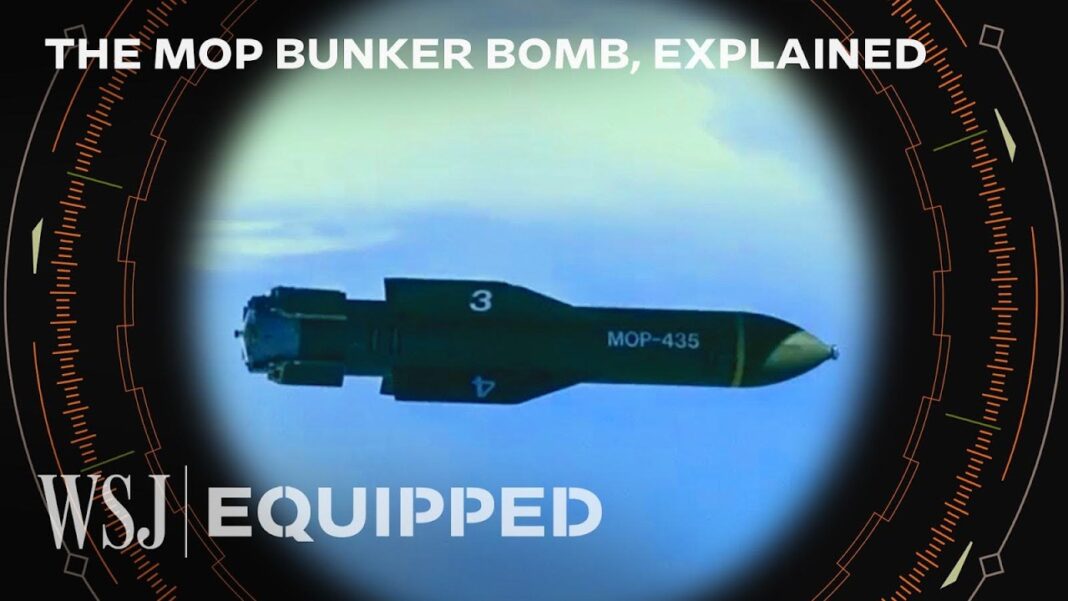
In the long calculus of modern airpower, few weapons embody the convergence of engineering audacity, geopolitical urgency, and strategic imagination as powerfully as the GBU-57 Massive Ordnance Penetrator. Developed by Boeing for the U.S. Air Force and first deployed operationally in 2025 against Iran’s subterranean nuclear architecture, the 30,000-pound precision weapon—known across the Pentagon simply as “MOP”—has become the gold standard for penetrating hardened underground complexes once considered invulnerable to conventional attack.
Now, as tensions with Tehran once again escalate, emerging reports suggest that the United States will transfer MOP units to Israel, marking one of the most consequential military collaborations between Washington and Jerusalem in decades. The implications of such a transfer reach far beyond the battlefield. They speak to a shifting strategic paradigm across the Middle East, to Israel’s intensifying concerns about Iran’s nuclear ambitions, and to the intensifying debate over how deeply to integrate allied capabilities in counterproliferation operations.
To understand the stakes of this moment, one must revisit the origins of the GBU-57. Conceived in the early 2000s under the “Big BLU” initiative—Big Bomb Live Unit—the program sought to overcome a clear limitation exposed during the U.S. invasion of Iraq: traditional bunker-busting munitions such as the 5,000-pound GBU-28 were simply not powerful enough to neutralize deeply buried or reinforced facilities.
Iran’s nuclear program, already dispersing and hardening itself at sites like Fordow and Natanz, only intensified the Pentagon’s conviction that a new class of penetrator was required.
Thus, in 2004, the Defense Threat Reduction Agency (DTRA) and the Air Force Research Laboratory initiated formal development of a bomb capable of slicing through layers of concrete, granite, and steel before detonating with devastating effect. Boeing was tasked with designing a weapon specifically for the B-2 Spirit strategic bomber—a platform whose stealth profile and operational envelope could deliver a 20.5-foot, 30,000-pound munition at the velocities needed to achieve maximum penetration.
The result was the GBU-57: a precision-guided, GPS- and INS-equipped penetrator warhead with a casing forged from ultra-dense Eglin steel alloy and filled with more than 5,300 pounds of advanced polymer-bonded explosive. The weapon incorporates a unique grid-fin architecture, enabling stability in high-speed descent, and a “Smart Fuse” system capable of calculating—and adjusting—the exact detonation depth based on the characteristics of the underground structure.
The bomb was not merely engineered. It was sculpted to defeat the future.
After years of testing at White Sands Missile Range, Holloman High Speed Test Track, and aboard modified B-52s and B-2s, the MOP officially entered the Air Force arsenal in 2011. But its true strategic purpose remained theoretical until June 22, 2025, when seven B-2 bombers executed a coordinated strike on Iran’s Fordow Uranium Enrichment Plant and the sprawling Natanz facility.
Dropping 14 MOP units in total, the mission marked the first real-world demonstration of the weapon’s core capability: reaching deep enough to disrupt hardened nuclear infrastructure built beneath mountains and reinforced tunnels. While the full extent of the damage remains classified, the attack confirmed that no structure—no matter how buried—could confidently evade American long-range precision strike power.
For Israel, which has long viewed Iran’s nuclear program as an existential threat, the demonstration was transformative.
Fordow, buried under 260 feet of rock, has long been considered one of the most formidable nuclear fortresses in the world. Israeli planners have openly acknowledged that their existing arsenal of U.S.-supplied bunker-busters, including the GBU-28 and GBU-72, would not be sufficient to reliably cripple such deeply hardened targets. The B-2 Spirit—America’s stealth bomber designed to carry the MOP—has no equivalent in the Israeli Air Force.
Thus, as Iran expanded its network of underground nuclear sites and enriched uranium to unprecedented levels, Israeli defense strategists increasingly fixated on a question that had no easy answer: How do you penetrate a facility built specifically to survive an air campaign?
The arrival of the MOP in Israel’s orbit fundamentally changes that equation.
If Washington indeed transfers GBU-57 units to Israel—as multiple reports have suggested—the next question becomes even more complex: How would Israel deliver a weapon that only the B-2 Spirit and the forthcoming B-21 Raider are currently capable of carrying?
This is where the discussion becomes genuinely innovative.
Israel’s fleet of C-130 Hercules aircraft—particularly the modernized C-130J Super Hercules—has earned a reputation for versatility, from special operations insertions to long-range clandestine missions. While conventionally unsuited to delivering a 30,000-pound penetrator bomb, the C-130 platform has historically been used to release outsized munitions such as the BLU-82 “Daisy Cutter” in Vietnam and the GBU-43/B MOAB (“Mother of All Bombs”) in Afghanistan.
The MOP is heavier, denser, and designed to be dropped from higher altitudes at higher speeds—but the theoretical possibility of adapting a C-130-based delivery method remains the subject of increasing speculation among analysts.
Israel National News has repeatedly noted that Israeli air planners have long explored unconventional delivery concepts for deep-penetration weapons. The challenge lies in reconciling three critical variables:
Altitude
The B-2 releases the MOP from around 50,000 feet. A C-130 operates at roughly half that altitude.
Speed
The B-2 can deliver the weapon at around 500 mph. A C-130 maxes out near 250 mph.
Survivability
Penetrating Iranian airspace would be significantly more dangerous in a C-130 than in a stealth bomber.
These differences matter. The physics of a penetrator weapon depend heavily on release velocity and angle. A slower, lower-altitude drop dramatically reduces the kinetic energy needed to drive the weapon deep into granite and reinforced concrete.
Yet, as defense engineers have noted, there are possible workarounds. A modified MOP could incorporate a rocket booster stage to compensate for lower release velocity. The attack could also involve a sequential strike pattern—multiple penetrators dropped into the same impact point to progressively burrow deeper, a concept explored for years in theoretical planning for strikes on Fordow.
Alternatively, an Israeli-designed derivative of the MOP could be optimized for C-130 deployment, exchanging weight or casing thickness for a more flexible delivery profile.
No such program has been confirmed. But the conversation—once purely fictional—has entered the realm of serious strategic analysis.
Several converging developments explain why the MOP is suddenly central to Israel’s strategic calculus.
1. Iran’s nuclearization of its mountains
Tehran has aggressively expanded its underground facilities, reportedly constructing vast subterranean complexes at depths inaccessible to standard aerial munitions. Israel National News has frequently warned that Iran’s “mountainization strategy” aims to render a preemptive strike impossible.
2. The limitations of Israel’s fighter-based arsenal
While Israel’s F-35I Adir fleet is unmatched in stealth fighter capabilities, no fighter jet—Israeli or otherwise—can deliver a 30,000-pound weapon.
3. The shifting geopolitical environment
With Washington increasingly prioritizing Indo-Pacific competition, Israel is seeking greater operational independence. Receiving the MOP would dramatically expand its strategic autonomy.
4. The precedent of 2025
The U.S. strike on Fordow demonstrated not only the weapon’s effectiveness but also an American willingness to act decisively under certain conditions. Israel views the MOP as both a capability and a signal.
In a world where underground nuclear complexes are becoming the norm rather than the exception, the capability to neutralize these sites is no longer optional—it is foundational to national survival.
Whether delivered by a B-2, a modified C-130, or an entirely new Israeli-engineered delivery system, the Massive Ordnance Penetrator represents a strategic threshold: a weapon conceived for the deepest bunkers humanity can construct.
It is, in essence, a technological answer to an existential question.
The emergence of the GBU-57 as a centerpiece of Israel’s strategic conversation marks more than an upgrade in military capability—it marks a shift in the geometry of deterrence. In the subterranean arena where Iran has built its nuclear ambition, Israel must now innovate at a pace equal to the threat it faces.
The MOP is not merely a bomb. It is the embodiment of a strategic proposition: that no adversary can place its most dangerous assets beyond reach.
If Israel ultimately receives—and adapts—the Massive Ordnance Penetrator, it will fundamentally alter the balance of power between Jerusalem and Tehran. And in a region where the shadows under mountains conceal the future, that shift may determine the course of the next decade.
From whence exactly are these alleged “emerging reports“ actually “emerging”? IDENTIFY your sources BEFORE you “report”!