



By: Fern Sidman
As Israel’s fourth election in two years comes to close on Tuesday evening, exit polls have projected that Israeli Prime Minister Benjamin Netanyahu and his Likud party are holding a lead in the hotly contested race. This essentially translates into Netanyahu being given the opportunity to form a coalition and retain his authority for an unprecedented sixth term. Israel’s governmental system is predicated on a parliamentary model, and the Israeli populace does not vote for an individual, so to speak, but for a party instead.

Netanyahu’s Likud party has been ruling the government since 2009, when he was re-elected to the leadership role of prime minister. He also served a three year stint as prime minister from 1996-1999. He is currently the longest serving prime minister in Israel’s history.
According to a New York Times report of Tuesday, three exit polls conducted by Israeli broadcasting networks indicated that Likud won from 31-33 seats, while the wider right wing bloc of smaller parties won anywhere from 53 to 54 seats. A 61 seat majority is necessary to form a coalition and for a party to rule legitimately.
Israel National News reported on Tuesday evening that as the polls closed on election day Channel 12 News released an exit poll showing the Likud winning 31 seats, becoming the largest party in the Knesset by a wide margin.
The poll found Yesh Atid trailing far behind with 18 seats. Shas and the Joint Arab List winning nine each, Yamina winning eight seats, Yisrael Beytenu, Blue and White, Religious Zionism, and Labor winning seven seats each, and United Torah Judaism, New Hope, and Meretz winning six seats each, according to the INN report.

An AP report indicated that Naftali Bennett, leader of the small nationalist Yamina party, could be left as the potential kingmaker, though that was not certain at the time of this writing. The election was seen as a referendum on Netanyahu’s leadership style, and the initial results showed that the country remains with intractable divisions, along with an array of small sectarian parties dominating the parliament. If the exit poll is accurate, Netanyahu will be able to form a coalition of 61 MKs if Yamina joins him, as was reported by INN.
The Channel 13 News exit poll shows that the Likud wins 32 seats. Yesh Atid wins only 16. The Joint List, Yisrael Beytenu, Shas and Blue and White, which becomes the surprise of the election, win eight seats each. Yamina gets only seven seats. Religious Zionism, United Torah Judaism, Meretz and Labor also receive seven seats. New Hope wins just five seats.
Kan 11’s exit poll showed the Likud winning 31 seats with Yesh Atid placing second with 18 seats. Shas received nine seats and the Joint Arab List eight seats. Yamina won seven seats, as did United Torah Judaism, Blue and White, Labor, Religious Zionism, and Yisrael Beytenu. New Hope won six seats, as did Meretz. The Ra’am party did not pass the electoral threshold.
All three polls show Netanyahu as able to form a coalition of at least 61 Knesset seats if Yamina joins his coalition, according to the INN report.
If Bennett should decide to align himself and his party with Likud and join the coalition, that could mean that Netanyahu would be in an excellent position to assemble one of the most right-wing governments in Israeli history, as was reported by the New York Times. The ruling coalition would consist of the ultra-Orthodox parties and the nationalist parties.
Bennett previously served under Netanyahu as defense minister, and his second-in-command, Ayelet Shaked, was justice minister. Bennett will likely demand Netanyahu accede to his desire for policy changes, including tackling Israel’s Supreme Court, which the Right sees as overreaching, as well as top portfolios like defense, foreign affairs and justice, according to a report on the World Israel News web site.

Final results of the election are not expected until the end of the week and will most probably coincide with the upcoming Passover holiday which is nationally observed in Israel.
Netanyahu campaigned on his stellar record of handling the coronavirus pandemic by instituting strict lockdowns and keeping the infection rate from skyrocketing out of control. Experts agree that the death rate from the Covid virus in Israel could have been significantly higher had it not been for Netanyahu’s plan to stop the virus from spreading. Israel’s highly successful vaccine rollout has been lauded by the entire world for its efficacy and this too has benefited Netanyahu at the polls.
Despite the fact that Netanyahu was the only prime minister in the 70 plus year history of the modern state of Israel to run for re-election while undergoing a trial that charged him with corruption, bribery and fraud, he still managed to curry favor with diverse segments of Israeli society. He has categorically denied any wrongdoing.
On Tuesday night, Netanyahu expressed his thanks to voters on Twitter for handing “an enormous victory to the right wing and Likud under my leadership.” Netanyahu continued by saying: “It is clear that the overwhelming majority of the citizens of Israel are right wingers and they want a strong and stable right-wing government that will safeguard the economy of Israel, the security of Israel and the land of Israel. This is what we will do. Love you!”
World Israel News reported that Ari Shavit, a Channel 20 journalist, said, “These results show that the people of Israel voted more than anything else against the demonstrators at Balfour,” referring to anti-Netanyahu protests that have taken place near the Prime Minister’s Jerusalem residence for nearly a year.
With a clear majority of right-wing representatives and little differences in terms of overall policy, it would seem that the parties are well placed to join forces and finally settle in to stable governance following two years of back-to-back elections and one highly dysfunctional unity government, according to the WIN report.
Former Jerusalem mayor and Likud MK Nir Barkat spoke to Arutz Sheva on Tuesday evening following the publication of the exit polls in the elections to the 24th Knesset.
“There are two clear understandings from the results of these elections. The first is that there’s only one candidate for Prime Minister and that is Binyamin Netanyahu with over 30 seats. Naftali Bennett with 6 seats cannot be Prime Minister, neither can Gideon Sa’ar,” he said.
“Therefore,” continued Barkat, “another observation is that there are over 60 seats that are right of center, so the natural and right thing to do is for all the members of the right of center to come to Netanyahu and swiftly move on to form a right of center government that will focus on the real challenges of the country.”
INN reported that he noted that Bennett, Sa’ar and Liberman are on the right of center but “unfortunately have not joined the government, and the only alternative to forming a right-wing government is a fifth election, and I think that the public does not want that. The public has voted, accept what the public has said and help us to create a government that will exploit the huge potential of Israel.”
Tuesday evening’s results do not include some 600,000 absentee ballots, which could account for as many as 15 mandates. While those votes will likely reflect overall trends, they have the potential to be a game-changer, as was reported by WIN.
WIN also reported that two hours before the polls closed, the Central Elections Committee (CEC) reported that 4 million out of the 6.6 eligible voters had cast their ballots at 13,685 polling stations around the country. Three thousand additional polling stations were set up to cope with the coronavirus crisis and allow the 15,000 Israelis currently infected with the virus and 85,000 in mandatory quarantine to be able to vote.
At 10:00 p.m. the doors on the polling stations were locked and tens of thousands of election officials began the task of unsealing the ballot boxes and hand-counting the votes, as was reported by World Israel News. As each poll completes the count, the results will be reported to the Central Elections Committee at the Knesset in Jerusalem and the numbers will be added to the running tally on the CEC website.
WIN reported that special polling stations had been set up across the country for the eligible voters among the 15,000 Israelis currently infected with the virus and 85,000 others who are in mandatory quarantine after being exposed to somebody who was infected.
The Central Elections Committee (CEC) was operating hundreds of special polling stations including 38 located in hospital coronavirus wards, five coronavirus quarantine hotels and 547 old age homes along with scores of parking lots at sports stadiums and university campuses, as was reported by WIN.
There were even rolling polling stations set up on public transportation buses that have had the seats removed, and four polling booths at Ben Gurion Airport for the several thousand Israelis expected to return to the country from abroad on election day, according to the WIN report.
Prior to the 2021 Israeli elections, a report on the Calcalist website indicated that hackers had exposed online personal details of 6.5 million Israeli voters.
The most sensitive details, which appear to be the residential addresses, phone numbers, and dates of birth of the registered voters, are apparently from a leak that took place a year ago, according to the Calcalist report. One file, however, which includes people’s full names and their assigned voting stations, looks to be updated to reflect the current voting round.
Calcalist reported that the data was exposed after hackers made threats last week against Elector Software Ltd., the operators of the voter-prompting Elector App, which is used by the ruling Likud party and several others.
WIN reported that as Israelis headed to the polls on Tuesday, security forces at the Knesset were scrupulously monitoring the situation for any signs of violent activity, including possible attempts by protesters to enter the building in a manner similar to the Jan. 6 Capitol riot in Washington, DC.
Channel 13 reported Monday that the Knesset Guard and other security agencies were preparing for several Election Day scenarios such as a mass attempt to storm the Knesset during or after the election.
A special operations room has been established at the location to enable the police and Shin Bet security agency to monitor events.
The security agencies remained on high alert throughout the day and into the night, according to the WIN report..
On Monday night Prime Minister Benjamin Netanyahu left a note at the Western Wall in Jerusalem praying for victory in the elections and expressing gratitude for his wife’s recent recovery from appendicitis.
WIN reported that Netanyahu’s wife Sara was released from Hadassah Ein Kerem Hospital on Sunday, following an emergency appendectomy surgery which required her to be hospitalized for seven days.
“Thank you to the Creator of the World for helping us come out of the coronavirus in peace, and for the speedy recovery of my beloved wife, Sara,” Netanyahu wrote in his note. “I pray for victory in the Israeli elections for the good of Israel, and for the economy of Israel. I am committing to continue serving all Israeli citizens,” the note concluded.
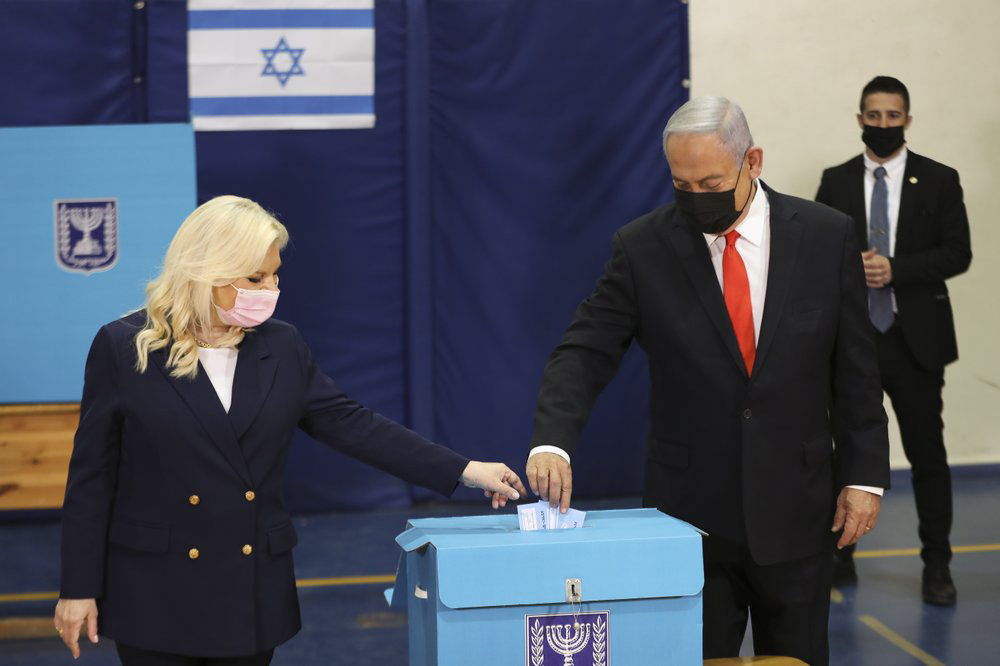
On Tuesday, Netanyahu and his wife voted in Jerusalem, where they reside. On his way out of the hall, Netanyahu said, “hoping these are the last elections,” as they are the fourth in less than two years.
WIN reported that other important personages also headed to the polls early, including President Reuven Rivlin.
“With all the difficulties of the current situation, elections to the Knesset are the pinnacle of our democracy. Four elections in two years erode public trust in the democratic process, but only you can influence. There is no other way,” he said.
Although largely a figurehead role, the president plays an important part in Israeli elections, choosing which candidate to entrust with forming a government.
(AP, NYT, World Israel News, Israel National News)
Read more at: www.worldisraelnews.com
