



|
Getting your Trinity Audio player ready...
|
Edited by: Fern Sidman
Israel’s rival political factions agreed to begin negotiations Tuesday after Prime Minister Benjamin Netanyahu paused a controversial judicial overhaul plan on Monday that had triggered unprecedented street protests and a spiraling domestic crisis, according to an AP report.
The office of the figurehead president, Isaac Herzog, announced that he would host the negotiating teams for their first meeting late Tuesday to begin talks on a potential compromise plan. On Tuesday evening, Israel National News reported that President Herzog did indeed hold the first round of negotiations between the coalition and opposition on the government’s planned judicial reforms at his official residence.

INN reported that the Likud party’s negotiating team consists of Minister Ron Dermer, government secretary Yossi Fuchs, and Dr. Aviad Bakshi, the director of the legal department in the Kohelet Policy Forum. Netanyahu is the chairman of the Likud party in the ruling government. Dermer previously held the post of the Israeli Ambassador to the United States.
The architects of the judicial reforms, Justice Minister Yariv Levin and Knesset Constitution Committee chairman MK Simcha Rothman, are not included in the coalition’s negotiating team, INN reported.
Opposition chairman MK Yair Lapid’s team consists of MK Orna Barbivay, MK Karin Elharar, a former director of the Prime Minister’s Office, Naama Shultz, and attorney Oded Gazit.
INN also reported that the team chosen by National Unity party chairman MK Benny Gantz consists of MK Gideon Sa’ar, MK Yehiel Tropper, MK Orit Farkash-Hacohen, and attorney Ronen Aviani.
President Herzog will meet with negotiating teams from the other political parties later this week. On Wednesday, he will meet with representatives of the Labor and Yisrael Beytenu parties, according to the INN report.
On Tuesday, the Times of Israel reported that following the first round of talks with Herzog, the Yesh Atid delegation says they pushed for a significant reform — including a constitution.
“We told the president that in the 75th year of the State of Israel, we can make a real change — not just cosmetic fixes, but a widely agreed upon constitution based on the values of the Declaration of Independence,” according to a statement from the delegation, as was reported by the TOI.
The delegation says it is seeking to come to a “broad consensus of public representatives to reflect a national consensus of the citizens of Israel.”
The TOI also reported that it also says that it expects the legislation currently in progress in the Knesset to be removed from the agenda completely in order “to start talks on a fresh page.”
The AP report indicated that whether it would be possible for them to reach an agreement or come to a compromise in the coming weeks remained in question after a tumultuous period in which positions only appear to have hardened.
A senior official from the Religious Zionism Party on Tuesday objected to Israeli President Herzog brokering talks between the coalition and the opposition aimed at reaching a compromise on the overhaul of the Israeli judiciary, according to a report on the World Israel News web site.

Yehuda Wald, CEO of the Religious Zionism Party, tweeted Tuesday morning that the president had capitulated to pressure from opponents of the judicial reform, accusing him of turning down overtures by the coalition for a watered-down reform.
“We already held discussions and drafts were already proposed to the president, but ultimately, he submitted to the pressure from the Left and also to the wave of refusals to serve in the IDF, rejected all the suggestions, and took the side of the leftists and the anarchists,” Wald tweeted, according to the WIN report.
Wald accused the president, who has publicly offered to mediate negotiations between the coalition and the opposition, of being biased in favor of opponents of the government’s plan, adding that his behavior has made him “part of the problem,” the report indicated.
“Why should things be any different this time around? Unfortunately, the president is not objective. We do need to hold talks and arrive at a balanced outline, but without him involved. He is a part of the problem, not part of the solution.”
Three months of demonstrations against the judicial reform plan intensified this week and Israel’s main trade union, the Histadrut, declared a general strike on Monday, leading to chaos that shut down much of the country, including the country’s one international airport in Lod as well as research institutes and schools. Such closures threatened to paralyze the economy.
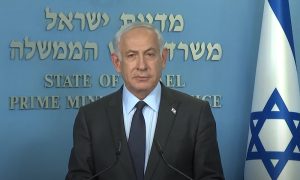
During a prime-time address on Monday night, Netanyahu acknowledged the divisions roiling the nation and announced a month long delay for the legislation. The announcement followed a spontaneous mass demonstration against his firing of his defense minister, Yoav Gallant, who had spoken out against the judicial reform plan, and the sudden general strike.
Netanyahu has argued that the overhaul is needed to rein in a liberal and overly interventionist court of unelected judges, the AP reported. But his opponents say the package would concentrate too much power in the hands of Netanyahu’s allies. They also say that he has a conflict of interest as a criminal defendant.
In his address, Netanyahu expressed concerned that members of the Israel Defense Forces and the Israeli Air Force had refused to show up for duty and training. He told Israelis that Israel cannot exist without the IDF and that nothing can stop people from fulfilling their obligation to serve in the military.
“The State of Israel cannot exist without the IDF and the IDF cannot exist with refusal to serve. Refusal to serve by one side will lead to refusal to serve by the other. Refusal to serve is the end of our country. Therefore, I demand that the heads of the security services and of the army vigorously oppose the phenomenon of refusal to serve, not contain it, not understand it, not accept it – but put a stop to it, “ Netanyahu said.
Concerning the massive demonstrations taking place against the judicial reforms measures; especially the most recent ones that occurred in the aftermath of Netanyahu firing Defense Minister Yoav Gallant over his opposing views of the measures and the fact that the military was being adversely effected, Netanyahu said in his Monday address:
“When there is a chance to prevent civil war through dialogue, I – as Prime Minister – will take a time-out for dialogue. I will give a genuine chance for genuine dialogue. We insist on the need to enact the necessary changes in the judicial system and we will give a chance to achieving broad consensus. This is an incomparably worthy goal.”
In terms of the future of the judicial reform legislation that his coalition has put forth for the approval of the Knesset, Netanyahu promised to revisit this matter and expressed confidence that is would eventually succeed.
Netanyahu said, “Our path is just. Today, the great majority of the public recognizes the urgency of democratic reform of the judicial system. We will not allow anyone to rob the people of its free choice. While we will not give up on the path for which we were elected, we will make the effort to achieve broad agreement.”
Striking a tone of unity and positing himself as a peacemaker and one that can bring this divided nation together in the days before Passover and many other holidays that are celebrated and commemorated in Israel, Netanyahu concluded his address by saying:
“We live in the generation of national revival. History has given us an extraordinary opportunity, unprecedented in the annals of nations, to return to our land and build up our homeland and our state. Soon we will celebrate Passover, the days of remembrance and Independence Day. We will gather around the holiday table – together. We will mourn our fallen – together. We will celebrate our independence – together. And together we will thank the men and women of the security forces, who do not forget, even for a moment, their duty to defend all of us, all the time. We all have a common fate and we all have a common mission, which is to ensure the eternity of Israel.”
The situation escalated on Sunday night after Netanyahu abruptly fired Defense Minister Yoav Gallant, who had urged him to put his plan on hold, citing concerns about damage to the Israeli military, the AP reported.
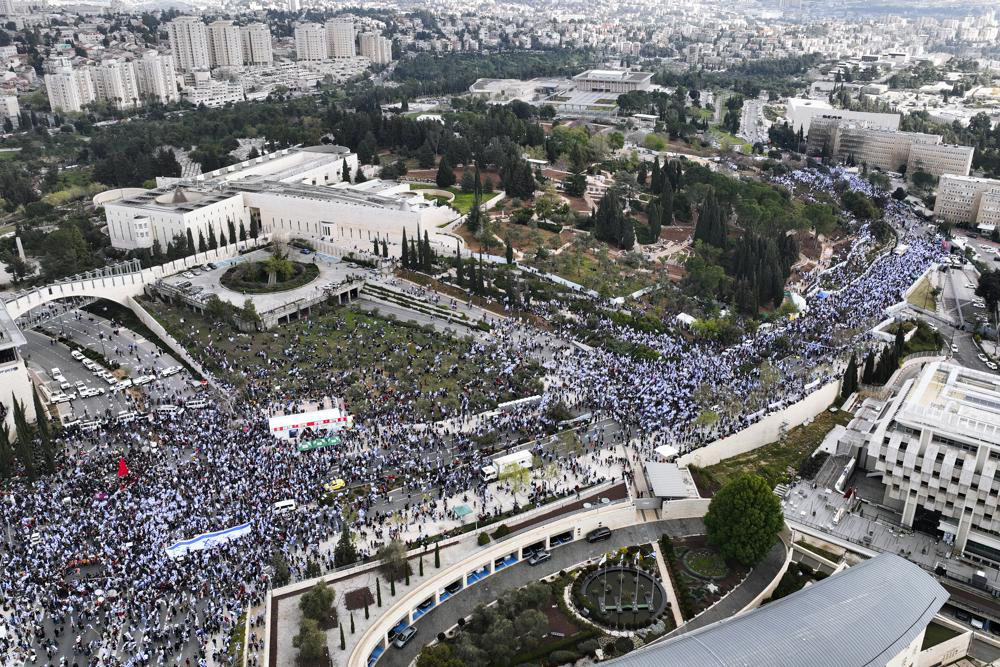
Chanting “the country is on fire,” furious protesters lit bonfires on Tel Aviv’s main highway, closing the thoroughfare and many others throughout the country for hours, according to the AP report. Demonstrators continued Monday outside the Knesset, or parliament, turning the streets surrounding the building and the Supreme Court into a roiling sea of blue-and-white Israeli flags dotted with rainbow Pride banners. The demonstrators, for the most part, have been secular, with a liberal, left wing perspective.
Departing flights from the main international airport were grounded, stranding tens of thousands of travelers. The AP also reported that large mall chains and universities closed their doors, and the union called for its 800,000 members to stop work in health care, transit, banking and other fields.
On Tuesday, WIN reported that the abrupt labor strike called on Monday by the Histadrut, Israel’s labor union, was illegal due to both its political nature and its failure to follow procedural guidelines, said Religious Zionism MK Simcha Rothman.
WIN reported that since the new Netanyahu government took office, hundreds of thousands of people have taken to the streets, blocking major highways and causing “national disruption” in protest against a judicial overhaul, which was part of the Likud party’s platform.
“The political strike yesterday was illegal, there’s no question,” Rothman, an architect of the judicial reforms, told Radio 103FM, according to the WIN report. “Do you know how many messages I saw yesterday from workers saying that the Histadrut was hurting them? [Histadrut] officials made an illegal decision to harm workers.”
In a later conversation with Army Radio, Rothman categorized the strike as a “violation of the rights of the workers,” noting that many of those forced to strike likely voted for the current government and are in favor of judicial reform, as was reported by WIN.
Rothman hinted that the Histadrut will face consequences for the strike. WIN reported that he said, “Whoever uses his business power as a labor organization to force their political position should not be surprised that political forces will act against him in the same way.”
Rothman’s position was supported by Lavi, a Zionist NGO.
WIN also reported that Yitzhak Bam, an attorney working on behalf of Lavi, wrote an open letter to the Finance and Labor Ministries, noting that the strike violated legal requirements for labor disputes.
Labor disputes that could result in a strike must be declared to employers at least 15 days before workers halt their activities, Bam said.
The strike was also illegitimate because it was aimed at the Israeli government, not a specific employer, he added, as was reported by WIN. The only purpose of the strike was “to strengthen the political power of the chairman of the Histadrut. Such a strike cannot be legal according to the ruling of the Supreme Court,” Bam wrote.
According to a Channel 13 report already in January, Opposition leader Yair Lapid was working to persuade Bar-David to partner with him on a major strike that would disrupt Israel’s economy as an act of protest against the new government, the report indicated.
On Monday evening, tens of thousands of demonstrators in favor of judicial reform gathered in Jerusalem to support the government’s efforts, according to a report on the WIN web site.
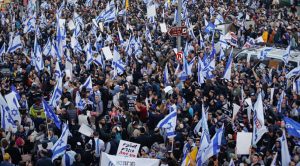
Standing near Sacher Gardens and in front of the Knesset, the crowds waved Israeli flags as they held signs with slogans such as “They are stealing the elections from us” and “I serve in the army but am a second-class citizen.”
WIN also reported that many who support the religious parties that are Likud’s main coalition partners believe that the Supreme Court automatically rules against them in such cases as the right to build in Judea and Samaria and the implementation of an incremental draft law for the ultra-Orthodox. They fervently support changing the makeup of the Judicial Selection Committee to rid it of the natural veto the justices currently hold, the report indicated.
Many displayed one of the right-wing’s main contentions, that the elected legislature’s power has been eroded by an unelected judiciary’s constant interference, with a pre-printed sign saying, “Stop the rule of the Supreme Court! Reform now!” WIN also reported that others held home-made posters with the same idea, such as one that said, “We are all prisoners of the Supreme Court.”
After Netanyahu announced a freeze on the reform legislation in an effort to reach a compromise with the opposition, at least one demonstrator could be seen writing a new sign, using Netanyahu’s nickname: “Bibi folded,” the WIN report indicated.
Speaking to the Walla news site, one demonstrator said, “There’s a strong need for legal reform. The side that’s against the reform did not accept the decision of the voter…. If Netanyahu surrenders, then I see him as a prime minister who can be pressured and who is unable to run the government and follow the voters’ will,” as was reported by WIN.
Finance Minister Bezalel Smotrich, who heads the Religious Zionism party, called to continue the legislative process, telling the masses, “You represent the majority of the nation – the Zionist, nationalist, determined Jew. The one who wants to fix the justice system and make changes that will strengthen Israeli democracy and the Jewish state.”
Addressing Netanyahu, Smotrich said, “See how great the support is, how much love there is, how much determination,” according to the WIN report.
However, Smotrich later agreed to the delay announced by Netanyahu.
WIN reported that at one point later in the evening, hundreds temporarily blocked Begin Boulevard, one of the city’s main arteries. Dozens also started walking towards the prime minister’s home but were stopped by the police, who said that some pro-reform demonstrators threw objects at them and at journalists, according to the report.
Smaller demonstrations by supporters of judicial reform took place in other parts of the country, such as Haifa, Tel Aviv and Eilat, as was reported by WIN. After Netanyahu’s announcement about delaying the overhaul, a few activists in Tel Aviv threw a smoke grenade at anti-reform protestors who had gathered nearby.
(Sources: AP.com. worldisraelnews.com. israelnationalnews.com, timesofisrael.com, and JPost.com)