



|
Getting your Trinity Audio player ready...
|
]By: Fern Sidman
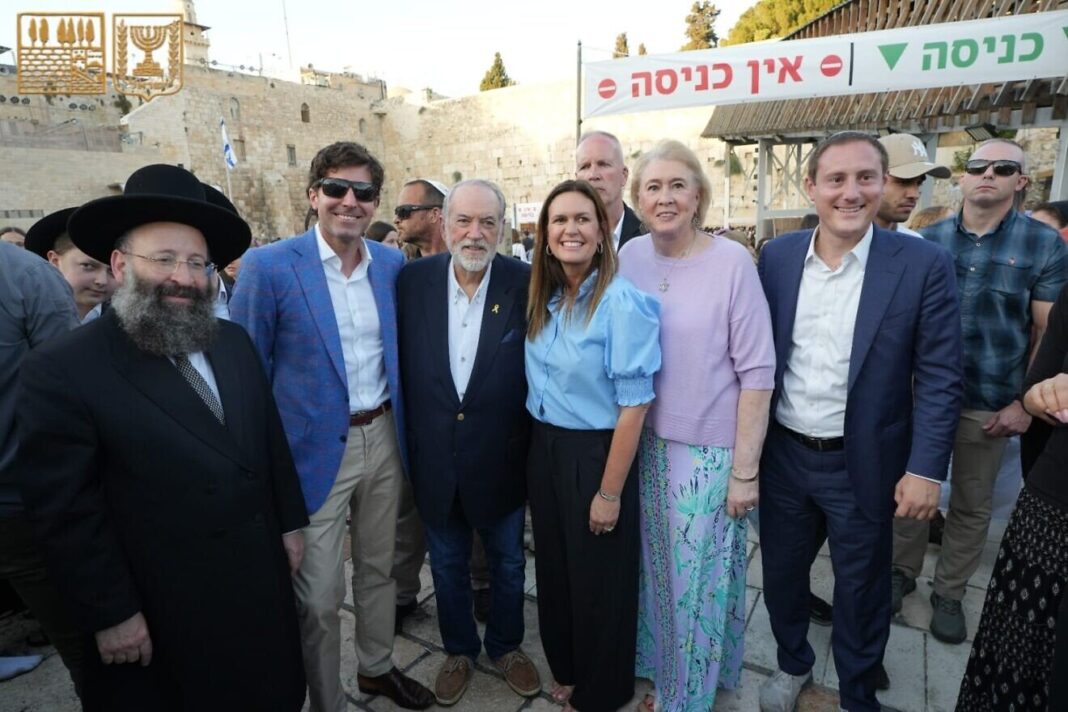
On Sunday, Arkansas Governor Sarah Huckabee Sanders made a deeply symbolic visit to Jerusalem’s Western Wall, accompanied by her husband Bryan, her mother Janet, and her father, former Arkansas governor and current U.S. Ambassador to Israel, Mike Huckabee. The visit, reported prominently by VIN News, took place on Tisha B’Av, the solemn day of mourning in the Jewish calendar marking the destruction of both the First Temple by the Babylonians in 586 BCE and the Second Temple by the Romans in 70 CE.
For Sanders, the timing and setting of the visit carried profound meaning. She not only joined millions of Jews around the world in acknowledging the tragedy of the Temples’ destruction but also affirmed, alongside her family, the unwavering bond between the United States and Israel at one of Judaism’s most sacred sites.
According to the information provided in the VIN News report, the Sanders family was greeted at the Western Wall Plaza by Rabbi Shmuel Rabinowitz, the Chief Rabbi of the Western Wall and Israel’s holy sites. Rabbi Rabinowitz shared reflections on the enduring role of the Wall throughout centuries of Jewish exile and struggle, describing it as a place where generations of Jews prayed for return and redemption.
Governor Sanders took a quiet moment at the ancient stones. She placed a handwritten note into the crevices of the Wall, a centuries-old tradition observed by Jews and visitors of many faiths. The governor later signed the official Western Wall guestbook, where she recorded her impressions of the site’s spiritual power.
“This is a sacred place — not only for the people of Israel, but for all who value faith, perseverance, and freedom,” Sanders wrote. “I’m grateful to stand here with my parents and pray for the people of Arkansas, for America, and for our unbreakable bond with Israel.”
VIN News highlighted how Sanders’ words underscored not only the personal dimension of her visit but also the political resonance of her message at a time of global scrutiny over Israel’s role in defending itself against ongoing threats.
To fully grasp the significance of Sanders’ visit, it is essential to understand the weight of Tisha B’Av in Jewish history. On this day, Jews mourn not only the destruction of the Temples but also a litany of other tragedies that befell the Jewish people: the expulsion from Spain in 1492, the exile from England in 1290, and more recently, the memories of mass slaughter during the Holocaust.
As VIN News reported in its coverage of Tisha B’Av observances across Israel, thousands of Israelis and visitors gathered at the Western Wall throughout the day, reciting kinot (lamentations) and reading from the Book of Lamentations (Eicha), a text mourning the destruction of Jerusalem. For many, it is not only a commemoration of past catastrophes but also a reminder of the resilience and survival of the Jewish people.
By arriving at the Wall on this specific day, Sanders linked herself and her family to the narrative of Jewish endurance, standing in solidarity with the Jewish people not only in times of triumph but in times of grief and historical reflection.
The presence of Ambassador Mike Huckabee lent additional resonance to the moment. Huckabee has long been one of Israel’s most vocal supporters among American political leaders. As the VIN News report noted, his tenure as U.S. Ambassador has been marked by strong advocacy for Israel on the international stage, emphasizing both the historical justice of Jewish sovereignty in their ancestral homeland and the practical security needs of the modern State of Israel.
For Sarah Huckabee Sanders, a rising star in the Republican Party and the daughter of such a figure, the visit underscored a family legacy of solidarity with Israel. Her mother, Janet Huckabee, also present at the Wall, joined the family in prayer, reflecting a shared commitment that transcends politics and enters the realm of faith.
VIN News framed the visit as a unique convergence of public service, family continuity, and religious symbolism — a moment where personal devotion and political message blended seamlessly.
Though Sanders’ role is primarily as the governor of Arkansas, her presence in Israel carried national implications. As the VIN News report emphasized, Sanders is widely seen as a figure with potential future aspirations beyond her current office. Her visit to the Western Wall positioned her squarely within the tradition of American leaders demonstrating solidarity with Israel — a tradition dating back to President Harry Truman’s recognition of the Jewish state in 1948.
By describing Israel as a place of “faith, perseverance, and freedom,” Sanders echoed the themes long cherished by pro-Israel Americans, particularly evangelical Christians who see in the rebirth of Israel not only a political ally but a fulfillment of biblical prophecy. Her words served as a reminder that Israel’s struggle for survival and security is not merely a foreign issue but a matter of deep personal concern to millions of Americans.
The Western Wall — known in Hebrew as the Kotel — is more than a remnant of the Temple. It is a global symbol of resilience, continuity, and hope. For centuries, Jews from every corner of the diaspora directed their prayers toward Jerusalem, yearning for the restoration of Zion. In modern times, the Wall has become a place of pilgrimage not only for Jews but also for leaders of many nations who wish to honor Jewish history and affirm ties with Israel.
As VIN News reported, Sanders’ quiet prayer mirrored the actions of countless visitors who, regardless of background, feel the weight of history when standing before the Wall’s massive stones. The visit on Tisha B’Av made that connection even more poignant, as mourners around her recalled the suffering of exile and the dream of return.
Sanders’ visit also comes at a fraught time for Israel, as it continues to grapple with the fallout from Hamas’ October 7 massacre and the ongoing conflict in Gaza. Internationally, the Jewish state has faced criticism and accusations, often rooted in distorted portrayals of events.
Against this backdrop, Sanders’ words — “our unbreakable bond with Israel” — carried unmistakable weight. As VIN News noted in its analysis of American political trends, public displays of solidarity from U.S. leaders serve as critical counterweights to growing hostility in international forums and on American campuses. Sanders’ statement aligned with a pro-Israel perspective that insists on recognizing the moral clarity of Israel’s struggle against terrorism.
Sanders’ visit highlights a long-standing reality: the relationship between the United States and Israel extends beyond the transactional realm of foreign policy into shared values and historical bonds. As VIN News has frequently reported, bipartisan support for Israel has been tested in recent years, with some political figures embracing rhetoric critical of the Jewish state.
For supporters of Israel, Sanders’ pilgrimage to the Western Wall on Tisha B’Av represented the opposite trend: a reaffirmation that Israel’s security and legitimacy remain a cornerstone of American foreign policy, rooted in both moral conviction and strategic necessity.
Tisha B’Av is a day of mourning, but it is also a day of renewal. Jewish tradition teaches that from the depths of destruction comes the possibility of redemption. Standing at the Wall, Sanders participated in that cycle of grief and hope, affirming that the tragedies of the past cannot erase the determination to build a better future.
As VIN News wrote in its reflections on the day, “Tisha B’Av is not only about what was lost but also about what remains — the Jewish spirit, the dream of Jerusalem, and the promise of renewal.” Sanders’ visit embodied that lesson, demonstrating that solidarity with Israel is not merely about politics or diplomacy but about shared faith in resilience and rebirth.
Governor Sarah Huckabee Sanders’ visit to the Western Wall on Tisha B’Av was more than a ceremonial stop on a foreign trip. It was a statement of faith, a gesture of solidarity, and a reaffirmation of America’s historic bond with Israel. Joined by her family, including Ambassador Mike Huckabee, Sanders connected herself to the enduring story of Jewish perseverance and placed a significant emphasis on her own commitment to Israel’s security and survival.
In a world where Israel is often subjected to slander and misrepresentation, moments like these stand out. They remind both Israelis and Americans that their bond is not merely political but deeply spiritual and historical. On the day marking the destruction of the Temples, Sanders and her family offered a counterpoint: the enduring strength of memory, faith, and friendship.
For Israel, for America, and for all who cherish the values of freedom and resilience, the governor’s visit was a profound symbol — one amplified by the coverage of VIN News, which rightly placed it at the center of Tisha B’Av’s modern meaning.
