



|
Getting your Trinity Audio player ready...
|
Apocalyptic Rhetoric and Unraveling Authority: Iran Casts Trump as Pharaoh as Regime Battles Existential Unrest
By: Fern Sidman
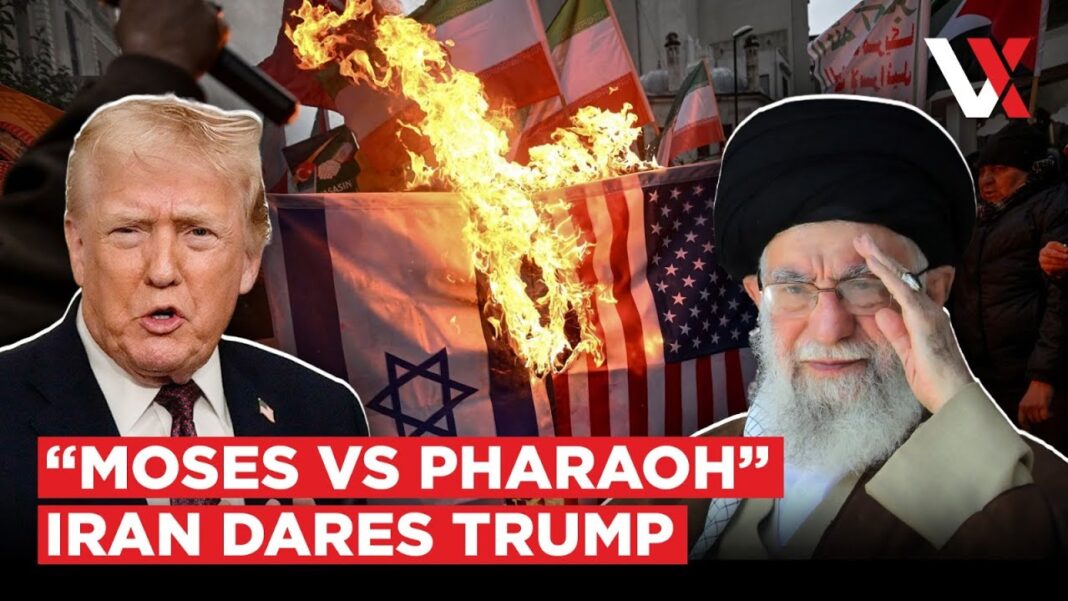
As Iran convulses under the weight of nationwide protests, economic collapse, and intensifying confrontation with the United States, the country’s political leadership has turned to an increasingly fevered blend of religious imagery and revolutionary bravado. According to a report that appeared on Monday in The Algemeiner, senior Iranian lawmakers likened President Donald Trump to a modern-day Pharaoh and exalted Supreme Leader Ayatollah Ali Khamenei as a contemporary Moses, casting the regime’s spiraling domestic crisis as nothing less than a biblical struggle between righteousness and tyranny.
The remarks, delivered on Monday during a charged parliamentary session in Tehran, underscored how dramatically the Iranian leadership has escalated its rhetoric in response to internal rebellion and external pressure. Speaker of Parliament Mohammad Bagher Ghalibaf declared that Khamenei would “make Trump and his allies taste humiliation,” warning ominously that Iran’s leader would “drown you in the sea of the anger of believers and the oppressed of the world.” The statements, as quoted by local media and highlighted in The Algemeiner report, revealed a regime increasingly reliant on grandiose threats and apocalyptic metaphors as it fights to retain legitimacy.
Yet beneath the bombast lies a stark reality: Iran is facing perhaps the gravest domestic challenge to its authority since the 1979 Islamic Revolution. What began on December 28 as a shopkeepers’ strike in Tehran—sparked by soaring prices, rampant inflation, and the collapse of the national currency—has metastasized into a broad-based revolt demanding an end to clerical rule itself. As The Algemeiner report chronicled, demonstrations have erupted across the country for more than three weeks, evolving from economic grievances into open calls for the overthrow of both Khamenei and President Masoud Pezeshkian.
The government, unwilling to acknowledge the depth of public fury, has instead sought to frame the unrest as a foreign conspiracy. Ghalibaf dismissed the protests as an “American-Israeli plot” and labeled them a “terrorist war” designed to destabilize the Islamic Republic. In official statements cited in The Algemeiner report, Iranian leaders have insisted that shadowy external forces—principally Washington and Jerusalem—are orchestrating the uprising through financial support, propaganda campaigns, and covert weapons transfers.
This narrative has been echoed forcefully by Iran’s judiciary chief, Gholamhossein Mohseni Ejei, who vowed to pursue legal action not only against protesters but also against foreign governments accused of backing them. “Those who called for it, those who provided financial support, propaganda or weapons—whether the United States, the Zionist regime or their agents—are all criminals,” Ejei thundered in comments relayed by The Algemeiner. In an extraordinary escalation, he pledged to seek prosecution of President Trump himself, declaring that Tehran would not “abandon the pursuit” of those it deems responsible.
Such pronouncements reflect a regime that feels besieged from all sides. The protests have erupted at a moment of acute economic fragility. Renewed U.S. sanctions, currency devaluation, and inflation approaching 40 percent have devastated ordinary Iranians, eroding living standards and shattering confidence in the state. The rial has plunged to record lows, while unemployment and shortages of basic goods have become pervasive.
President Pezeshkian, struggling to project authority, has attempted to rally the nation around a narrative of defiance. In a statement on Sunday, he warned that any effort to target Khamenei would constitute an act of war and accused Washington of deliberately fomenting chaos. “If there are hardship and constraints in the lives of the dear people of Iran,” he said, “one of the main causes is the longstanding hostility and inhumane sanctions imposed by the U.S. government and its allies.” The remarks underscored how tightly the regime has tied its survival to opposition against America.
Trump, for his part, has offered little comfort to Tehran. He has repeatedly denounced Khamenei as “a sick man who should run his country properly and stop killing people,” language that Iranian officials have interpreted as direct incitement for regime change. The American president has also warned that further brutality against demonstrators could provoke a decisive U.S. response—comments that have reverberated powerfully through the halls of power in Tehran.
The Iranian leadership initially appeared to believe that it could ride out the unrest through a combination of repression and propaganda. In recent days, officials have claimed to have defeated what they call “one of the most complex conspiracies ever launched by the enemies of” the nation. Government communiqués have praised the “smart, noble, and perceptive” Iranian people for rejecting foreign plots—language that The Algemeiner report characterized as increasingly detached from conditions on the ground.
The reality, however, tells a far more harrowing story. Independent human rights organizations have documented staggering levels of bloodshed. The U.S.-based group Human Rights Activists in Iran reports that more than 4,000 people have already been killed, with an additional 9,049 fatalities still under investigation. At least 5,811 have been injured, and over 26,000 arrested. Other sources paint an even grimmer picture: a recent report obtained by the Sunday Times and cited in The Algemeiner report suggests that as many as 16,500 protesters may have died and 330,000 suffered injuries.
The true toll is impossible to verify with precision, in large part because the regime has imposed sweeping internet blackouts and communications restrictions designed to conceal the scope of the crackdown. As The Algemeiner report noted, these measures have severely limited the flow of independent information and allowed state media to promote its own sanitized version of events.
Far from easing tensions, the government has signaled its intent to intensify repression. On Monday, National Police Chief Ahmad-Reza Radan issued a chilling ultimatum to demonstrators, giving them three days to surrender or face “decisive” punishment. Those who turn themselves in, he said, would be treated as “deceived individuals” eligible for leniency; those who persist in protest would be regarded as enemies of the state. The threat reflects a strategy aimed at dividing the opposition and isolating its most determined elements.
Iranian officials have also reacted angrily to Trump’s recent claim that Tehran had canceled plans to execute hundreds of detainees. The judiciary dismissed the assertion as “useless and baseless nonsense,” insisting that the government’s response to the unrest would remain “swift and deterrent.” The contradiction between these competing narratives highlights the confusion and volatility surrounding decision-making at the highest levels of the Iranian state.
What has emerged, according to analysts interviewed by The Algemeiner, is a regime torn between fear and defiance. On one hand, leaders appear genuinely alarmed by the breadth of the protests, which have united disparate segments of society—students, workers, merchants, and professionals—around the common demand for systemic change. On the other, they remain ideologically committed to portraying dissent as treason and resistance as a sacred duty.
The decision to cloak political conflict in religious allegory—casting Trump as Pharaoh and Khamenei as Moses—reveals how deeply the regime is leaning into its revolutionary mythology. For decades, Iran’s clerical establishment has justified its rule through a narrative of perpetual struggle against imperialism and oppression. By invoking the Exodus story, officials are attempting to frame themselves as divinely guided liberators confronting an evil empire.
Yet the analogy carries an unintended irony. In the biblical account, it was Pharaoh who oppressed his own people and refused to heed their cries for freedom. Many Iranians, as The Algemeiner report observed, appear increasingly inclined to see their own rulers in precisely that light.
Internationally, the crisis has placed Tehran in a precarious position. Relations with Europe are strained, regional rivals are watching nervously, and the United States has signaled that it is prepared to escalate pressure further. The regime’s threats to prosecute foreign leaders are unlikely to deter Washington or its allies; if anything, they reinforce perceptions that Iran’s leadership is growing more desperate and isolated.
For Israel and its supporters, the turmoil offers both hope and uncertainty. Israeli officials have expressed solidarity with the protesters while warning that the regime may seek to distract from internal problems through external aggression. The Algemeiner has repeatedly emphasized that any miscalculation—whether by Tehran or Washington—could rapidly ignite a broader regional conflict.
Within Iran itself, the coming weeks are likely to prove decisive. The regime faces a stark choice: continue down a path of brutal repression that risks further radicalizing the population, or seek some form of accommodation that might preserve stability at the cost of ideological purity. So far, the signs point overwhelmingly toward the former.
As the protests grind on and the rhetoric grows ever more extreme, the Islamic Republic appears trapped in a dangerous cycle of defiance and decline. The biblical imagery deployed in parliament may rally the faithful, but it cannot fill empty stomachs, restore a shattered economy, or silence a generation that has lost faith in the system.
The drama now unfolding is not merely a geopolitical confrontation between Tehran and Washington. It is a profound internal reckoning over the future of a nation—one in which the outcome remains uncertain, but the stakes could not be higher. Whether the regime’s leaders emerge as triumphant “Moses” figures or as the last pharaohs of a fading theocracy will depend on forces far more tangible than any metaphorical sea of believers.
For now, Iran stands at a perilous crossroads, its streets filled with anger, its prisons filled with dissenters, and its rulers clinging to power through threats and sermons. The world watches closely, aware that what happens next will reverberate far beyond the borders of the Islamic Republic.

This is insane – Khomeini is more like Pharaoh – a Tyrant who controls his people and forces them into economic hardship and troubling times (like Pharaoh) and then he wants to accuse Trump of being a tyrant? Isn’t that a case of the pot calling the kettle black? They need to depose him and get new young leadership that does not rely on the Koran for rules and running the country.